

AI Providers Module Documentation
Table of Contents
Section titled “Table of Contents”- Module Overview (Technical)
- Module Overview (Commercial & Business Value)
- 🎯 User Roles & Key Capabilities
- Visual Interface & Form Structure
- Architectural Flow & Security Governance
- Common Scenarios & Operational Playbooks
- Troubleshooting & Diagnostic Commands
- Model Context Protocol (MCP) AI Integration
- Glossary
1. Module Overview (Technical)
Section titled “1. Module Overview (Technical)”The AI Providers module (public.ai_providers) establishes and governs external upstream connections to Large Language Model (LLM) and Text-To-Speech (TTS) cloud inference engines for Ring2All Billing. In modern telecom operations, AI agents assist with billing inquiries, automated CDR fraud explanation, conversational IVRs, and natural language customer support.
This module provides a unified abstraction layer connecting to premier AI backends—including OpenAI, Anthropic, DeepSeek, and private OpenAI-compatible inference servers (such as vLLM, Ollama, or LiteLLM gateways)—with credential encryption, capability discovery, base URL overrides, and live connectivity health checks.
Data Model & Architecture Diagram
Section titled “Data Model & Architecture Diagram” ┌────────────────────────────────────────────────────────────────────────┐ │ AI Providers (public.ai_providers) │ │ • id: bigint (Primary Key) │ │ • uuid: UUID (Unique Public Identifier) │ │ • tenant_id: bigint / domain_id: bigint │ │ • provider: 'openai' | 'anthropic' | 'deepseek' | 'custom' │ │ • name: text (e.g., 'OpenAI Official Cloud', 'DeepSeek Copilot') │ │ • organization: text (Optional Org ID / Tenant Header) │ │ • api_key: text (Encrypted Upstream Bearer Token) │ │ • base_url: text (Custom Gateway Endpoint e.g., https://api.openai...)│ │ • api_key_type: VARCHAR(50) ('standard', 'managed') │ │ • capabilities: jsonb (Supported features: chat, tts, vision, etc.) │ │ • status: boolean (Active / Inactive) │ └───────────────────────────────────┬────────────────────────────────────┘ │ Upstream Transport Gateway ▼ ┌────────────────────────────────────────────────────────────────────────┐ │ External AI Inference Engines │ │ • OpenAI API (GPT-4o, GPT-4o-mini, Whisper, TTS-1) │ │ • Anthropic API (Claude 3.5 Sonnet, Claude 3.5 Haiku) │ │ • DeepSeek API (DeepSeek-V3, DeepSeek-Reasoner R1) │ │ • Private On-Premise Gateways (vLLM / LiteLLM / Ollama) │ └────────────────────────────────────────────────────────────────────────┘PostgreSQL Schema Architecture
Section titled “PostgreSQL Schema Architecture”public.ai_providers:id: Numeric primary key (bigserial).uuid: Immutable UUID utilized in frontend routing and REST APIs.provider: Upstream provider protocol driver (openai,anthropic,deepseek,custom).name: Descriptive label assigned by the administrator.organization: Optional organization ID header passed to providers supporting multi-project billing.api_key: API authorization key.base_url: Optional custom endpoint URL, allowing rerouting to private proxies or localized regional endpoints.capabilities: Dynamic JSONB schema storing discovered model lists, token limits, and TTS voice registries.status: Operational toggle enabling or disabling all profiles linked to the provider.
2. Module Overview (Commercial & Business Value)
Section titled “2. Module Overview (Commercial & Business Value)”- Multi-Provider Resilience & Zero Vendor Lock-In: Organizations are not tethered to a single AI vendor. If an upstream provider suffers rate limiting or an outage, billing copilots can be switched across providers seamlessly.
- Cost Optimization Across Workload Profiles: High-reasoning tasks (such as forensic CDR fraud analysis) can leverage DeepSeek Reasoner or Claude 3.5 Sonnet, while high-volume standard customer notifications leverage cost-efficient models.
- Private & On-Premise Compliance: Financial institutions and telecom carriers with strict data residency laws can direct
base_urlto an internal on-premise vLLM or Ollama cluster, guaranteeing customer billing data never leaves the private perimeter. - Centralized Key Management: API tokens are managed in one secure vault rather than distributed across multiple microservices or client applications.
3. 🎯 User Roles & Key Capabilities
Section titled “3. 🎯 User Roles & Key Capabilities”| Role | Key Capabilities & Permissions in AI Providers |
|---|---|
| Platform Administrator | Adds, configures, and tests AI service providers; enters upstream API keys; manages organization tags and custom base URLs. |
| Security Engineer | Rotates API tokens, reviews outgoing connection security, and ensures private endpoints adhere to TLS encryption standards. |
| NOC Engineer | Monitors provider connectivity status, executes live test connection probes, and troubleshoots upstream latency or rate limits. |
| Billing Specialist | Views available providers and supported capabilities when configuring AI Profiles for customer billing support. |
4. Visual Interface & Form Structure
Section titled “4. Visual Interface & Form Structure”The AI Providers module features a clean administrative list view and a dedicated creation/editing surface.
4.1 AI Providers Listing
Section titled “4.1 AI Providers Listing”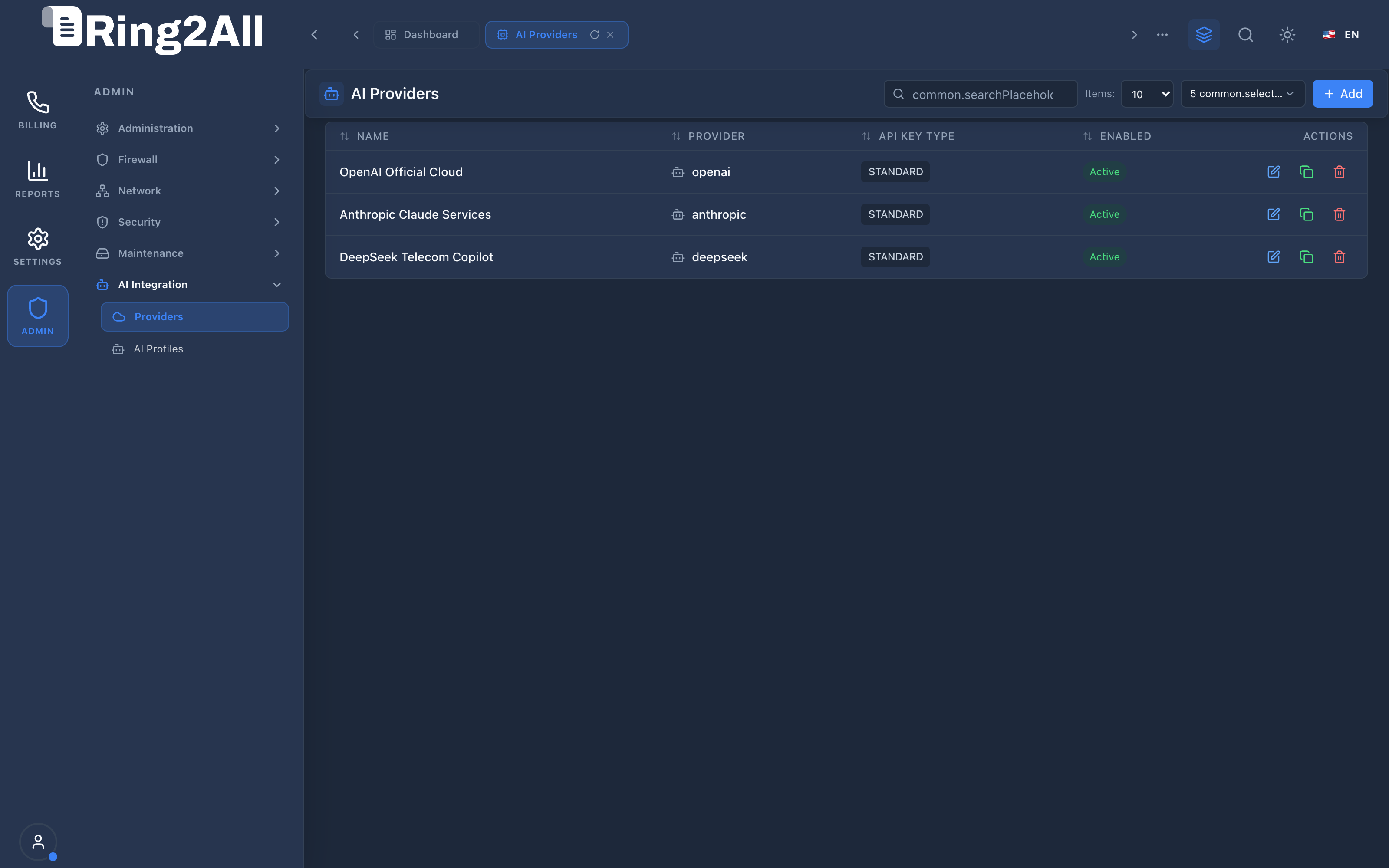
The list view displays all configured AI inference providers:
- Header Controls:
Search Input: Filters providers by name or provider type.+ Add: Navigates to/ai-providers/newto register a new provider.
- Data Grid Columns:
Name: Descriptive name of the integration (e.g.,OpenAI Official Cloud,Anthropic Claude Services,DeepSeek Telecom Copilot).Provider: Driver engine badge with Bot icon (openai,anthropic,deepseek).API Key Type: Credential type badge (STANDARD).Enabled: Operational status badge (Activein green).Actions: Direct actions to edit settings (Pencil), duplicate configuration (Copy), or delete provider (Trash).
4.2 Create / Edit AI Provider Form
Section titled “4.2 Create / Edit AI Provider Form”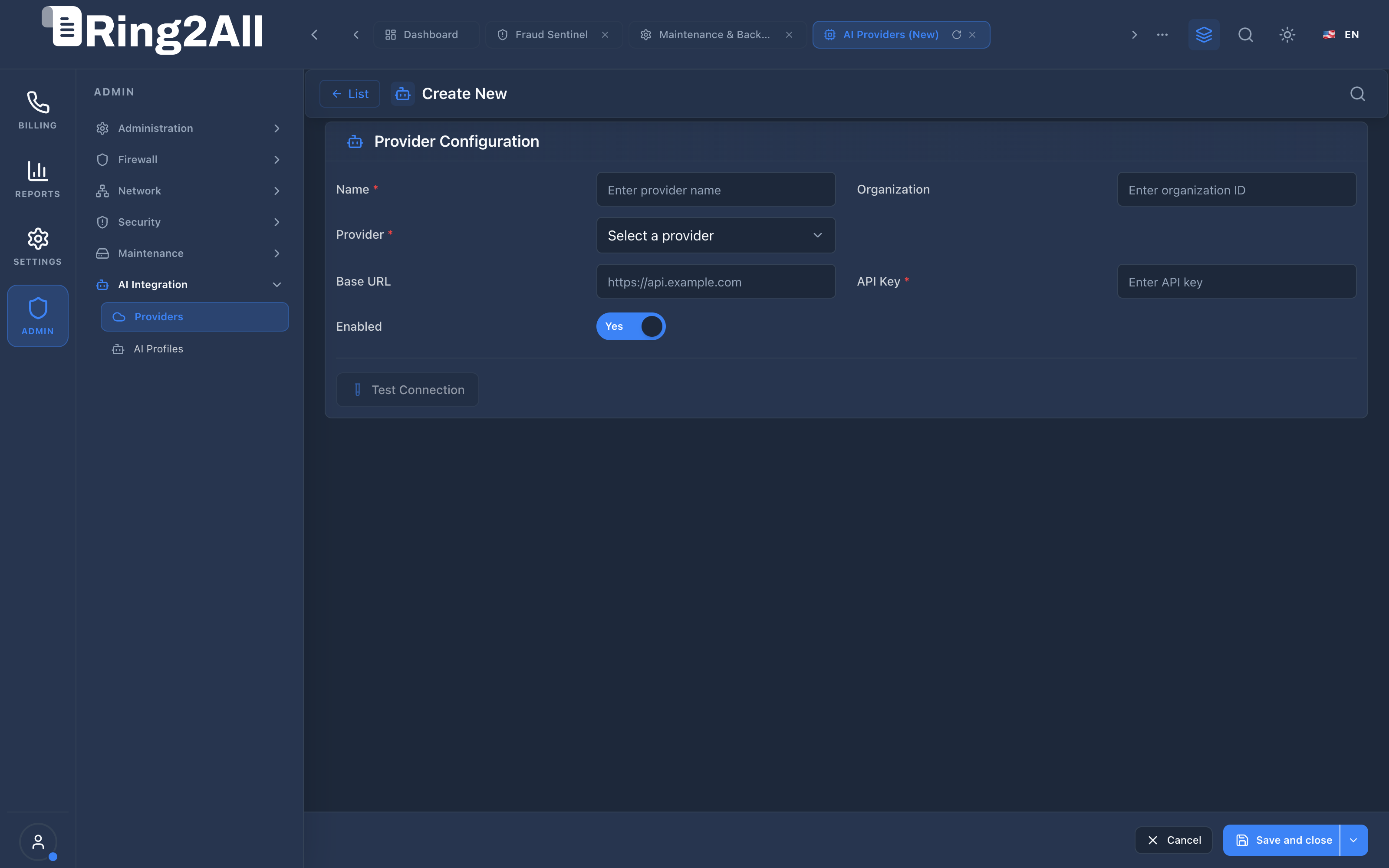
The Level 2 form provides a structured configuration box with immediate verification capabilities:
- Header:
< List: Returns to the main providers grid.- Title:
Create NeworEdit Provider.
- Provider Configuration Fields:
Name *: Human-readable label (e.g.,OpenAI Official Cloud).Organization: Optional organization ID (e.g.,org-xxxxxxxx).Provider *: Dropdown selection (OpenAI,Anthropic,DeepSeek,Custom).Base URL: Endpoint override (e.g.,https://api.openai.com/v1or custom on-premise proxy).API Key *: Secret token provided by the upstream AI vendor.Enabled: Switch toggling provider availability.Test Connection: Interactive button that initiates an immediate ping to the upstream API to validate credentials before saving.
- Sticky Bottom Bar (
FixedActionBar):Cancel: Discards uncommitted changes.Save and close: Validates input and persists configuration.
5. Architectural Flow & Security Governance
Section titled “5. Architectural Flow & Security Governance” ┌──────────────────────┐ │ AI Profile Request │ │ (Copilot / Assistant)│ └──────────┬───────────┘ │ ▼ ┌────────────────────────────────────────────────────────┐ │ AI Gateway Dispatcher │ │ 1. Fetches provider credentials from public.ai_providers│ │ 2. Appends auth headers & optional Org ID │ │ 3. Routes HTTP/SSE request to configured Base URL │ └──────────────────────────┬─────────────────────────────┘ │ ┌──────────────┼──────────────┐ ▼ ▼ ▼ [ OpenAI Cloud ] [ Anthropic ] [ DeepSeek / On-Prem ]- Token Protection: API keys are restricted at the database level and never exposed in plain text in browser client applications.
- Dynamic Header Injection: The gateway dynamically injects vendor-specific headers (e.g.,
x-api-keyfor Anthropic,Authorization: Bearerfor OpenAI). - Connection Pre-Flight Checks: The Test Connection button sends a lightweight query (e.g., model listing) to verify authentication without consuming inference credits.
6. Common Scenarios & Operational Playbooks
Section titled “6. Common Scenarios & Operational Playbooks”Playbook A: Registering an Official OpenAI Provider
Section titled “Playbook A: Registering an Official OpenAI Provider”- Navigate to ADMIN > AI Integration > Providers.
- Click + Add.
- Set Name to
OpenAI Official Cloud. - Select Provider as
OpenAI. - Enter the API Key beginning with
sk-.... - Click Test Connection. A green success notification confirms API key validity.
- Click Save and close.
Playbook B: Connecting a Private On-Premise vLLM Server
Section titled “Playbook B: Connecting a Private On-Premise vLLM Server”- Click + Add.
- Set Name to
Private Datacenter LLM. - Select Provider as
Custom(orOpenAI Compatible). - In Base URL, enter
http://10.10.50.20:8000/v1. - Enter the internal cluster token in API Key.
- Click Test Connection and verify reachability.
- Click Save and close.
7. Troubleshooting & Diagnostic Commands
Section titled “7. Troubleshooting & Diagnostic Commands”Querying Configured Providers in SQL
Section titled “Querying Configured Providers in SQL”SELECT id, name, provider, base_url, status, created_atFROM public.ai_providersORDER BY id ASC;Testing Upstream Provider Reachability via Curl
Section titled “Testing Upstream Provider Reachability via Curl”curl -s -X POST https://api.openai.com/v1/chat/completions \ -H "Authorization: Bearer <API_KEY>" \ -H "Content-Type: application/json" \ -d '{"model": "gpt-4o-mini", "messages": [{"role": "user", "content": "ping"}], "max_tokens": 5}'8. Model Context Protocol (MCP) AI Integration
Section titled “8. Model Context Protocol (MCP) AI Integration”The AI Providers module connects directly to the Ring2All BSS MCP Server, providing administrators and cognitive copilots with programmatic visibility into registered neural model inference backends and operational states.
Available MCP Tools
Section titled “Available MCP Tools”| Tool Name | Access Role | Description & Primary Function | Example Arguments |
|---|---|---|---|
list_ai_providers |
Super Administrator |
Lists upstream Artificial Intelligence (LLM) inference providers with active status and model types. | {} |
Sample MCP Tool Execution: list_ai_providers
Section titled “Sample MCP Tool Execution: list_ai_providers”Request Payload
Section titled “Request Payload”{ "name": "list_ai_providers", "arguments": {}}Response Payload
Section titled “Response Payload”[ { "id": 1, "name": "OpenAI Production", "provider": "openai", "status": "active", "baseUrl": "https://api.openai.com/v1", "modelsCount": 4 }, { "id": 2, "name": "Anthropic Claude Core", "provider": "anthropic", "status": "active", "baseUrl": "https://api.anthropic.com", "modelsCount": 3 }]Conversational AI Prompts for Copilot
Section titled “Conversational AI Prompts for Copilot”- “List all active AI inference providers and their configured endpoints.”
- “Is OpenAI Production currently active and accessible?”
- “Show which AI providers are registered for chatbot operations.”
9. Glossary
Section titled “9. Glossary”- LLM (Large Language Model): Advanced neural network models capable of understanding, summarizing, and generating natural language and code.
- Base URL: The target root URL where REST requests are dispatched, allowing rerouting to local models or enterprise caching proxies.
- Provider Protocol: The specific API convention implemented by the vendor (OpenAI REST, Anthropic Messages API, etc.).
- Test Connection: An active probe verifying API authentication and network reachability without committing configuration.
- Model Context Protocol (MCP): Open protocol standard that enables secure, controlled integration between Large Language Models and external tools, databases, and telecom rating engines.