

SIP Traces & Diagnostics
Table of Contents
Section titled “Table of Contents”- Overview & Signaling Inspection Architecture
- Business & Operational Significance
- 🎯 User Roles & Key Capabilities
- Visual Interface & Call Sequence Drawer
- Field & Control Reference
- Kamailio siptrace Module Engine Mechanics
- AI NOC Copilot Deep Diagnostics
- Troubleshooting & Direct CLI Inspection
- Model Context Protocol (MCP) AI Integration
- Glossary
1. Overview & Signaling Inspection Architecture
Section titled “1. Overview & Signaling Inspection Architecture”In Ring2All SBC, the SIP Traces & Diagnostics module provides deep-packet inspection, interactive call ladder diagram visualization, and automated protocol diagnostics for all SIP signaling transiting the carrier perimeter. Powered by Kamailio’s native siptrace module and integrated with PostgreSQL storage (kamailio.sip_trace), this module captures complete raw SIP messages—including full headers and SDP session descriptions—directly at the network boundary.
External Network Ring2All SBC Core (Kamailio) Diagnostic Subsystems │ │ │ │──────── SIP Signaling (INVITE) ────────>│ │ │ ├─── In-Memory Inspection ───────────────>│ │ │ Match IP / Trunk Filters │ │ │ Capture Raw Headers & SDP │ │ │ INSERT INTO kamailio.sip_trace ─────>│ │<─────── 100 Trying / 180 Ringing ───────│ │ │<─────── 200 OK (Answered) ──────────────│ │ │──────── ACK (Session Established) ─────>│ │ │ │ ▼ │ │ ┌─────────────────────────────┐ │ │ │ CallSequenceDrawer UI │ │ │ │ • Sequence Ladder Flow │ │ │ │ • Syntax Highlighting │ │ │ │ • AI NOC Copilot (MCP) │ │ │ └─────────────────────────────┘To eliminate the performance degradation and disk exhaustion risks associated with indiscriminate packet tracing in high-CPS production environments, Ring2All SBC implements:
- On-Demand Capture with Safety Timers: Tracing is inactive by default and automatically disables itself after a user-defined interval (1, 5, 15, or 30 minutes).
- Selective Pre-Filtering: Signaling can be filtered at ingestion by source/destination IP or specific SIP Trunk accounts.
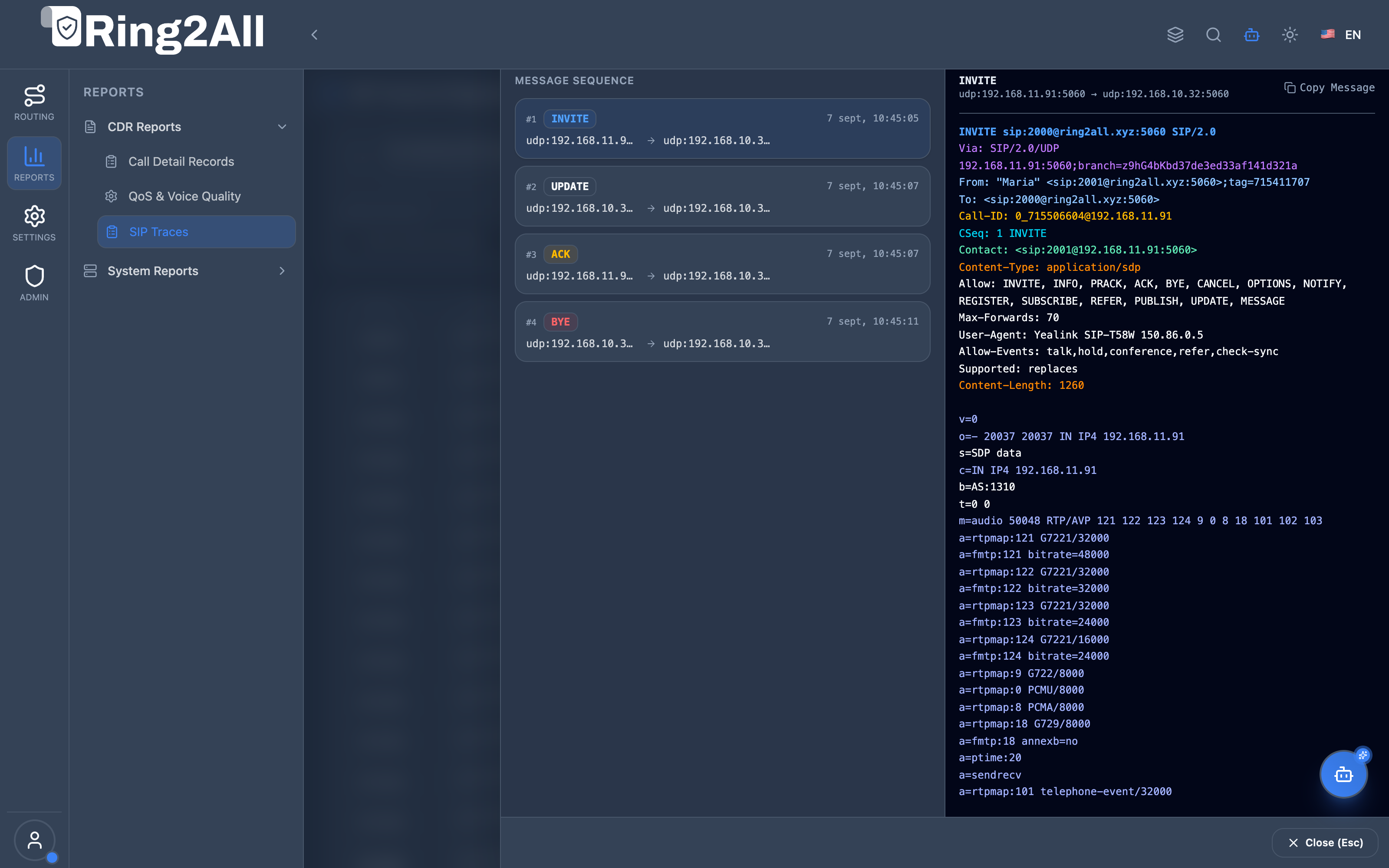
- Interactive Sequence Ladder Diagrams: Chronological visual flow charts showing message progression, directionality, and elapsed inter-message intervals.
- AI NOC Copilot Integration: Native connection to the Model Context Protocol (MCP) AI diagnostics engine for automated root-cause analysis of signaling anomalies.
2. Business & Operational Significance
Section titled “2. Business & Operational Significance”- Accelerated Interconnect Turn-Up: Reduces the time required to onboard new telecom carriers and enterprise SIP trunks from days to minutes by instantly visualizing protocol mismatches.
- Elimination of Server Access Overhead: Enables NOC and support personnel to diagnose complex signaling failures directly from the web interface without requiring SSH access,
sngrep, or packet captures (tcpdump). - Root Cause Identification for Silent Failures: Immediately isolates common VoIP anomalies such as 32-second call drops (missing
ACK), one-way audio (SDP IP mismatch), or continuous407 Proxy Authenticationloops. - Automated AI Triage: Translates complex RFC 3261 protocol discrepancies into plain-language operational summaries and actionable remediation steps.
3. 🎯 User Roles & Key Capabilities
Section titled “3. 🎯 User Roles & Key Capabilities”| Role | Primary Use Case | Key Capabilities |
|---|---|---|
| Carrier Interconnect Engineer | Trunk Interoperability & Turn-Up | Validate SDP offer/answer exchanges, verify custom SIP headers (P-Asserted-Identity, Diversion), and inspect codec negotiations. |
| NOC Telephony Analyst | Real-Time Fault Resolution | Enable on-demand tracing for reported calling issues, inspect visual call ladders, and identify SIP error codes. |
| Security Operations Engineer | Anti-Fraud & Attack Forensics | Inspect malformed SIP requests, track registration flood attempts, and verify IP spoofing patterns. |
| SBC Core Administrator | Signaling Pipeline Optimization | Govern trace retention intervals, verify PostgreSQL database pruning, and tune Kamailio siptrace buffers. |
| AI Platform Copilot / NOC Diagnostic Agent | Autonomous Signaling Inspection & Ladder Analysis | Initiate on-demand SIP captures with safety timers, extract chronological message ladders, decode SDP codecs, and detect protocol violations (missing ACK, 401 loops, 503 errors). |
4. Visual Interface & Call Sequence Drawer
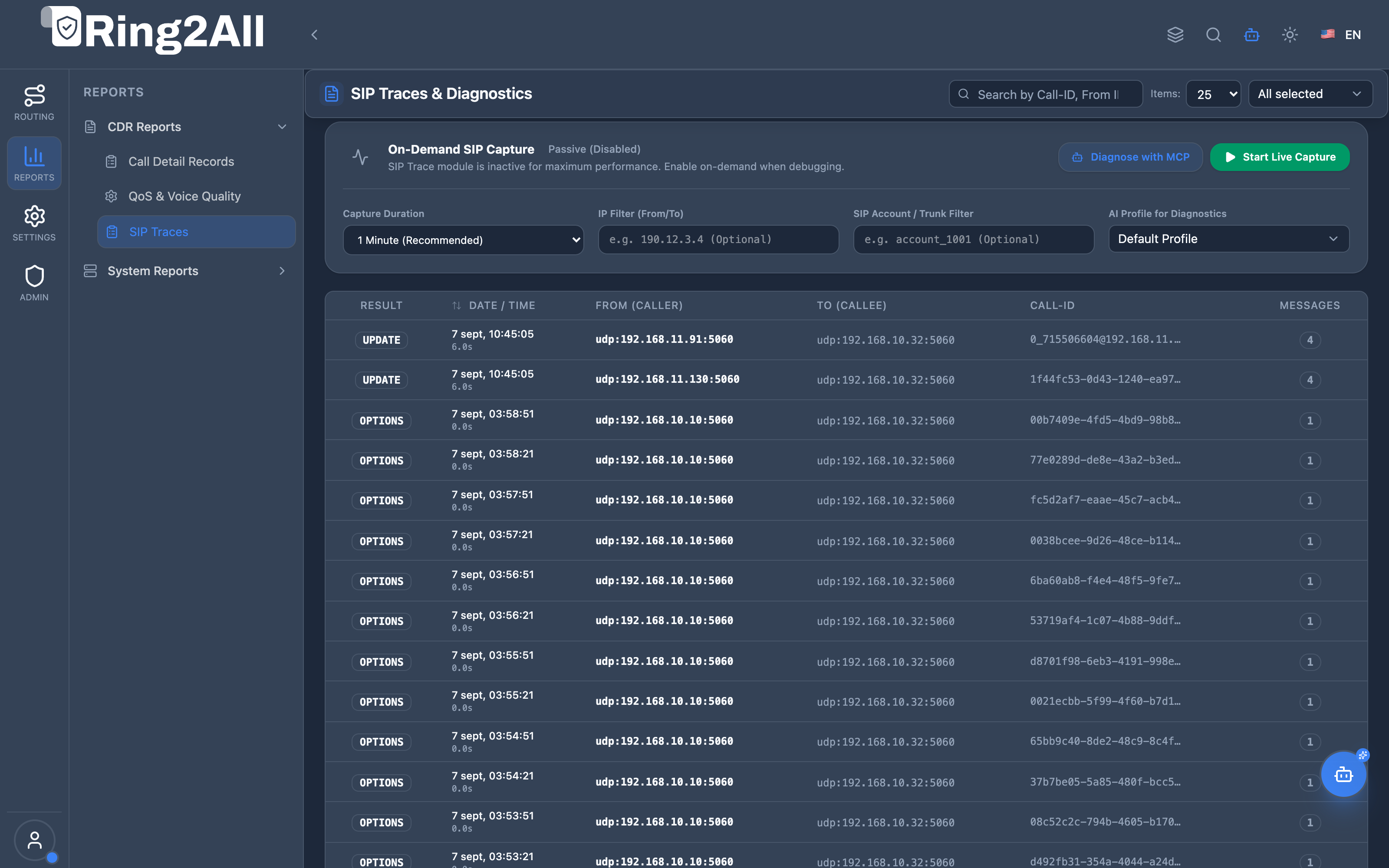
Section titled “4. Visual Interface & Call Sequence Drawer”The interface comprises an on-demand capture management banner, a grouped sessions DataGrid, and an interactive slide-in Call Sequence Drawer.
4.1 On-Demand Capture & Traced Sessions Ledger
Section titled “4.1 On-Demand Capture & Traced Sessions Ledger”The primary view displays the active tracing status, capture parameters, and a consolidated ledger of all traced call sessions with message counts and final response codes.
4.2 Interactive Call Sequence Ladder Drawer
Section titled “4.2 Interactive Call Sequence Ladder Drawer”Clicking View Sequence or selecting a Call-ID opens the drawer, featuring the chronological ladder diagram, raw message syntax highlighter, and AI analysis tools.
5. Field & Control Reference
Section titled “5. Field & Control Reference”Capture Control Banner
Section titled “Capture Control Banner”| Control Element | Options / Constraints | Description |
|---|---|---|
| Capture Status Indicator | Active (Green) / Passive (Gray) |
Real-time state of the Kamailio siptrace ingestion engine. |
| Capture Duration | 1 Min (Recommended), 5 Min, 15 Min, 30 Min |
Automated safety countdown timer after which tracing automatically deactivates. |
| IP Filter (From/To) | Valid IPv4 / IPv6 (Optional) | Restricts packet ingestion to messages originating from or destined to the specified address. |
| SIP Account / Trunk Filter | Text string (Optional) | Filters traffic by matching specific user accounts or trunk identifiers in the Request-URI. |
| AI Profile for Diagnostics | Configured AI Profiles dropdown | Selects the language model and domain context profile utilized for automated troubleshooting. |
| Live Capture Toggle | Start Live Capture / Stop Capture |
Manually starts or stops signaling recording. |
Traced Sessions DataGrid Columns
Section titled “Traced Sessions DataGrid Columns”| Column | Data Type | Description |
|---|---|---|
| Result | Status Badge | Final termination status of the session (200 OK, 487 Request Terminated, 404 Not Found, etc.). |
| Date / Time | Timestamp / Duration | Starting timestamp and total elapsed conversational duration. |
| From (Caller) | Transport / Socket | Originating transport socket (e.g., udp:192.168.11.91:5060). |
| To (Callee) | Transport / Socket | Ingress SBC listening socket receiving the request. |
| Call ID | Monospace String | Unique SIP Call-ID header identifying the end-to-end dialog. |
| Messages | Integer Badge | Total count of SIP requests and responses captured within the session. |
| Actions | Action Button | Opens the interactive sequence ladder drawer for signaling visualization. |
6. Kamailio siptrace Module Engine Mechanics
Section titled “6. Kamailio siptrace Module Engine Mechanics”Ring2All SBC leverages Kamailio’s siptrace module configured with asynchronous database logging:
# Kamailio siptrace module configurationloadmodule "siptrace.so"modparam("siptrace", "db_url", "postgres://kamailio:SECRET@localhost/kamailio")modparam("siptrace", "table", "sip_trace")modparam("siptrace", "trace_on", 0)modparam("siptrace", "trace_flag", 22)modparam("siptrace", "trace_to_database", 1)modparam("siptrace", "trace_mode", 0)modparam("siptrace", "duplicate_uri", "sip:127.0.0.1:9060")Dynamic Activation Lifecycle
Section titled “Dynamic Activation Lifecycle”- Activation via RPC: When an operator clicks Start Live Capture, the backend issues a JSON-RPC command to Kamailio:
{"jsonrpc": "2.0", "method": "siptrace.status", "params": [1], "id": 1}
- Selective Packet Duplication: Inbound and outbound SIP packets matching transaction flags are serialized along with network metadata (source IP, destination IP, timestamp, protocol).
- Automated Safety Deactivation: A Node.js timer enforces the selected duration limit, issuing an RPC call to disable
siptrace.statusupon expiration, ensuring production memory and disk stability.
7. AI NOC Copilot Deep Diagnostics
Section titled “7. AI NOC Copilot Deep Diagnostics”Integrated with the Model Context Protocol (MCP), the Diagnose with MCP engine provides instant expert analysis of captured call flows.
Common Diagnosed Anomalies
Section titled “Common Diagnosed Anomalies”Symptom: Call drops after exactly 32 secondsSIP Ladder Pattern: Caller Ring2All SBC Carrier │ │ │ │────── INVITE ───────>│────── INVITE ────────>│ │<───── 200 OK ────────│<───── 200 OK ─────────│ │ │ │ │ (ACK Missing) │ (ACK Missing) │ │ │ │ │ [Timer H Fires] │ [Timer H Fires] │ │<───── BYE ───────────│<───── BYE ────────────│AI Diagnosis: "The carrier terminated the call after 32 seconds because no SIP ACK was received following the 200 OK. Check NAT traversal on the caller network; the Contact header advertised an unreachable private IP (192.168.1.50) without NAT proxy rewriting."Other automated detection capabilities include:
- SDP Codec Mismatches: Highlights incompatible audio payloads (e.g., caller offers only
PCMUwhile callee requiresG.729). - Authentication Failures: Pinpoints wrong passwords, realm mismatches, or missing nonce responses in
401 Unauthorized/407 Proxy Authentication Requiredexchanges. - DNS SRV & Transport Failures: Identifies transport timeouts when resolving upstream carrier hostnames over TCP or TLS.
8. Troubleshooting & Direct CLI Inspection
Section titled “8. Troubleshooting & Direct CLI Inspection”Checking Runtime Tracing Status via CLI
Section titled “Checking Runtime Tracing Status via CLI”Query Kamailio to verify if tracing is actively capturing packets:
# Check if siptrace module is currently activekamcmd siptrace.statusInspecting Captured Messages in PostgreSQL
Section titled “Inspecting Captured Messages in PostgreSQL”Retrieve the raw signaling history for a specific Call-ID:
psql -U kamailio -d kamailio -c "SELECT id, time_stamp, direction, fromip, toip, method, statusFROM sip_traceWHERE callid = '0_715506604@192.168.11.91'ORDER BY id ASC;"Cleaning Up Historic Trace Data
Section titled “Cleaning Up Historic Trace Data”To free database storage space following intensive troubleshooting sessions:
# Prune traces older than 7 dayspsql -U kamailio -d kamailio -c "DELETE FROM sip_traceWHERE time_stamp < NOW() - INTERVAL '7 days';"9. Model Context Protocol (MCP) AI Integration
Section titled “9. Model Context Protocol (MCP) AI Integration”The SIP Traces & Diagnostics subsystem is tightly coupled with the Ring2All SBC Model Context Protocol (MCP) server, empowering NOC AI Copilots to trigger on-demand trace captures, inspect chronological message ladders, and perform autonomous root-cause analysis on signaling failures.
Available MCP Tools
Section titled “Available MCP Tools”| Tool Name | Operation Type | Risk Level | Description |
|---|---|---|---|
capture_and_analyze_sip_trace |
Autonomous Workflow | operational |
Activates on-demand capture for a specified duration, collects live SIP packets matching filters, extracts the call ladder, and returns an expert diagnostic breakdown. |
start_sip_trace_capture |
State Mutation | operational |
Starts live packet capture in Kamailio with an auto-off countdown timer and optional IP or extension filters. |
stop_sip_trace_capture |
State Mutation | operational |
Immediately halts live SIP trace recording and deactivates the siptrace module in Kamailio. |
get_sip_trace_capture_status |
Status Query | read |
Retrieves current capture operational status, remaining safety timer seconds, and active pre-filters. |
get_sip_traces |
Forensic Query | read |
Queries recent historical SIP call traces recorded in PostgreSQL, grouped by Call-ID. |
explain_sip_call |
Deep Protocol Analysis | read |
Extracts the full chronological ladder diagram, parsed headers, and SDP media codecs for a specific Call-ID string. |
diagnose_sip_error_spikes |
Real-time Triage | diagnostic |
Scans recent SIP signaling packets for surges of 4xx, 5xx, or 6xx errors, groups failure rates by carrier/gateway, and automatically isolates root causes (404, 486, 487, 500, 503). |
Tool Schemas & Payloads
Section titled “Tool Schemas & Payloads”1. capture_and_analyze_sip_trace
Section titled “1. capture_and_analyze_sip_trace”Input Schema
Section titled “Input Schema”{ "type": "object", "properties": { "duration_seconds": { "type": "number", "description": "Duration in seconds to capture live SIP traffic (default 30, range 5-120)." }, "target_ip": { "type": "string", "description": "Target source or destination IP address to filter (e.g. '192.168.11.91')." }, "extension": { "type": "string", "description": "Target extension, phone number or user to filter (e.g. '+15551234567')." }, "method": { "type": "string", "description": "SIP Method filter (e.g. 'INVITE', 'REGISTER', 'OPTIONS', 'BYE')." }, "callid": { "type": "string", "description": "Filter for a specific Call-ID string if known." } }}Output Payload Example
Section titled “Output Payload Example”{ "success": true, "duration_seconds": 30, "captured_messages_count": 8, "calls_analyzed": 1, "analysis": { "call_id": "0_715506604@192.168.11.91", "caller": "sip:2001@192.168.11.91", "callee": "sip:+18005550199@sbc.ring2all.com", "final_status": "200 OK", "codecs_negotiated": ["Opus/48000/2", "PCMU/8000"], "anomalies_detected": [], "summary": "Successful call establishment without signaling violations. Normal teardown observed via BYE." }}2. explain_sip_call
Section titled “2. explain_sip_call”Input Schema
Section titled “Input Schema”{ "type": "object", "properties": { "callid": { "type": "string", "description": "The exact SIP Call-ID string to inspect and reconstruct into a ladder diagram." } }, "required": ["callid"]}Output Payload Example
Section titled “Output Payload Example”{ "call_id": "0_715506604@192.168.11.91", "total_messages": 6, "ladder": [ { "step": 1, "time_delta_ms": 0, "direction": "inbound", "from": "192.168.11.91:5060", "to": "192.168.10.31:5060", "method": "INVITE", "cseq": "1 INVITE", "summary": "Initial INVITE offering Opus and PCMU" }, { "step": 2, "time_delta_ms": 4, "direction": "outbound", "from": "192.168.10.31:5060", "to": "192.168.11.91:5060", "status": 100, "cseq": "1 INVITE", "summary": "100 Trying" }, { "step": 3, "time_delta_ms": 142, "direction": "outbound", "from": "192.168.10.31:5060", "to": "192.168.11.91:5060", "status": 180, "cseq": "1 INVITE", "summary": "180 Ringing" }, { "step": 4, "time_delta_ms": 2180, "direction": "outbound", "from": "192.168.10.31:5060", "to": "192.168.11.91:5060", "status": 200, "cseq": "1 INVITE", "summary": "200 OK answering call" }, { "step": 5, "time_delta_ms": 2192, "direction": "inbound", "from": "192.168.11.91:5060", "to": "192.168.10.31:5060", "method": "ACK", "cseq": "1 ACK", "summary": "ACK received, media session confirmed" }, { "step": 6, "time_delta_ms": 45120, "direction": "inbound", "from": "192.168.11.91:5060", "to": "192.168.10.31:5060", "method": "BYE", "cseq": "2 BYE", "summary": "Caller hang-up via normal BYE" } ], "root_cause_diagnosis": "Normal session completion. RFC 3261 compliance verified."}3. start_sip_trace_capture
Section titled “3. start_sip_trace_capture”Input Schema
Section titled “Input Schema”{ "type": "object", "properties": { "duration_seconds": { "type": "number", "description": "Duration in seconds for the capture timer (default 60, min 10, max 300)." }, "target_ip": { "type": "string", "description": "Optional IP address filter for the on-demand trace capture." }, "extension": { "type": "string", "description": "Optional extension or account ID filter for the on-demand trace capture." } }}Output Payload Example
Section titled “Output Payload Example”{ "success": true, "status": "capturing", "duration_seconds": 60, "filters": { "target_ip": "192.168.11.91", "extension": null }, "expires_at": "2026-09-08T15:35:00.000Z"}Natural Language AI Prompts
Section titled “Natural Language AI Prompts”English Examples
Section titled “English Examples”- “Analyze if there are recent SIP error spikes and triage the root causes.”
- “Start a 60-second SIP trace capture targeting IP 192.168.11.91 and analyze any INVITE messages.”
- “Explain the SIP signaling ladder for Call-ID 0_715506604@192.168.11.91 and check if the ACK was received.”
- “What is the current status of live SIP trace capture on the SBC?”
- “Stop the ongoing SIP trace capture immediately.”
Spanish Examples (Español)
Section titled “Spanish Examples (Español)”- “Analiza si hay picos de errores SIP recientes y triage de causas raíz.”
- “Inicia una captura SIP de 60 segundos filtrando por la IP 192.168.11.91 y analiza cualquier mensaje INVITE.”
- “Explica el diagrama de escalera SIP para el Call-ID 0_715506604@192.168.11.91 y verifica si se recibió el ACK.”
- “¿Cuál es el estado actual de la captura de trazas SIP en el SBC?”
- “Detén la captura de trazas SIP en curso de inmediato.”
Enterprise Safeguards & Access Governance
Section titled “Enterprise Safeguards & Access Governance”- Mandatory Auto-Off Timer: Every trace capture initiated via MCP enforces a hard countdown timer (maximum 300 seconds). Kamailio’s
siptracemodule is automatically disabled upon expiration to protect database disk space and CPU queues. - Selective Filter Enforcement: Tracing supports strict IP or Extension pre-filters to prevent indiscriminate capture of unrelated subscriber traffic.
- Role-Based Execution Isolation: Tools that modify capture state (
start_sip_trace_capture,stop_sip_trace_capture,capture_and_analyze_sip_trace) require operational roles (noc_network_engineerorsuper_admin). Read-only users can only view previously recorded ladders.
10. Glossary
Section titled “10. Glossary”- ACK (Acknowledgment): SIP transaction confirming receipt of a final response to an
INVITErequest. - Call Sequence Ladder: Chronological diagram displaying vertical participant lifelines and horizontal message vectors.
- Model Context Protocol (MCP): Open standard enabling AI models to interact with local development tools, logs, and diagnostic databases.
- SDP (Session Description Protocol): Syntax format (RFC 4566) describing multimedia communication parameters, codecs, and transport ports.
- siptrace: Kamailio core module responsible for copying SIP transactions into relational database tables.