

Public Blacklists & Threat Intelligence Feeds (VoIPBL & APIBAN)
Table of Contents
Section titled “Table of Contents”- Overview & Threat Intelligence Architecture
- Business & Operational Significance
- 🎯 User Roles & Key Capabilities
- Visual Interface & Layout
- Field Reference & Threat Feed Parameters
- Feed Synchronization & In-Memory Drop Pipeline
- Operational Best Practices & False-Positive Mitigation
- Verification & Diagnostics
- Model Context Protocol (MCP) AI Integration
- Glossary
1. Overview & Threat Intelligence Architecture
Section titled “1. Overview & Threat Intelligence Architecture”In Ring2All SBC, the Public Blacklists module provides real-time community threat intelligence integration. By synchronizing with globally recognized VoIP honeypot feeds—primarily APIBAN and VoIPBL—the SBC dynamically downloads, caches, and enforces thousands of known bad actors, botnets, and SIP exploit sources before they can interact with local telecom infrastructure.
┌─────────────────────────────────────────────────────────────┐ │ GLOBAL THREAT FEEDS (APIBAN & VoIPBL) │ │ (Worldwide Distributed Honeypots) │ └──────────────────────────────┬──────────────────────────────┘ │ (Automated Sync via REST API) ▼ ┌─────────────────────────────────────────────────────────────┐ │ RING2ALL SBC FEED INGESTION ENGINE │ │ (Validated API Key, JSON Parser) │ └──────────────────────────────┬──────────────────────────────┘ │ ┌───────────────────────┴───────────────────────┐ ▼ ▼ ┌──────────────────────────────┐ ┌──────────────────────────────┐ │ KAMAILIO MEMORY HASH TABLE │ │ LINUX NFTABLES KERNEL SET │ │ ($sht(voipbl=>$si)) │ │ (set: sbc_public_bans) │ ├──────────────────────────────┤ ├──────────────────────────────┤ │ • Instant SIP-level rejection│ │ • Sub-microsecond packet drop│ │ • Telemetry drop counters │ │ • Zero CPU kernel discard │ └──────────────────────────────┘ └──────────────────────────────┘The system continuously tracks drop statistics—including cumulative packets dropped and total bandwidth saved—while maintaining automated synchronization cadences without administrative intervention.
2. Business & Operational Significance
Section titled “2. Business & Operational Significance”- Preemptive Zero-Day Protection: Blocks aggressive SIP scanning botnets within minutes of their first appearance on global honeypots, neutralizing threats before they reach your infrastructure.
- Radical Reduction in Server Load: Discards malicious packets directly in the Linux network stack, preserving Kamailio worker threads and Telephony Server RTP resources for revenue-generating client calls.
- Elimination of Password Guessing: Prevents credential stuffing against SIP extension passwords by blacklisting distributed botnets actively rotating across cloud VPS providers.
- Automated Cloud Sync: Seamlessly polls upstream API feeds, extracts IP indicators of compromise (IoC), and updates local kernel sets without requiring service reboots or manual list management.
3. 🎯 User Roles & Key Capabilities
Section titled “3. 🎯 User Roles & Key Capabilities”| Role | Primary Use Case | Key Capabilities |
|---|---|---|
| SBC Security Administrator | Threat Feed Management | Register APIBAN API credentials, enable/disable automated feed synchronization, and trigger on-demand sync operations. |
| SecOps Analyst | Threat Intelligence Oversight | Monitor total banned IP volumes, analyze packet and bandwidth drop telemetry, and audit sync status logs. |
| Carrier Operations Lead | Interconnect Protection | Ensure high-volume public trunks are insulated from automated attacks without impacting legitimate carrier traffic. |
| Compliance Auditor | Cybersecurity Baseline Audit | Verify the deployment of external threat intelligence feeds in compliance with telecom industry standards. |
| AI Threat Intelligence Agent / NOC Copilot | Automated Threat Feed Auditing & Synchronization | Inspect APIBAN/VoIPBL module health, query active banned IP volumes and drop counters, and trigger immediate threat feed synchronization via MCP. |
4. Visual Interface & Layout
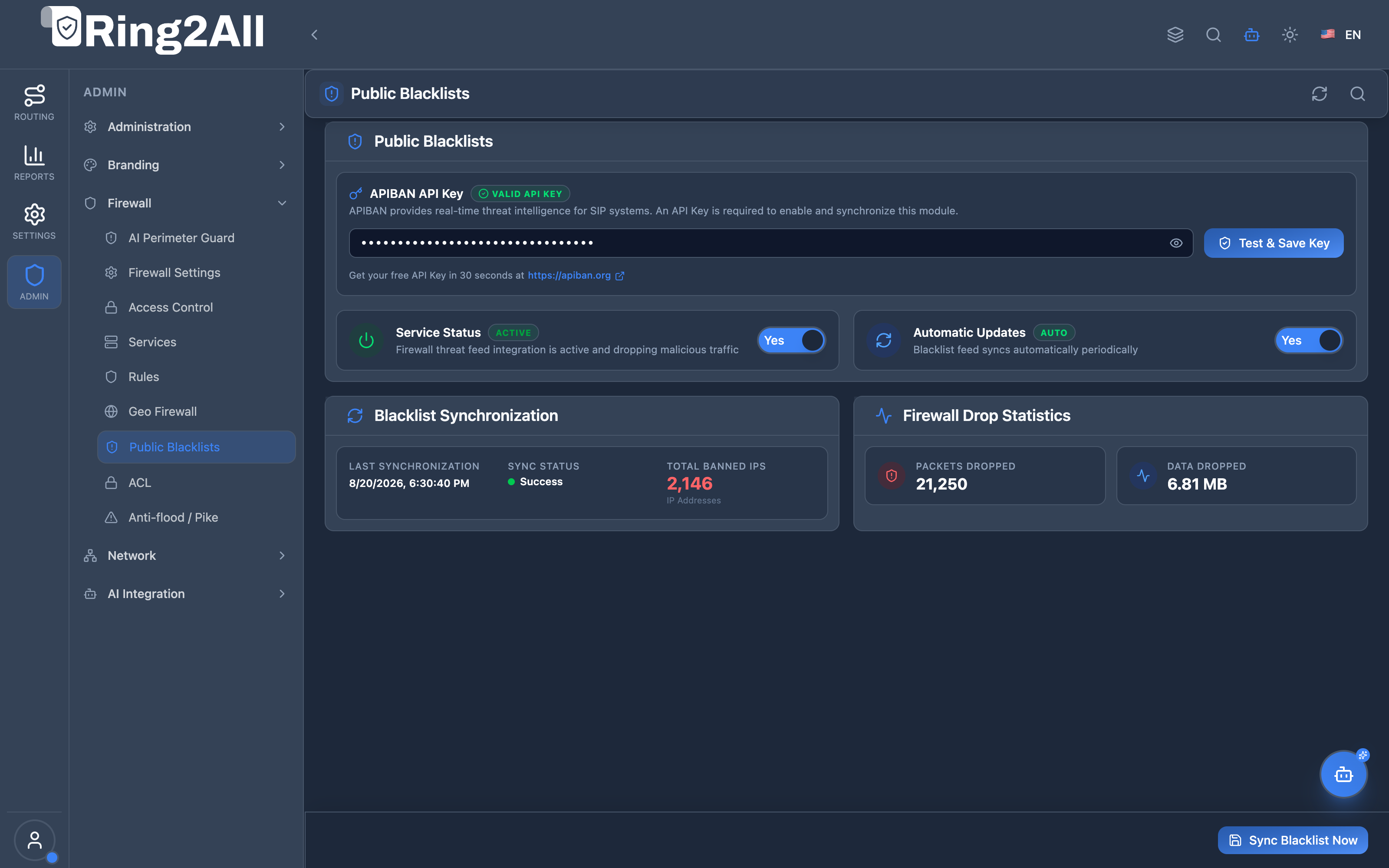
Section titled “4. Visual Interface & Layout”The Public Blacklists console provides an intuitive dashboard featuring API key management, service toggle states, synchronization progress indicators, and drop telemetry statistics.
4.1 Public Blacklists Management View
Section titled “4.1 Public Blacklists Management View”Displays API key validation, service status toggles, synchronization metrics, and live packet/bandwidth drop counters.
5. Field Reference & Threat Feed Parameters
Section titled “5. Field Reference & Threat Feed Parameters”5.1 API Key & Service Configuration
Section titled “5.1 API Key & Service Configuration”| Field | Type | Default | Description |
|---|---|---|---|
| APIBAN API Key | Secret Key | Enforced | Personal API authentication key issued by APIBAN (e.g., via https://apiban.org). Required for feed downloads. |
| API Key Status | Badge | Valid / Invalid | Real-time status badge validating cryptographic credential legitimacy against the upstream API server. |
| Service Status | Switch Toggle | Yes (Active) |
Master toggle controlling active threat intelligence enforcement and packet dropping. |
| Automatic Updates | Switch Toggle | Yes (Auto) |
Enables scheduled cron-based background polling to synchronize incremental blacklist updates. |
5.2 Synchronization & Telemetry Metrics
Section titled “5.2 Synchronization & Telemetry Metrics”| Field | Type | Description |
|---|---|---|
| Last Synchronization | Timestamp | The exact date and time of the most recent successful feed download and kernel set ingestion. |
| Sync Status | Badge | Operational health indicator (Success, Pending, or Error). |
| Total Banned IPs | Metric Counter | Real-time count of active malicious IP addresses currently enforced in memory (e.g., 2,146). |
| Packets Dropped | Metric Counter | Cumulative number of malicious network packets intercepted and discarded by the firewall (e.g., 21,250). |
| Data Dropped | Metric Counter | Total volume of hostile network traffic discarded before reaching application memory (e.g., 6.81 MB). |
6. Feed Synchronization & In-Memory Drop Pipeline
Section titled “6. Feed Synchronization & In-Memory Drop Pipeline”When Sync Blacklist Now is clicked or the scheduled background worker triggers, the SBC initiates an incremental synchronization workflow:
- Incremental Feed Query:
Terminal window GET https://apiban.org/api/<API_KEY>/banned/ID - Database Ingestion: Downloaded IPs are committed to the local database with timestamps.
- Kernel Set Sync: The daemon injects newly reported addresses into the
nftablesset:Terminal window nft add element inet filter sbc_public_bans { 198.51.100.89, 203.0.113.14 } - Kamailio Shared Memory Sync: The list is pushed to Kamailio’s memory table via RPC:
Terminal window kamcmd htable.sets voipbl "198.51.100.89" 1
7. Operational Best Practices & False-Positive Mitigation
Section titled “7. Operational Best Practices & False-Positive Mitigation”- Obtain a Dedicated APIBAN Key: Always generate a dedicated, free API key directly from apiban.org rather than sharing keys across multiple client installations.
- Carrier Subnet Exemption: Verify that local carriers and PSTN gateway IP ranges are explicitly listed in the AI Perimeter Guard Whitelist or ACL Trusted IPs so that global feed anomalies cannot inadvertently block wholesale partners.
- Keep Automatic Updates Active: Threat actors frequently cycle IP addresses across cloud providers within 24–48 hours; maintaining
Automatic Updatesensures obsolete bans are refreshed with current active threats. - Monitor Drop Metrics After Maintenance: Review
Packets Droppedcounters following network maintenance to verify that threat feeds remain properly bound to public network interfaces.
8. Verification & Diagnostics
Section titled “8. Verification & Diagnostics”8.1 Check Database Blacklist Settings
Section titled “8.1 Check Database Blacklist Settings”Query current threat feed parameters and synchronization history:
sudo -u postgres psql -d sbc_admin -c "SELECT * FROM voipbl_settings;"8.2 Inspect Kernel Threat Set
Section titled “8.2 Inspect Kernel Threat Set”Verify that public blacklist IPs are loaded into the Linux kernel set:
nft list set inet filter sbc_public_bans | head -n 258.3 Live Sync Daemon Execution
Section titled “8.3 Live Sync Daemon Execution”Trigger a manual CLI test of the threat feed synchronization script:
/usr/local/bin/ring2all-sync-blacklists --verbose9. Model Context Protocol (MCP) AI Integration
Section titled “9. Model Context Protocol (MCP) AI Integration”The Ring2All SBC MCP Server exposes dedicated threat intelligence tools under the security category. Autonomous SecOps agents and the Ring2All SBC NOC Copilot can inspect external blacklist module health, audit IP threat reputations, and trigger asynchronous feed synchronization pipelines.
9.1 Available MCP Tools
Section titled “9.1 Available MCP Tools”| Tool Name | Operation Type | Risk Level | Description |
|---|---|---|---|
get_threat_intel_status |
Read-only | read_only |
Retrieves the status of the APIBAN/VoIPBL public blacklist module, including API key validation, active ban counts, and last synchronization timestamp. |
sync_threat_intel |
Mutating / Operational | operational |
Triggers an immediate background synchronization of upstream APIBAN threat intelligence into Kamailio htable and Linux nftables. |
check_ip_threat_status |
Read-only / Query | read_only |
Checks whether a specific IP address is currently blocked in Kamailio memory tables (Pike anti-flood or APIBAN threat intel). |
9.2 Tool Schemas & Parameter Definitions
Section titled “9.2 Tool Schemas & Parameter Definitions”get_threat_intel_status
Section titled “get_threat_intel_status”- Description: Get status of the Ring2All SBC Public Blacklist (APIBAN) threat intelligence module and Kamailio in-memory protection.
- Input Schema:
{ "type": "object", "properties": {}}sync_threat_intel
Section titled “sync_threat_intel”- Description: Trigger an immediate background synchronization of APIBAN threat intelligence into Kamailio htable and nftables firewall.
- Input Schema:
{ "type": "object", "properties": {}}check_ip_threat_status
Section titled “check_ip_threat_status”- Description: Check if a specific IP address is currently blocked in Kamailio (Pike anti-flood or APIBAN threat intel).
- Input Schema:
{ "type": "object", "properties": { "ipAddress": { "type": "string", "description": "The IPv4 address to verify (e.g., '198.51.100.25')" } }, "required": ["ipAddress"]}9.3 Sample Tool Execution Payloads
Section titled “9.3 Sample Tool Execution Payloads”Example 1: Ingesting Threat Feed Status
Section titled “Example 1: Ingesting Threat Feed Status”Request Payload:
{ "tool": "get_threat_intel_status", "parameters": {}}Response Payload:
{ "success": true, "data": { "module": "apiban", "serviceEnabled": true, "apiKeyConfigured": true, "lastSyncTimestamp": "2026-09-08T11:30:00Z", "syncStatus": "success", "totalBannedIps": 2146, "packetsDropped": 21250, "bandwidthSaved": "6.81 MB" }}Example 2: Verifying an External IP’s Threat Status
Section titled “Example 2: Verifying an External IP’s Threat Status”Request Payload:
{ "tool": "check_ip_threat_status", "parameters": { "ipAddress": "198.51.100.25" }}Response Payload:
{ "success": true, "data": { "ipAddress": "198.51.100.25", "isBanned": true, "table": "apiban", "details": "Present in APIBAN global honeypot blacklist; blocked at wire speed." }}9.4 Bilingual Natural Language Copilot Prompts
Section titled “9.4 Bilingual Natural Language Copilot Prompts”English Prompts
Section titled “English Prompts”- “Check the status of the APIBAN public blacklist module and tell me how many IPs are currently blocked.”
→ Agent calls
get_threat_intel_status(). - “Trigger an immediate background synchronization of global threat intelligence feeds.”
→ Agent calls
sync_threat_intel(). - “Is IP 198.51.100.25 currently flagged or blocked in our threat intelligence tables?”
→ Agent calls
check_ip_threat_status({"ipAddress": "198.51.100.25"}).
Spanish Prompts (Español)
Section titled “Spanish Prompts (Español)”- “Verifica el estado del módulo de listas negras públicas (APIBAN) y dime cuántas IPs están bloqueadas.”
→ Agente invoca
get_threat_intel_status(). - “Sincroniza de inmediato las fuentes de inteligencia de amenazas globales en el firewall.”
→ Agente invoca
sync_threat_intel(). - “¿Está la IP 198.51.100.25 actualmente marcada o bloqueada en las tablas de inteligencia de amenazas?”
→ Agente invoca
check_ip_threat_status({"ipAddress": "198.51.100.25"}).
9.5 Enterprise Security & Execution Safeguards
Section titled “9.5 Enterprise Security & Execution Safeguards”- Non-Blocking Background Dispatch: Executing
sync_threat_intellaunches an asynchronous child worker to fetch remote feeds, preventing HTTP request blocking on Kamailio or the Fastify REST backend. - Rate-Limiting API Protection: Outgoing API requests to
apiban.orgrespect upstream rate limits (maximum 1 request per 4 minutes during polling cycles) to avoid credential throttling. - In-Memory Volatility Protection: Addresses downloaded from external feeds are cached in persistent PostgreSQL storage and repopulated into memory upon daemon reloads.
10. Glossary
Section titled “10. Glossary”- APIBAN: Free, automated, community-driven threat intelligence system providing IP addresses actively attempting unauthorized SIP interactions.
- VoIPBL: Distributed VoIP blacklist that aggregates reports from PBX honeypots worldwide to identify fraudulent and scanning networks.
- IoC (Indicator of Compromise): Forensic evidence on a network or in an operating system that indicates a security breach or active exploit attempt.
- Kernel Set: In-memory list structure in Linux packet filtering that allows evaluating thousands of IP addresses with $O(1)$ constant time lookup complexity.
- Model Context Protocol (MCP): An open standard enabling autonomous AI assistants and NOC copilots to securely discover and invoke SBC operational tools.