

Access Control Lists (ACL) & Trusted SIP Peers
Table of Contents
Section titled “Table of Contents”- Overview & Permissions Architecture
- Business & Operational Significance
- 🎯 User Roles & Key Capabilities
- Visual Interface & Layout
- Field Reference: Trusted IPs & Address Groups
- Kamailio Permissions Module & Routing Logic
- Address Group Numbering & Telephony Roles
- Operational Hardening & Best Practices
- Verification & Diagnostics
- Model Context Protocol (MCP) AI Integration
- Glossary
1. Overview & Permissions Architecture
Section titled “1. Overview & Permissions Architecture”In Ring2All SBC, the Access Control List (ACL) module delivers telecom-grade trust governance and IP authorization for SIP signaling. Directly backed by Kamailio’s native permissions module, the ACL engine manages two fundamental database tables: kamailio.trusted (IP-based authentication for PBX core nodes and carrier gateways) and kamailio.address (group-based IP/subnet routing classifications).
┌─────────────────────────────────────────────────────────────┐ │ INCOMING SIP SIGNALING PACKET │ │ (Source IP, Protocol, Port) │ └──────────────────────────────┬──────────────────────────────┘ │ ┌──────────────────────────────▼──────────────────────────────┐ │ KAMAILIO PERMISSIONS MODULE EVALUATION │ └──────────────────────────────┬──────────────────────────────┘ │ ┌───────────────────────┴───────────────────────┐ ▼ ▼ ┌──────────────────────────────┐ ┌──────────────────────────────┐ │ check_source_address(grp) │ │ allow_trusted() CHECK │ │ (Table: kamailio.address) │ │ (Table: kamailio.trusted) │ ├──────────────────────────────┤ ├──────────────────────────────┤ │ • Group 1: Trusted SBC Node │ │ • Core Telephony Cluster │ │ • Group 8: PBX Auth (Bypass) │ │ • Carrier Wholesale Gateways │ │ • Group 9: CPS Rate Limits │ │ • RTPEngine Media Relays │ └──────────────────────────────┘ └──────────────────────────────┘ │ ▼ ┌─────────────────────────────────────────────────────────────┐ │ AUTHENTICATION BYPASS & ROUTING DISPATCH │ │ (Trusted traffic skips SIP 401/407 digest challenges; │ │ Untrusted traffic strictly requires digest challenge) │ └─────────────────────────────────────────────────────────────┘By maintaining pre-compiled in-memory hash tables of trusted peers, Kamailio evaluates incoming SIP packets in zero clock cycles, bypassing digest authentication challenges for authorized carrier trunks while strictly enforcing password authentication for remote endpoints.
2. Business & Operational Significance
Section titled “2. Business & Operational Significance”- Carrier IP-Based Authentication: Enables seamless SIP trunking with Tier-1 wholesale telecom operators that rely on static IP peering rather than SIP registration or Digest (MD5/SHA) credentials.
- Core PBX Cluster Interconnect: Authorizes internal Ring2All Telephony cluster nodes and RTPEngine media proxies to dispatch calls through the SBC perimeter without authentication overhead.
- Elimination of Auth Overhead on High CPS: Eliminates the latency, packet round-trips, and CPU load of sending SIP
407 Proxy Authentication Requiredmessages on high-volume inbound wholesale DID trunks. - Zero-Downtime Cache Reloading: Changes committed in the web interface automatically trigger Kamailio
permissions.addressReloadandpermissions.trustedReloadvia RPC, updating routing permissions instantaneously without restarting SIP daemons.
3. 🎯 User Roles & Key Capabilities
Section titled “3. 🎯 User Roles & Key Capabilities”| Role | Primary Use Case | Key Capabilities |
|---|---|---|
| SBC Telephony Engineer | Carrier Interconnect Provisioning | Register trusted carrier IP addresses, allocate address groups, specify port and transport protocols, and assign routing tags. |
| Core PBX Administrator | Cluster Node Authorization | Add newly provisioned Telephony nodes and media relays to the Trusted IPs table to ensure unimpeded internal signaling. |
| NOC Systems Operator | Peering Verification | Inspect active ACL groups, verify subnet mask lengths, and trigger on-demand permissions reloads. |
| Security Auditor | Trust Relationship Review | Review all authorized IP addresses to ensure no stale, unauthorized, or overly permissive subnets bypass SIP authentication. |
| AI Peering & ACL Engineer / NOC Copilot | Automated Trunk Whitelisting & Cache Verification | Query trusted peer records, add or remove authorized gateway IPs, and trigger atomic in-memory permissions cache reloads via MCP. |
4. Visual Interface & Layout
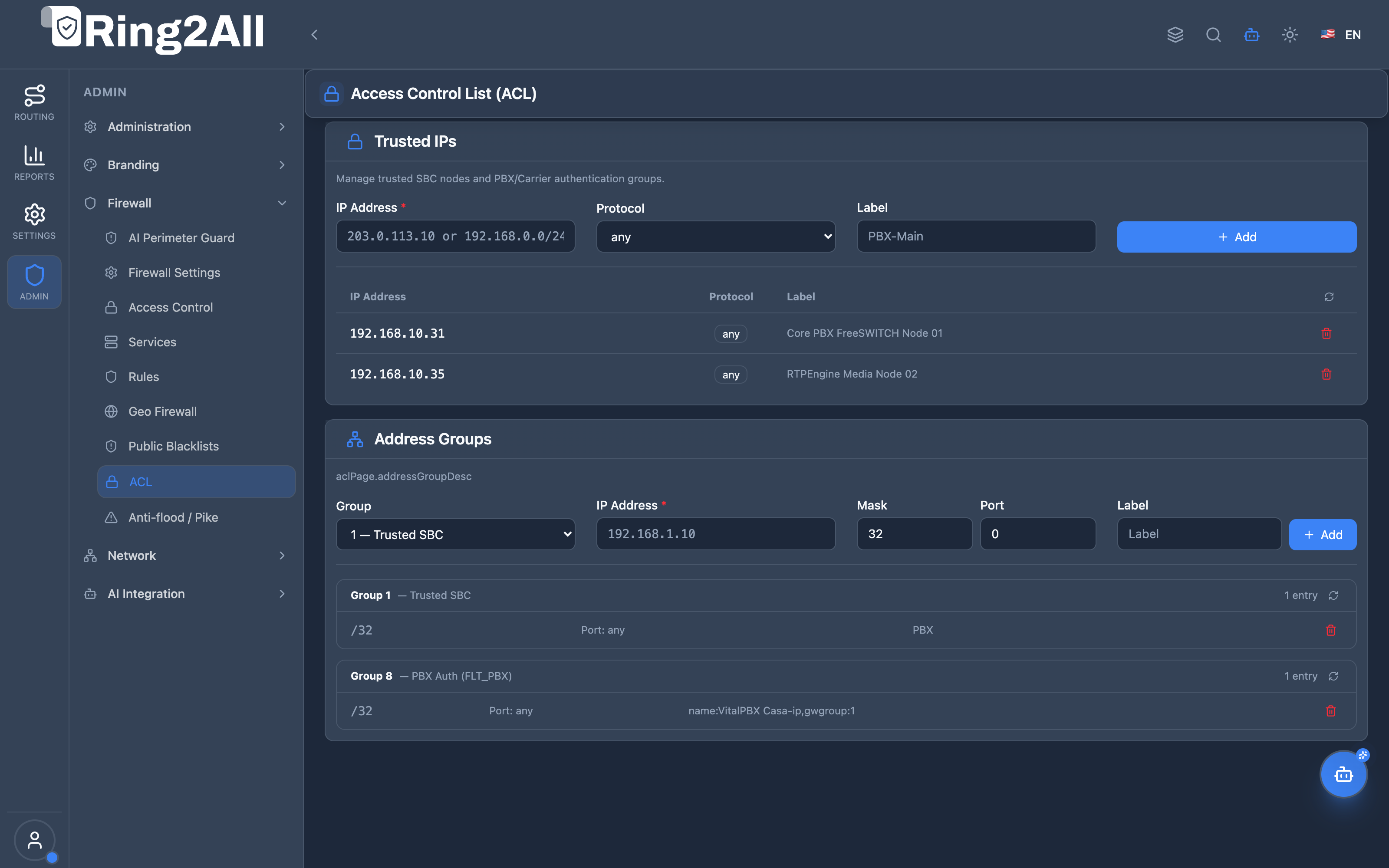
Section titled “4. Visual Interface & Layout”The ACL console provides an organized dual-section view featuring Trusted IPs at the top and Address Groups at the bottom, complete with instant creation dialogues and deletion protection for core loopback addresses.
4.1 ACL & Trusted Peers View
Section titled “4.1 ACL & Trusted Peers View”Displays authorized trusted peer IPs (e.g., Telephony nodes, RTPEngine media engines) and group-based subnet address definitions.
5. Field Reference: Trusted IPs & Address Groups
Section titled “5. Field Reference: Trusted IPs & Address Groups”5.1 Trusted IPs (kamailio.trusted) Parameters
Section titled “5.1 Trusted IPs (kamailio.trusted) Parameters”| Field | Type | Constraint | Description |
|---|---|---|---|
| IP Address | String (IPv4/IPv6) | Required | The static IP address or CIDR subnet of the trusted telecom partner, PBX node, or carrier gateway. |
| Protocol | Dropdown | any, udp, tcp, tls |
Transport protocol constraint. Selecting any authorizes signaling across all transport types. |
| Label | String | Optional | Descriptive identification tag (e.g., Core PBX Telephony Node 01, RTPEngine Media Node 02). |
| Actions | Action Icon | Trash Can | Removes the peer from the trusted table and triggers an automatic cache reload. |
5.2 Address Groups (kamailio.address) Parameters
Section titled “5.2 Address Groups (kamailio.address) Parameters”| Field | Type | Constraint | Description |
|---|---|---|---|
| Group | Dropdown / Int | Numeric Group ID | The functional routing classification group (e.g., 1 — Trusted SBC, 8 — PBX Auth, 9 — CPS Limits). |
| IP Address | String (IPv4/IPv6) | Required | IP address or network boundary associated with the group. |
| Mask | Number (0–32) | Default 32 |
Subnet bitmask (e.g., 32 for a single host, 24 for a /24 subnet block). |
| Port | Number (0–65535) | Default 0 |
Port constraint. A value of 0 matches all source ports. |
| Label / Tag | String | Optional | Custom telemetry metadata or functional configuration string (e.g., name:VitalPBX Casa-ip,gwgroup:1). |
6. Kamailio Permissions Module & Routing Logic
Section titled “6. Kamailio Permissions Module & Routing Logic”When incoming SIP requests enter Kamailio’s main request route, they are evaluated against the permissions cache:
# kamailio.cfg snippetroute[REQINIT] {    # 1. Evaluate Trusted Peers (IP Auth)    if (allow_trusted()) {        xlog("L_INFO", "ACL: Authorized trusted peer $si:$sp [$proto]\n");        setflag(FLAG_TRUSTED_PEER);        route(DISPATCH_INTERNAL);        exit;    }
    # 2. Evaluate Address Groups    if (check_source_address("1")) {        xlog("L_INFO", "ACL: Source $si matched Group 1 (Trusted SBC)\n");        setflag(FLAG_SBC_INTERCONNECT);    }}
7. Address Group Numbering & Telephony Roles
Section titled “7. Address Group Numbering & Telephony Roles”Ring2All SBC adopts a standardized group numbering taxonomy across the kamailio.address table:
| Group ID | Functional Purpose | Operational Behavior |
|---|---|---|
| 1 | Trusted SBC Interconnect | High-priority inter-SBC cluster signaling and management links. |
| 8 | PBX Auth Bypass (FLT_PBX) | Certified Core PBX nodes authorized to originate calls without challenge. |
| 9 | CPS Rate Limit Rules | Carrier endpoints with custom Calls-Per-Second rate exception thresholds (tag: cps:50). |
| 10 | Emergency Dispatch | Public Safety Answering Point (PSAP) and E911 high-priority trunks. |
8. Operational Hardening & Best Practices
Section titled “8. Operational Hardening & Best Practices”- Always Specify Subnet Masks Explicitly: Use
/32for individual server nodes rather than accepting broad defaults, preventing entire cloud hosting provider subnets from gaining trusted status. - Protect Loopback Addresses: Ring2All SBC automatically blocks deletion of
127.0.0.1,::1, orlocalhostfrom permissions tables to prevent breaking internal RPC communication. - Avoid Tag Clashes in Group 9: When configuring CPS rate exceptions in Group 9, always format the tag as
cps:<number>(e.g.,cps:50) so the Pike rate limiting parser can extract the integer value accurately. - Verify Cache Reloads: Ensure that every insertion or modification is followed by a successful
permissions.addressReloadto prevent drift between PostgreSQL and Kamailio memory.
9. Verification & Diagnostics
Section titled “9. Verification & Diagnostics”9.1 Query Active Permissions in Database
Section titled “9.1 Query Active Permissions in Database”Inspect all entries in both tables:
# Query Trusted Peerssudo -u postgres psql -d kamailio -c "SELECT id, src_ip, proto, pattern, tag FROM trusted;"
# Query Address Groupssudo -u postgres psql -d kamailio -c "SELECT id, grp, ip_addr, mask, port, tag FROM address ORDER BY grp;"
9.2 Trigger In-Memory Cache Reload via RPC
Section titled “9.2 Trigger In-Memory Cache Reload via RPC”Manually refresh Kamailio’s in-memory permissions tables:
kamcmd permissions.addressReloadkamcmd permissions.trustedReload9.3 Dump In-Memory Permissions Cache
Section titled “9.3 Dump In-Memory Permissions Cache”Inspect the live routing tables in Kamailio memory:
kamcmd permissions.addressDumpkamcmd permissions.trustedDump10. Model Context Protocol (MCP) AI Integration
Section titled “10. Model Context Protocol (MCP) AI Integration”The Ring2All SBC MCP Server exposes dedicated carrier peering and whitelist management tools under the acl category. Autonomous telephony agents and the Ring2All SBC NOC Copilot can audit trusted partner lists, provision new carrier IP endpoints, and trigger immediate Kamailio memory reloads.
10.1 Available MCP Tools
Section titled “10.1 Available MCP Tools”| Tool Name | Operation Type | Risk Level | Description |
|---|---|---|---|
list_trusted_ips |
Read-only | read_only |
Lists all trusted IP subnets, PBX core nodes, and carrier whitelist entries with transport protocols and labels. |
add_trusted_ip |
Mutating / Operational | critical |
Adds a new trusted IP or subnet to the Kamailio ACL permissions table, bypassing digest challenges and flood filtering. |
remove_trusted_ip |
Mutating / Operational | critical |
Removes a trusted IP address from Kamailio permissions (protected against deleting loopback or management addresses). |
reload_acl_permissions |
Operational / Sync | operational |
Triggers Kamailio RPC commands (permissions.addressReload, permissions.trustedReload) to synchronize memory with PostgreSQL. |
10.2 Tool Schemas & Parameter Definitions
Section titled “10.2 Tool Schemas & Parameter Definitions”list_trusted_ips
Section titled “list_trusted_ips”- Description: List all trusted IP subnets and carrier whitelist entries configured in Kamailio ACL permissions.
- Input Schema:
{ "type": "object", "properties": { "search": { "type": "string", "description": "Filter by IP address or tag/description" } }}add_trusted_ip
Section titled “add_trusted_ip”- Description: Add a new trusted IP address or subnet to Kamailio ACL permissions.
- Input Schema:
{ "type": "object", "properties": { "ipAddress": { "type": "string", "description": "IPv4 address or subnet (e.g., '198.51.100.50')" }, "proto": { "type": "string", "enum": ["any", "udp", "tcp", "tls"], "description": "Transport protocol (default: any)" }, "tag": { "type": "string", "description": "Descriptive label (e.g., 'Telnyx Carrier Gateway 01')" } }, "required": ["ipAddress"]}remove_trusted_ip
Section titled “remove_trusted_ip”- Description: Remove a trusted IP address from Kamailio ACL permissions.
- Input Schema:
{ "type": "object", "properties": { "ipAddress": { "type": "string", "description": "IP address to remove from trusted permissions" } }, "required": ["ipAddress"]}reload_acl_permissions
Section titled “reload_acl_permissions”- Description: Reload Kamailio ACL permissions and address tables from database into RAM memory.
- Input Schema:
{ "type": "object", "properties": {}}10.3 Sample Tool Execution Payloads
Section titled “10.3 Sample Tool Execution Payloads”Example 1: Listing Trusted Carrier Gateways
Section titled “Example 1: Listing Trusted Carrier Gateways”Request Payload:
{ "tool": "list_trusted_ips", "parameters": { "search": "Telnyx" }}Response Payload:
{ "success": true, "data": { "total": 2, "trustedIps": [ { "id": 12, "srcIp": "192.76.120.10", "proto": "any", "tag": "Telnyx Primary Interconnect" }, { "id": 13, "srcIp": "192.76.120.11", "proto": "any", "tag": "Telnyx Secondary Interconnect" } ] }}Example 2: Authorizing a New PBX Media Relay Node
Section titled “Example 2: Authorizing a New PBX Media Relay Node”Request Payload:
{ "tool": "add_trusted_ip", "parameters": { "ipAddress": "198.51.100.50", "proto": "udp", "tag": "Telephony Core Node 03" }}Response Payload:
{ "success": true, "data": { "message": "Trusted IP 198.51.100.50 added successfully", "ipAddress": "198.51.100.50", "proto": "udp", "tag": "Telephony Core Node 03", "reloaded": true }}10.4 Bilingual Natural Language Copilot Prompts
Section titled “10.4 Bilingual Natural Language Copilot Prompts”English Prompts
Section titled “English Prompts”- “List all trusted carrier IP addresses configured in Kamailio ACL.”
→ Agent calls
list_trusted_ips(). - “Add 198.51.100.50 as a trusted carrier gateway with tag ‘Telnyx Wholesale’.”
→ Agent calls
add_trusted_ip({"ipAddress": "198.51.100.50", "proto": "udp", "tag": "Telnyx Wholesale"}). - “Reload Kamailio permissions tables from the database to ensure all worker threads are synchronized.”
→ Agent calls
reload_acl_permissions().
Spanish Prompts (Español)
Section titled “Spanish Prompts (Español)”- “Lista todas las direcciones IP de confianza configuradas en las ACL de Kamailio.”
→ Agente invoca
list_trusted_ips(). - “Agrega la IP 198.51.100.50 como gateway de confianza con la etiqueta ‘Telnyx Wholesale’.”
→ Agente invoca
add_trusted_ip({"ipAddress": "198.51.100.50", "proto": "udp", "tag": "Telnyx Wholesale"}). - “Recarga las tablas de permisos de Kamailio desde la base de datos para sincronizar la memoria RAM.”
→ Agente invoca
reload_acl_permissions().
10.5 Enterprise Security & Execution Safeguards
Section titled “10.5 Enterprise Security & Execution Safeguards”- Loopback & Local Interface Protection: The
remove_trusted_iptool executes strict guard validation viaassertCanRemoveTrustedIp(). Any attempt to remove127.0.0.1,::1, or the host’s primary internal IP is blocked unconditionally with an error. - Automatic In-Memory Refresh: Successful insertions and deletions automatically issue RPC reload commands (
permissions.addressReload) within 3000ms timeouts to prevent memory-database divergence. - Audit Trail Accountability: All ACL modifications register the executing operator identity and a cryptographic change hash in the administrative audit journal.
11. Glossary
Section titled “11. Glossary”- allow_trusted(): Native Kamailio function that checks whether the incoming SIP message source matches an authorized entry in the
trustedtable. - check_source_address(): Kamailio function that verifies whether an IP/port/protocol tuple matches a specific numeric group in the
addresstable. - FLT_PBX: Internal transaction flag set when an incoming request originates from an authorized Core PBX node.
- Digest Authentication: Challenge-response mechanism (RFC 2617 / RFC 8760) used to authenticate SIP endpoints using MD5, SHA-256, or SHA-512 hashes.
- Model Context Protocol (MCP): An open standard enabling autonomous AI assistants and NOC copilots to securely discover and invoke SBC operational tools.