

SMS Settings Module Documentation
Table of Contents
Section titled “Table of Contents”- Navigation & Access
- Screenshots & Visual Interface
- Module Overview (Technical)
- Module Overview (Commercial / Business)
- Module Overview (End User / Administrator)
- Configuration Fields Reference
- Regulatory Compliance & Quiet Hours
- Three-Tier Rate Limiting Architecture
- Country & Prefix Filtering
- Model Context Protocol (MCP) AI Integration
- Troubleshooting Tips
- Database Schema
- Glossary
Navigation & Access
Section titled “Navigation & Access”To access the SMS Settings module:
- Log in to the Ring2All Web Portal (
https://<domain-or-ip>/login). - In the left navigation sidebar, expand PBX Engine.
- Under SMS Messaging, click Settings (
/pbx/sms/settings). - Modify the required parameters and click Save Changes on the action bar at the bottom.
Screenshots & Visual Interface
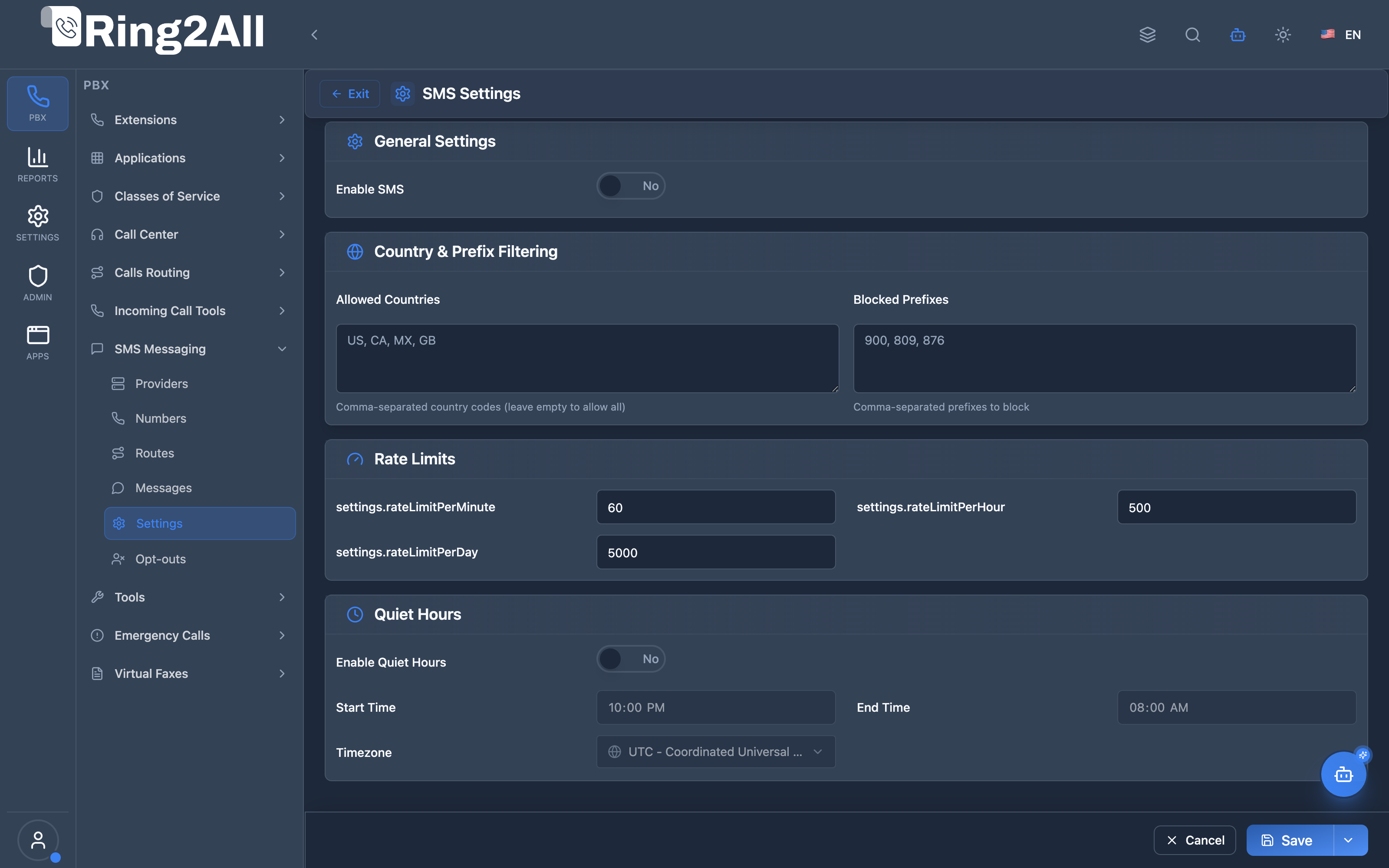
Section titled “Screenshots & Visual Interface”SMS Settings Configuration Form
Section titled “SMS Settings Configuration Form”Standard 4-column inline layout organized into functional FormBoxes: Master Service Toggle, Destination Filtering, Rate Limiting Throttles, and Quiet Hours Compliance.
1. Module Overview (Technical)
Section titled “1. Module Overview (Technical)”What is SMS Settings?
Section titled “What is SMS Settings?”The SMS Settings module controls tenant-level rules, compliance policies, sending quotas, geographic permissions, and quiet hours constraints for all text messaging operations on a domain.
Technical Architecture
Section titled “Technical Architecture”- Settings records are stored per domain in
ss_telephony.sms_settings. - Before any message is queued or submitted to a provider, the SMS controller evaluates:
- Master Toggle (
sms_enabled): Immediate rejection if false. - Destination Filtering: Verifies the country code against
allowed_countriesand ensures the number prefix is not listed inblocked_prefixes. - Rate Limits: Checks minute, hourly, and daily Redis counters against
rate_limit_per_minute,rate_limit_per_hour, andrate_limit_per_day. - Quiet Hours: Compares current time in
quiet_hours_timezoneagainstquiet_hours_startandquiet_hours_end. If quiet hours are active, the message is delayed or rejected based on compliance rules.
- Master Toggle (
2. Module Overview (Commercial / Business)
Section titled “2. Module Overview (Commercial / Business)”Business Value & Compliance Protection
Section titled “Business Value & Compliance Protection”- Cost Protection & Budget Safeguard: Multi-tier rate limits prevent runaway scripts, API leaks, or bot compromised endpoints from generating thousands of billable SMS in minutes.
- TCPA & Legal Penalty Avoidance: TCPA (Telephone Consumer Protection Act) fines range from $500 to $1,500 per unauthorized message. Automated Quiet Hours enforcement ensures messages are never delivered during nighttime hours.
- Geographic Fraud Mitigation: Restrict outbound messages to domestic territories, preventing international SMS toll fraud (IRSF) attacks.
3. Module Overview (End User / Administrator)
Section titled “3. Module Overview (End User / Administrator)”Administrator Experience
Section titled “Administrator Experience”Administrators configure safety thresholds and compliance policies in a single centralized screen:
- Toggle the entire domain’s SMS engine on or off during security audits.
- Adjust hourly burst limits during marketing campaigns.
- Define customer timezones for legal compliance.
4. Configuration Fields Reference
Section titled “4. Configuration Fields Reference”| Field Name | Technical Description | User-Friendly Tooltip | Example | Notes |
|---|---|---|---|---|
| SMS Enabled | Master boolean in sms_enabled. |
Master toggle to enable or disable SMS messaging on domain. | true |
Must be ON for any SMS sending or receiving. |
| Allowed Countries | Array in allowed_countries. |
Allowed destination countries (ISO 2-letter codes). | ["US", "CA", "GB", "MX", "ES"] |
Empty array allows all non-blocked countries. |
| Blocked Prefixes | Array in blocked_prefixes. |
Specific phone number prefixes to block from sending. | ["900", "976"] |
Used for blocking premium rate or restricted ranges. |
| Rate Limit / Min | Integer in rate_limit_per_minute. |
Maximum messages allowed per minute across domain. | 60 |
Prevents burst abuse and carrier throttling. |
| Rate Limit / Hour | Integer in rate_limit_per_hour. |
Maximum messages allowed per hour across domain. | 500 |
Sustained throughput control. |
| Rate Limit / Day | Integer in rate_limit_per_day. |
Maximum messages allowed per 24-hour day across domain. | 5000 |
Budget cap and volume ceiling. |
| Quiet Hours Enabled | Boolean in quiet_hours_enabled. |
Enforce TCPA quiet hours (delay/block night messages). | false |
When enabled, no messages are sent during quiet time. |
| Quiet Hours Start | Time string in quiet_hours_start. |
Start time for restricted messaging period. | 22:00 |
Standard 24-hour format (e.g. 10:00 PM). |
| Quiet Hours End | Time string in quiet_hours_end. |
End time for restricted messaging period. | 08:00 |
Standard 24-hour format (e.g. 8:00 AM). |
| Timezone | IANA timezone in quiet_hours_timezone. |
Reference timezone for calculating quiet hours window. | America/New_York |
Select from standard global timezones. |
5. Regulatory Compliance & Quiet Hours
Section titled “5. Regulatory Compliance & Quiet Hours”The TCPA and mobile network carriers strictly prohibit sending commercial or non-emergency automated messages outside of 8:00 AM to 9:00 PM in the recipient’s local timezone.
Quiet Hours Logic
Section titled “Quiet Hours Logic”- Start Time: Typically
21:00or22:00(9:00 PM or 10:00 PM). - End Time: Typically
08:00(8:00 AM). - Handling:
- Non-transactional messages submitted during quiet hours can either be held in queue until morning release or rejected with status
rejected. - Transactional critical messages (e.g., 2FA verification codes) can bypass quiet hours if explicitly marked as high-priority OTP transactions.
- Non-transactional messages submitted during quiet hours can either be held in queue until morning release or rejected with status
6. Three-Tier Rate Limiting Architecture
Section titled “6. Three-Tier Rate Limiting Architecture”Ring2All implements a cascading sliding window rate-limiter in Redis:
| Tier | Window Duration | Default Value | Purpose |
|---|---|---|---|
| Per-Minute Limit | 60 seconds | 60 msgs |
Prevents API burst flood and carrier 429 errors. |
| Per-Hour Limit | 3,600 seconds | 500 msgs |
Normalizes campaign distributions and agent throughput. |
| Per-Day Limit | 86,400 seconds | 5,000 msgs |
Protects telecom balance from catastrophic overspending. |
If any tier’s threshold is reached, subsequent requests return an error (429 RATE_LIMIT_EXCEEDED) and are logged in CDR audits.
7. Country & Prefix Filtering
Section titled “7. Country & Prefix Filtering”Whitelisting & Blacklisting
Section titled “Whitelisting & Blacklisting”- Allowed Countries: Specify target markets (
US,CA,GB). Any destination number belonging to another country code is rejected before reaching telecom carriers. - Blocked Prefixes: Specifically prevent calling high-risk prefixes, such as international premium rate services (IPRS), adult lines (
900), or disputed prefixes.
8. Model Context Protocol (MCP) AI Integration
Section titled “8. Model Context Protocol (MCP) AI Integration”The Ring2All Model Context Protocol (MCP) server provides tools for reading and configuring domain-wide SMS messaging policies, rate-limiting quotas, destination filters, and TCPA nighttime quiet hours through autonomous agents or Copilots.
Available MCP Tools
Section titled “Available MCP Tools”| Tool Name | Operation | Description | Target Entity |
|---|---|---|---|
get_sms_settings |
Read | Retrieves domain-level SMS policies, allowed countries, blocked prefixes, volume rate limits, and quiet hours | Domain Settings |
update_sms_settings |
Write | Updates domain SMS policies, rate limit quotas, quiet hours, and country whitelists | Domain Settings |
Protection & Validation Guards
Section titled “Protection & Validation Guards”- Singleton Domain Integrity (
sms_settings_domain_id_key): Configuration is managed at the domain level with atomicON CONFLICT (domain_id) DO UPDATEsemantics, ensuring no duplicate or conflicting policy rows exist. - TCPA Regulatory Window Enforcement: When
quietHoursEnabledis set totrue,send_sms_messageevaluates current local time inquietHoursTimezone. Any non-urgent promotional text dispatched during the nighttime window is held or rejected withQUIET_HOURS_ACTIVE. - Three-Tier Sliding Window Controls: Outbound limits (
rateLimitPerMinute,rateLimitPerHour,rateLimitPerDay) protect against runaway API loops and carrier 429 throttling.
Example MCP Payloads
Section titled “Example MCP Payloads”1. Retrieving Domain SMS Settings (get_sms_settings)
Section titled “1. Retrieving Domain SMS Settings (get_sms_settings)”{}Response:
{ "success": true, "data": { "domainId": 1, "smsEnabled": true, "allowedCountries": ["US", "CA", "MX"], "blockedPrefixes": ["+1900"], "rateLimitPerMinute": 60, "rateLimitPerHour": 500, "rateLimitPerDay": 5000, "quietHoursEnabled": true, "quietHoursStart": "21:00:00", "quietHoursEnd": "08:00:00", "quietHoursTimezone": "America/New_York" }}2. Updating SMS Governance Policies (update_sms_settings)
Section titled “2. Updating SMS Governance Policies (update_sms_settings)”{ "smsEnabled": true, "allowedCountries": ["US", "CA"], "blockedPrefixes": ["+1900", "+1976"], "rateLimitPerMinute": 100, "quietHoursEnabled": true, "quietHoursStart": "21:00", "quietHoursEnd": "08:00", "quietHoursTimezone": "America/New_York"}Copilot Natural Language Prompts
Section titled “Copilot Natural Language Prompts”- “Show our current SMS messaging settings, rate limits, and quiet hours policy.”
- “Enable SMS messaging for this domain and restrict delivery to the US and Canada.”
- “Configure quiet hours between 9:00 PM and 8:00 AM Eastern Time to prevent automated messages overnight.”
- “Increase our domain hourly SMS rate limit to 1,000 messages per hour.”
9. Troubleshooting Tips
Section titled “9. Troubleshooting Tips”| Symptom | Probable Cause | Corrective Action |
|---|---|---|
| All outbound SMS fail with “SMS_DISABLED” | Master toggle is turned off | In SMS Settings, turn ON the SMS Enabled toggle and save changes. |
| Messages fail at night with “QUIET_HOURS” | Quiet hours restriction is active | Verify quiet_hours_start and quiet_hours_timezone configuration. |
| Error: “COUNTRY_NOT_ALLOWED” | Recipient country not in allowed list | Add the recipient’s ISO country code to Allowed Countries. |
| Error: “RATE_LIMIT_EXCEEDED” | Minute, hourly, or daily quota reached | Increase the rate limit values in SMS Settings. |
10. Database Schema
Section titled “10. Database Schema”SMS settings are stored per domain in table sms_settings in ss_telephony:
CREATE TABLE public.sms_settings ( id SERIAL PRIMARY KEY, uuid UUID NOT NULL DEFAULT uuid_generate_v4(), domain_id INTEGER NOT NULL REFERENCES domains(id) ON DELETE CASCADE, sms_enabled BOOLEAN DEFAULT FALSE, allowed_countries TEXT[], blocked_prefixes TEXT[], rate_limit_per_minute INTEGER DEFAULT 60, rate_limit_per_hour INTEGER DEFAULT 500, rate_limit_per_day INTEGER DEFAULT 5000, quiet_hours_enabled BOOLEAN DEFAULT FALSE, quiet_hours_start TIME WITHOUT TIME ZONE, quiet_hours_end TIME WITHOUT TIME ZONE, quiet_hours_timezone VARCHAR(50) DEFAULT 'UTC', created_at TIMESTAMPTZ NOT NULL DEFAULT now(), created_by INTEGER, updated_at TIMESTAMPTZ, updated_by INTEGER, CONSTRAINT sms_settings_domain_id_key UNIQUE (domain_id));11. Glossary
Section titled “11. Glossary”- TCPA: Telephone Consumer Protection Act — US federal statute governing telemarketing and automated messaging.
- Quiet Hours: Restricted nighttime period during which automated text messages must not be delivered to consumers.
- Sliding Window: Rate limiting technique that tracks request counts over continuously moving time intervals.
- ISO 3166-1: International standard for country codes (e.g. US, CA, MX).