

Billing & OCS Settings
Table of Contents
Section titled “Table of Contents”- Overview & Integration Architecture
- Business & Operational Significance
- 🎯 User Roles & Key Capabilities
- Visual Interface & Form Layout
- Configuration Parameters Reference
- Real-Time OCS Call Flow & Signaling Mechanics
- Fallback Policies & Fraud Governance
- Troubleshooting & Verification
- Model Context Protocol (MCP) AI Integration
- Glossary
1. Overview & Integration Architecture
Section titled “1. Overview & Integration Architecture”In Ring2All SBC, the Billing & OCS module orchestrates real-time interconnectivity between the Kamailio perimeter signaling core and the Ring2All BSS Online Charging System (OCS) (or any 3GPP/RFC-compliant telecom rating engine). Through non-blocking asynchronous HTTP/REST queries, the SBC verifies account balances, checks prepaid credit limits, and enforces maximum call duration allowances before routing calls to downstream carrier gateways.
Caller (SIP Endpoint) Ring2All SBC (Kamailio Core) Ring2All BSS OCS Engine │ │ │ │─────── SIP INVITE ──────────────>│ │ │<────── 100 Trying ───────────────│ │ │ │─── POST /api/v1/ocs/authorize ───────>│ │ │ {caller, callee, domain, rate} │ │ │ │ │ │<── HTTP 200 OK (Authorized) ──────────│ │ │ {allowed: true, max_seconds: 300} │ │ │ │ │ │─── Set Dialog Timeout (300s) ─────────┐ │ │ │ │─────── 180 Ringing / 200 OK ─────│<──────────────────────────────────────┘ │═══════ Active Call ══════════════│By decoupling billing logic from the core SIP state machine via asynchronous workers (http_async_client), the SBC guarantees that charging queries do not block UDP worker processes or increase call setup latency.
2. Business & Operational Significance
Section titled “2. Business & Operational Significance”- Zero-Balance Fraud Elimination: Prevents wholesale and retail subscribers from placing high-cost international or premium-rate calls without verified prepaid funds or approved credit lines.
- Granular Session Duration Clamping: Dynamically sets dialog timers (
dialog.timeout) based on the caller’s available balance and target destination rate, automatically terminating the call before debt occurs. - Carrier Interconnect Revenue Assurance: Guarantees that wholesale accounts cannot exceed strictly defined daily or hourly credit thresholds.
- Fault-Tolerant Fallback Handling: Provides deterministic policies (Reject, Allow, or Divert) when the OCS engine is unreachable, safeguarding platform availability during network outages.
3. 🎯 User Roles & Key Capabilities
Section titled “3. 🎯 User Roles & Key Capabilities”| Role | Primary Use Case | Key Capabilities |
|---|---|---|
| Telecom Billing Administrator | Real-Time Charging Configuration | Configure OCS API endpoints, tune request timeouts, and align session safety caps with billing rate cards. |
| Carrier Interconnect Manager | Credit Risk & Quota Oversight | Audit credit check behaviors, inspect real-time authorization latencies, and monitor balance rejections. |
| SBC Operations Engineer | Engine Interconnect Tuning | Optimize asynchronous HTTP worker threads and verify network socket health between the SBC and the OCS cluster. |
| Fraud & Risk Analyst | Abuse & Overrun Prevention | Define strict fallback policies to automatically reject unverified outbound calls during billing server degradation. |
| AI Billing Auditor / NOC Copilot | Autonomous Health Auditing | Execute real-time OCS endpoint probes, verify authorization latencies, and adjust fallback risk profiles under incident response via MCP. |
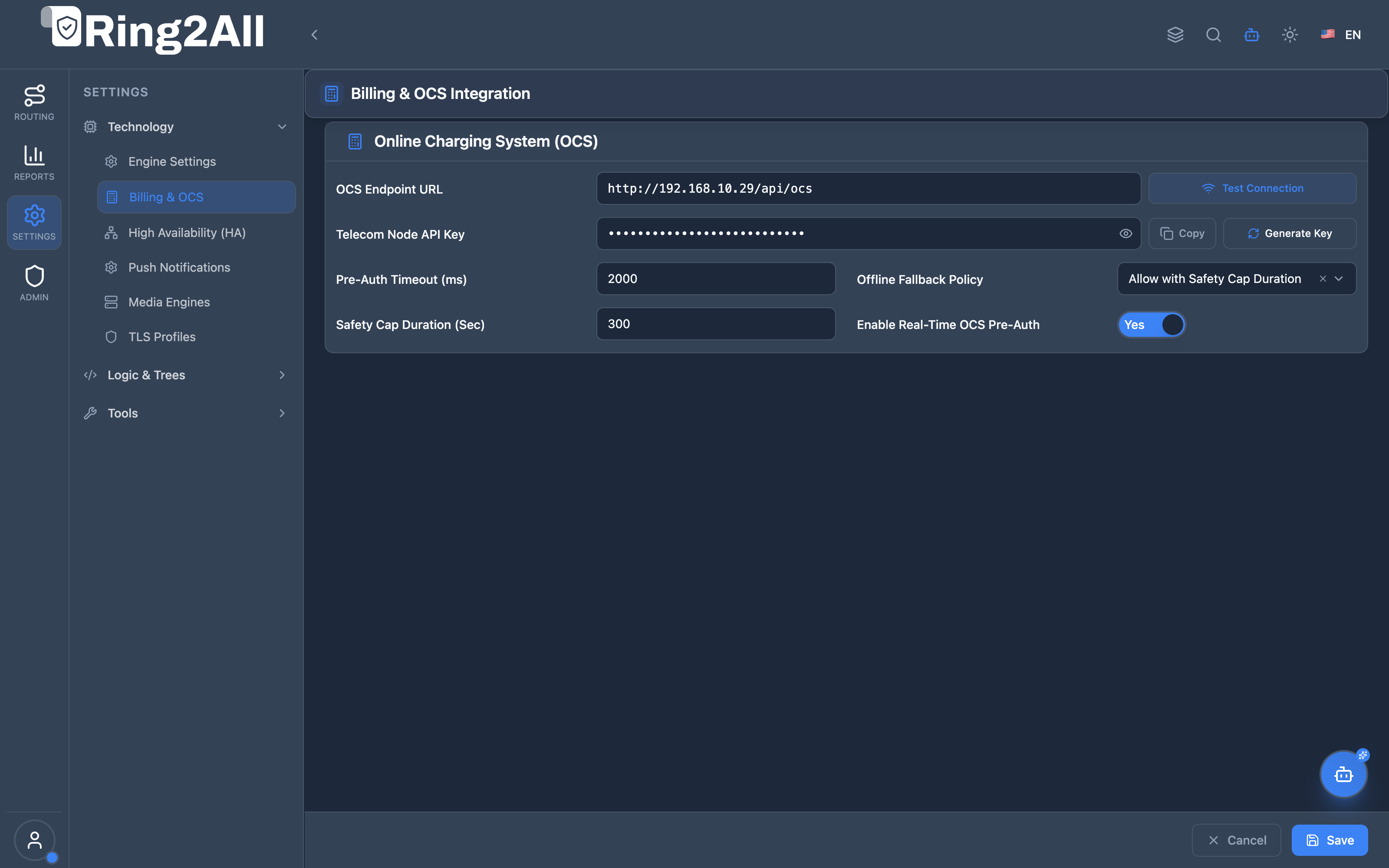
4. Visual Interface & Form Layout
Section titled “4. Visual Interface & Form Layout”The Billing & OCS configuration interface provides intuitive controls for enabling charging integrations, setting API connection details, configuring timeouts, and selecting fallback policies.
5. Configuration Parameters Reference
Section titled “5. Configuration Parameters Reference”| Parameter Name | Data Type | Default Value | Description |
|---|---|---|---|
| Enable Real-Time OCS | Switch | Enabled |
Master toggle to enforce real-time credit checks on all outbound or rated ingress SIP transactions. |
| OCS Engine Endpoint URL | Text / URL | http://127.0.0.1:8080/api/v1/ocs/authorize |
Fully qualified HTTP/HTTPS endpoint where the SBC transmits session authorization JSON payloads. |
| API Authentication Token | Password / Text | Bearer eyJ... |
Secure API key or JWT Bearer token passed in the Authorization header for OCS access control. |
| Request Timeout (ms) | Integer | 1500 |
Maximum time in milliseconds the SBC will wait for an OCS response before triggering the fallback policy. |
| Fallback Policy | Select | Reject Call (503) |
Action taken when OCS returns an HTTP 5xx error or times out: Reject Call (503), Allow Call (Free), or Route to IVR. |
| Safety Cap Duration (sec) | Integer | 7200 |
Absolute upper limit in seconds (default 2 hours) for any single session, regardless of balance. |
| Cache Authorization TTL | Integer | 0 |
Time-to-live in seconds for caching balance authorizations (0 disables caching, forcing fresh lookups). |
| Async HTTP Concurrency | Integer | 16 |
Number of non-blocking worker threads dedicated to handling outbound OCS HTTP requests. |
6. Real-Time OCS Call Flow & Signaling Mechanics
Section titled “6. Real-Time OCS Call Flow & Signaling Mechanics”The authorization workflow is embedded directly within the Kamailio routing script using the http_async_client and dialog modules:
- Transaction Interception: Upon receiving an initial
INVITE, the SBC evaluates whether the source domain or account requires real-time rating. - Asynchronous Dispatch: The SBC suspends the transaction and dispatches a JSON payload containing caller ID, destination number, and tenant UUID:
{"event": "session_authorize","call_id": "98a7bc-12df-48aa-b97c-91823ab0281@sbc","caller": "2000","callee": "+14155552671","domain": "customer-pbx.ring2all.com","timestamp": 1757268000}
- Response Processing:
- Approved (
HTTP 200): If the response contains"authorized": trueand"max_duration": 480, Kamailio resumes the transaction, routes the call to the carrier gateway, and setsdlg_set_timeout(480). - Insufficient Funds (
HTTP 402): If the balance is zero, Kamailio immediately replies to the caller withSIP/2.0 402 Payment Requiredand generates an audit log entry. - Timeout / Error: If no response arrives within the configured
Request Timeout, the engine activates the configured Fallback Policy.
- Approved (
7. Fallback Policies & Fraud Governance
Section titled “7. Fallback Policies & Fraud Governance”Choosing the correct fallback policy is critical for balancing business continuity against financial risk:
- Reject Call (
SIP 503 Service Unavailable) [Recommended for Wholesale]: Guarantees zero revenue leakage. If the billing engine is unreachable, no unauthorized calls are permitted to exit the network. - Allow Call (Free) [Recommended for Critical Enterprise]: Prioritizes high-priority enterprise communication continuity. Calls are allowed to proceed, and billing records are queued locally for retrospective settlement once OCS recovers.
- Route to Emergency / Notification IVR: Diverts the call to an internal media server announcement explaining that billing services are temporarily undergoing maintenance.
8. Troubleshooting & Verification
Section titled “8. Troubleshooting & Verification”Manual OCS Endpoint Health Probe
Section titled “Manual OCS Endpoint Health Probe”Validate that the OCS API responds within the SLA window directly from the SBC host:
curl -s -w "\nHTTP: %{http_code} | Total Time: %{time_total}s\n" \ -H "Authorization: Bearer YOUR_OCS_SECRET" \ -H "Content-Type: application/json" \ -d '{"caller":"2000","callee":"+14155552671","domain":"test.ring2all.com"}' \ http://127.0.0.1:8080/api/v1/ocs/authorizeInspecting Asynchronous HTTP Metrics
Section titled “Inspecting Asynchronous HTTP Metrics”In the RPC Console, check the health of the asynchronous HTTP worker queues:
http_async_client.status9. Model Context Protocol (MCP) AI Integration
Section titled “9. Model Context Protocol (MCP) AI Integration”The Billing & OCS subsystem exposes dedicated Model Context Protocol (MCP) tools for real-time rating auditability, dynamic parameter tuning, and synthetic connectivity diagnostics by LLM agents.
Available MCP Tools
Section titled “Available MCP Tools”| Tool Name | Operation Type | Risk Level | Description |
|---|---|---|---|
get_billing_settings |
Status Query | read |
Retrieve active OCS connection parameters, API endpoint URL, timeout thresholds, fallback policy, and safety caps. |
update_billing_settings |
Configuration Mutation | operational |
Update real-time OCS configuration including endpoint URL, fallback action, request timeouts, and safety caps. |
test_billing_connection |
Diagnostic Verification | read |
Transmit a synthetic test authorization request to the configured OCS endpoint and measure round-trip HTTP latency. |
Tool Schemas & Payloads
Section titled “Tool Schemas & Payloads”1. get_billing_settings
Section titled “1. get_billing_settings”Input Schema
Section titled “Input Schema”{ "type": "object", "properties": {}}Output Payload Example
Section titled “Output Payload Example”{ "success": true, "data": { "enabled": true, "endpoint_url": "http://127.0.0.1:8080/api/v1/ocs/authorize", "request_timeout_ms": 1500, "fallback_policy": "reject", "safety_cap_seconds": 7200, "cache_ttl": 0, "async_workers": 16, "updated_at": "2026-09-08T14:40:00.000Z" }}2. update_billing_settings
Section titled “2. update_billing_settings”Input Schema
Section titled “Input Schema”{ "type": "object", "properties": { "enabled": { "type": "boolean", "description": "Master switch to enable or disable real-time OCS authorization checks." }, "endpoint_url": { "type": "string", "description": "Fully qualified HTTP/HTTPS URL of the Ring2All BSS or external OCS rating engine." }, "request_timeout_ms": { "type": "number", "description": "HTTP request timeout in milliseconds before triggering fallback policy (e.g. 1500)." }, "fallback_policy": { "type": "string", "enum": ["reject", "allow", "route_ivr"], "description": "Policy to adopt when OCS is unreachable or times out." }, "safety_cap_seconds": { "type": "number", "description": "Maximum allowable call duration in seconds regardless of authorized balance." } }}Output Payload Example
Section titled “Output Payload Example”{ "success": true, "data": { "message": "Billing settings updated successfully." }}3. test_billing_connection
Section titled “3. test_billing_connection”Input Schema
Section titled “Input Schema”{ "type": "object", "properties": { "endpoint_url": { "type": "string", "description": "Optional override URL to test prior to applying permanent configuration changes." }, "api_token": { "type": "string", "description": "Optional override bearer token to validate authentication headers." } }}Output Payload Example
Section titled “Output Payload Example”{ "success": true, "data": { "reachable": true, "status_code": 200, "response_time_ms": 38, "details": "OCS endpoint responded with HTTP 200 OK." }}Natural Language AI Prompts
Section titled “Natural Language AI Prompts”English Examples
Section titled “English Examples”- “Check the active OCS billing settings and verify if real-time rating is currently enabled.”
- “Test the connection to the billing authorization endpoint and report the response latency.”
- “Set the OCS request timeout to 1200ms and switch the fallback policy to reject calls on failure.”
Spanish Examples (Español)
Section titled “Spanish Examples (Español)”- “Verifica los ajustes de facturación OCS activos y comprueba si la tarificación en tiempo real está habilitada.”
- “Prueba la conexión hacia el endpoint de autorización de facturación y reporta la latencia de respuesta.”
- “Configura el timeout de petición OCS a 1200ms y cambia la política de contingencia a rechazar llamadas.”
Enterprise Safeguards & Access Governance
Section titled “Enterprise Safeguards & Access Governance”- Token Masking: Secret API tokens and bearer authentication keys are never returned in plain text via
get_billing_settingspayloads. - Fail-Closed Protection: Wholesale interconnect configurations mandate
rejectfallback to prevent unbilled call termination during billing outages. - Non-Blocking Execution: Synthetic connectivity probes execute via isolated asynchronous HTTP workers without delaying active call processing pipelines.
10. Glossary
Section titled “10. Glossary”- OCS (Online Charging System): A core telecom element that performs real-time credit checks, rating, and balance reservation during active voice calls.
- Asynchronous Suspension: Temporarily parking a SIP transaction without consuming POSIX worker threads while waiting for external HTTP API responses.
- Safety Cap: A hard stop parameter that forcefully disconnects a call once it reaches a maximum allowable duration.
- Dialog Timeout (
dlg_timeout): A timer maintained in Kamailio shared memory that automatically sendsBYEteardown packets to both legs if the session exceeds authorized seconds.