

Fraud Sentinel Module Documentation
Table of Contents
Section titled “Table of Contents”- Module Overview (Technical)
- Module Overview (Commercial & Business Value)
- 🎯 User Roles & Key Capabilities
- Visual Interface & Form Structure
- Architectural Flow & Security Governance
- Common Scenarios & Operational Playbooks
- Troubleshooting & Diagnostic Commands
- Model Context Protocol (MCP) AI Integration
- Glossary
1. Module Overview (Technical)
Section titled “1. Module Overview (Technical)”The Fraud Sentinel module (public.fraud_rules, public.fraud_logs) delivers automated, real-time fraud mitigation and anomaly detection for Ring2All Billing. In high-throughput telecommunications networks, financial loss occurs within minutes during International Revenue Share Fraud (IRSF), PBX credential brute-forcing, or runaway automated dialing attacks. Fraud Sentinel interfaces directly with the Online Charging System (OCS) and CDR mediation pipeline to evaluate active traffic against granular velocity limits and security guardrails.
When an anomaly threshold is breached, Sentinel executes immediate policy-driven mitigation—such as shedding rogue call legs with SIP response codes (486 Busy Here), freezing international destination routing for compromised accounts, or fully suspending customer SIP trunks—while recording comprehensive incident traces for audit and review.
Data Model & Architecture Diagram
Section titled “Data Model & Architecture Diagram” ┌────────────────────────────────────────────────────────────────────────┐ │ Fraud Guardrails (public.fraud_rules) │ │ • id: bigint (Primary Key) │ │ • tenant_id: bigint / domain_id: bigint │ │ • name: VARCHAR(255) (e.g., 'Hourly Spend Velocity Guard') │ │ • rule_type: 'spend_velocity' | 'max_concurrent_calls' | 'daily_spend'│ │ • threshold_value: numeric(12,2) (e.g., 50.00) │ │ • action: 'terminate_calls' | 'freeze_route' | 'suspend_account' │ │ • is_active: boolean │ └───────────────────────────────────┬────────────────────────────────────┘ │ Evaluates Real-Time Traffic ▼ ┌────────────────────────────────────────────────────────────────────────┐ │ Incident Stream (public.fraud_logs) │ │ • id: bigint (Primary Key) │ │ • customer_id: bigint (FK to public.customers) │ │ • rule_name: VARCHAR(255) │ │ • severity: 'low' | 'medium' | 'high' | 'critical' │ │ • anomaly_score: integer (0 - 100) │ │ • details: jsonb (Trigger reasons, spend velocity, destination hops) │ │ • action_taken: VARCHAR(100) (Automated mitigation applied) │ │ • resolved: boolean (Operator review status) │ │ • created_at: timestamptz │ └────────────────────────────────────────────────────────────────────────┘PostgreSQL Schema Architecture
Section titled “PostgreSQL Schema Architecture”-
public.fraud_rules:id: Numeric primary key (bigserial).name: Descriptive identifier for the protection rule.rule_type: Metric being monitored (spend_velocity,max_concurrent_calls,daily_spend).threshold_value: Quantitative ceiling triggering mitigation (e.g.,$50.00/hror10 Max Channels).action: Enforcement directive executed upon breach (terminate_calls,freeze_international_routing,suspend_customer_account).is_active: Operational toggle enabling or pausing the rule.
-
public.fraud_logs:id: Numeric primary key (bigserial).customer_id: References the evaluated customer entity.rule_name: The specific guardrail triggered.severity: Threat severity categorization (low,medium,high,critical).anomaly_score: Normalized risk index between 1 and 100 calculated by the Sentinel engine.details: JSONB payload containing contextual parameters (e.g., hourly spend rate, country codes, call bursts).action_taken: Explicit defense action executed by the platform.resolved: Boolean indicating whether a security engineer has acknowledged and reviewed the event.
2. Module Overview (Commercial & Business Value)
Section titled “2. Module Overview (Commercial & Business Value)”- Elimination of IRSF Liability: International Revenue Share Fraud (IRSF) attacks often exploit compromised SIP credentials overnight, generating thousands of dollars in toll charges to premium-rate destinations in under an hour. Sentinel’s velocity limits halt unauthorized spend instantly.
- Preservation of Upstream Carrier Credit: Wholesale carriers enforce strict daily credit lines and fraud indemnification clauses. Unchecked fraudulent bursts can lead to sudden trunk suspension across an entire enterprise.
- Automated 24/7 Threat Neutralization: By operating autonomously at the database and rating engine layer, Fraud Sentinel provides unyielding perimeter defense without requiring manual NOC intervention outside business hours.
- Customer Trust & Dispute Reduction: Transparent incident logs with precise anomaly scoring allow billing teams to demonstrate exactly when an account was compromised and confirm that containment was immediate, eliminating contentious billing disputes.
3. 🎯 User Roles & Key Capabilities
Section titled “3. 🎯 User Roles & Key Capabilities”| Role | Key Capabilities & Permissions in Fraud Sentinel |
|---|---|
| Security Administrator | Full authority to configure anti-fraud guardrails, set financial thresholds, define automated containment actions (freeze_route, suspend_account), and modify risk formulas. |
| NOC Engineer | Monitors real-time incident streams, analyzes anomaly scores, reviews SIP trigger reasons, and clears reviewed incidents. |
| Billing Operator | Inspects customer spend spikes, checks affected rated CDRs, and verifies whether accounts were temporarily restricted due to policy enforcement. |
| Compliance Officer | Audits historical fraud logs, reviews mitigation timelines, and exports forensic evidence for carrier dispute resolution and regulatory filings. |
4. Visual Interface & Form Structure
Section titled “4. Visual Interface & Form Structure”The Fraud Sentinel interface consists of an unified navigation layout with two specialized operating surfaces: Incident Stream (real-time stream and metric telemetry) and Anti-Fraud Guardrails (policy management and rule creation).
4.1 Incident Stream View
Section titled “4.1 Incident Stream View”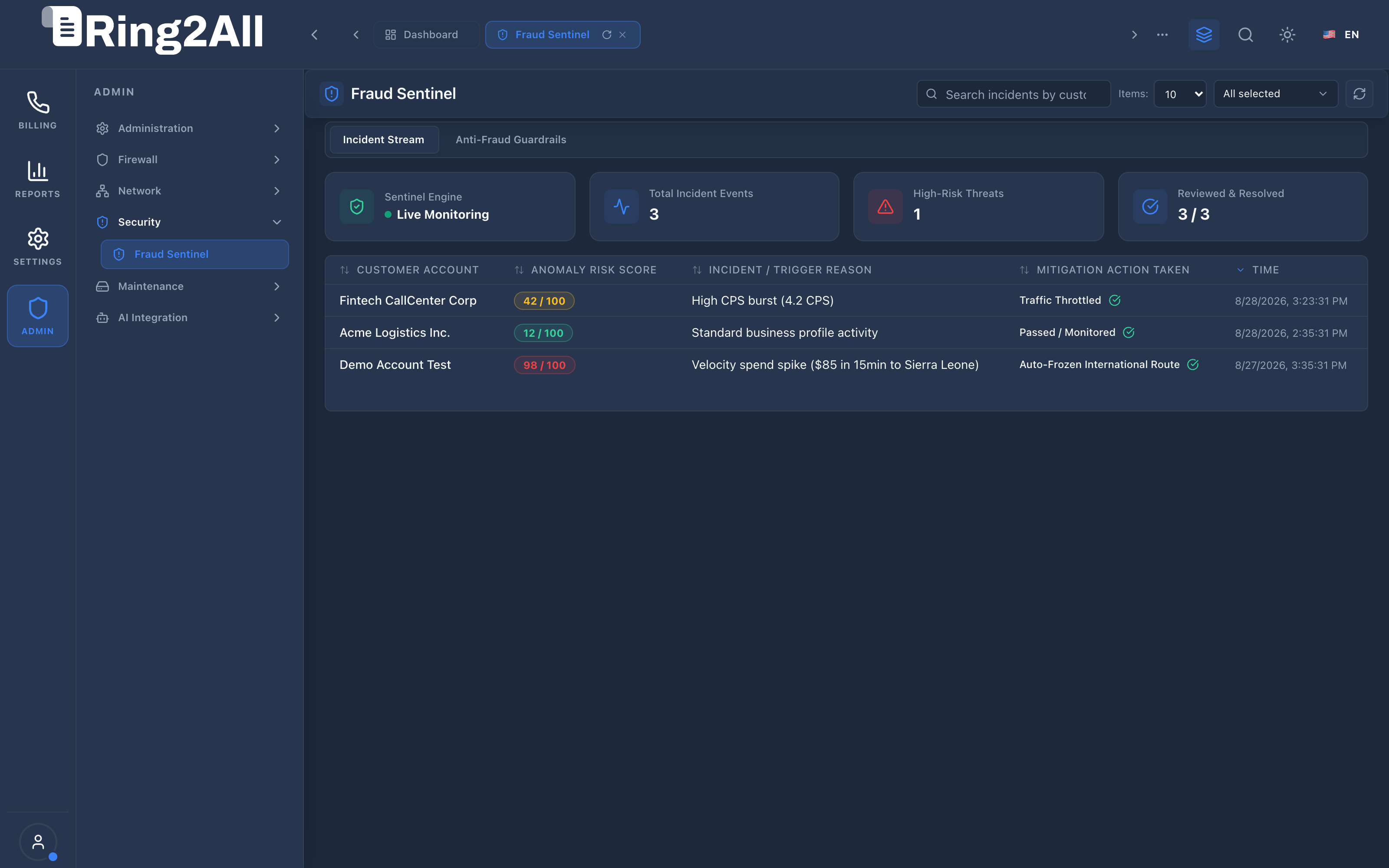
The Incident Stream displays high-level operational telemetry alongside a forensic data grid:
- Metric Cards:
- Sentinel Engine: Real-time operational state (Live Monitoring active).
- Total Incident Events: Aggregated count of flagged traffic anomalies.
- High-Risk Threats: Active incidents with anomaly scores equal to or exceeding 70/100.
- Reviewed & Resolved: Ratio of incidents investigated and resolved by operations staff.
- Forensic Table Fields:
Customer Account: Identifies the affected organization, tenant, or SIP trunk.Anomaly Risk Score: Color-coded badge displaying calculated risk (Green: Low, Amber: Medium, Red: Critical).Incident / Trigger Reason: Granular rationale (e.g., “Velocity spend spike ($85 in 15min to Sierra Leone)”).Mitigation Action Taken: Automated action enforced (e.g., “Auto-Frozen International Route”).Time: Timestamp of the detection event.Resolve Action: Quick-action button allowing operators to review and mark incidents as resolved.
4.2 Anti-Fraud Guardrails Management
Section titled “4.2 Anti-Fraud Guardrails Management”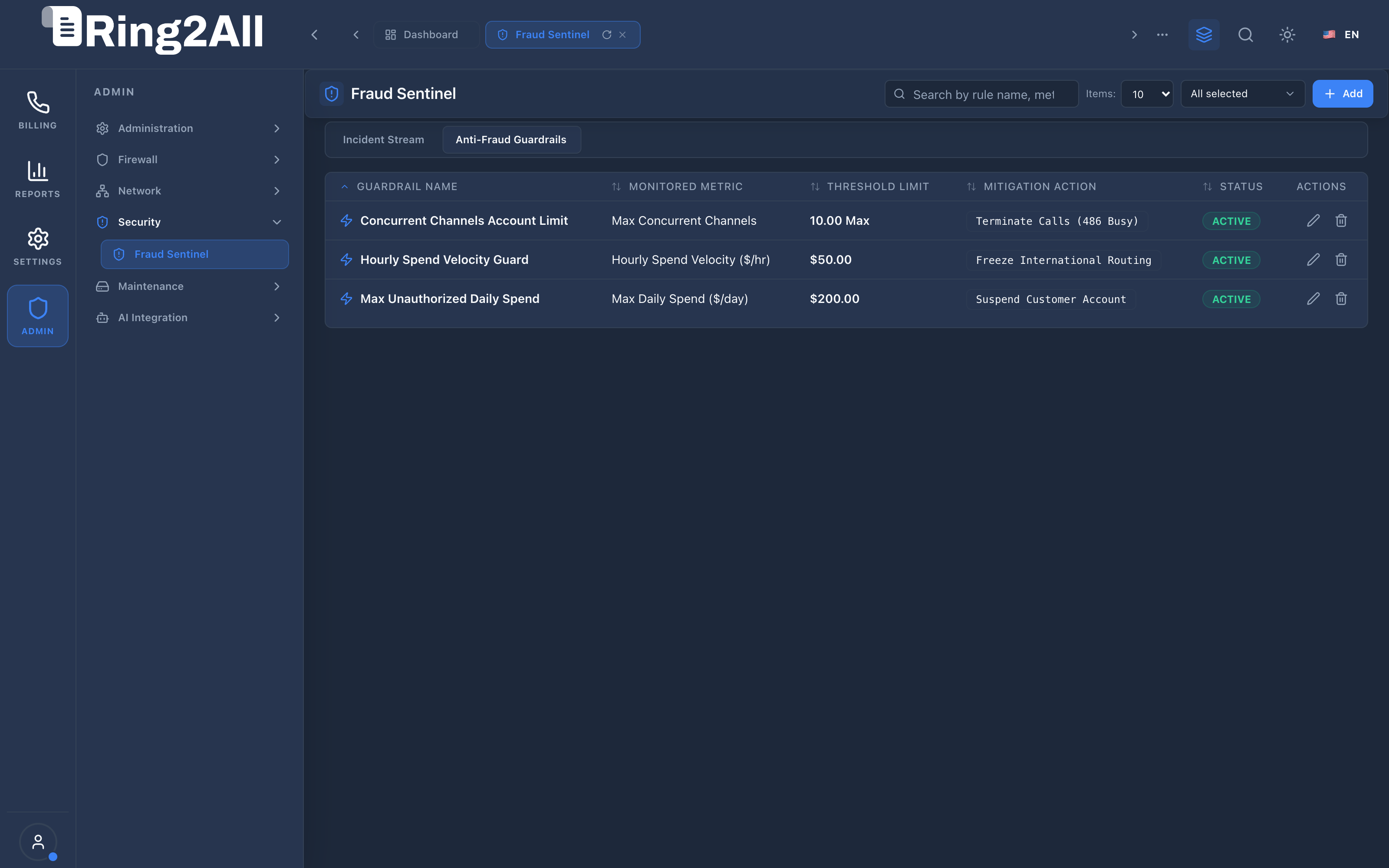
The Anti-Fraud Guardrails tab provides policy lifecycle administration:
- Guardrail Listing: Presents all active policies, monitored metrics (e.g., Max Concurrent Channels, Hourly Spend Velocity, Max Daily Spend), threshold limits, automated mitigation actions, and activation switches.
- Quick Actions: Edit existing thresholds or delete outdated guardrails with standard confirmation prompts.
4.3 Add Guardrail Modal
Section titled “4.3 Add Guardrail Modal”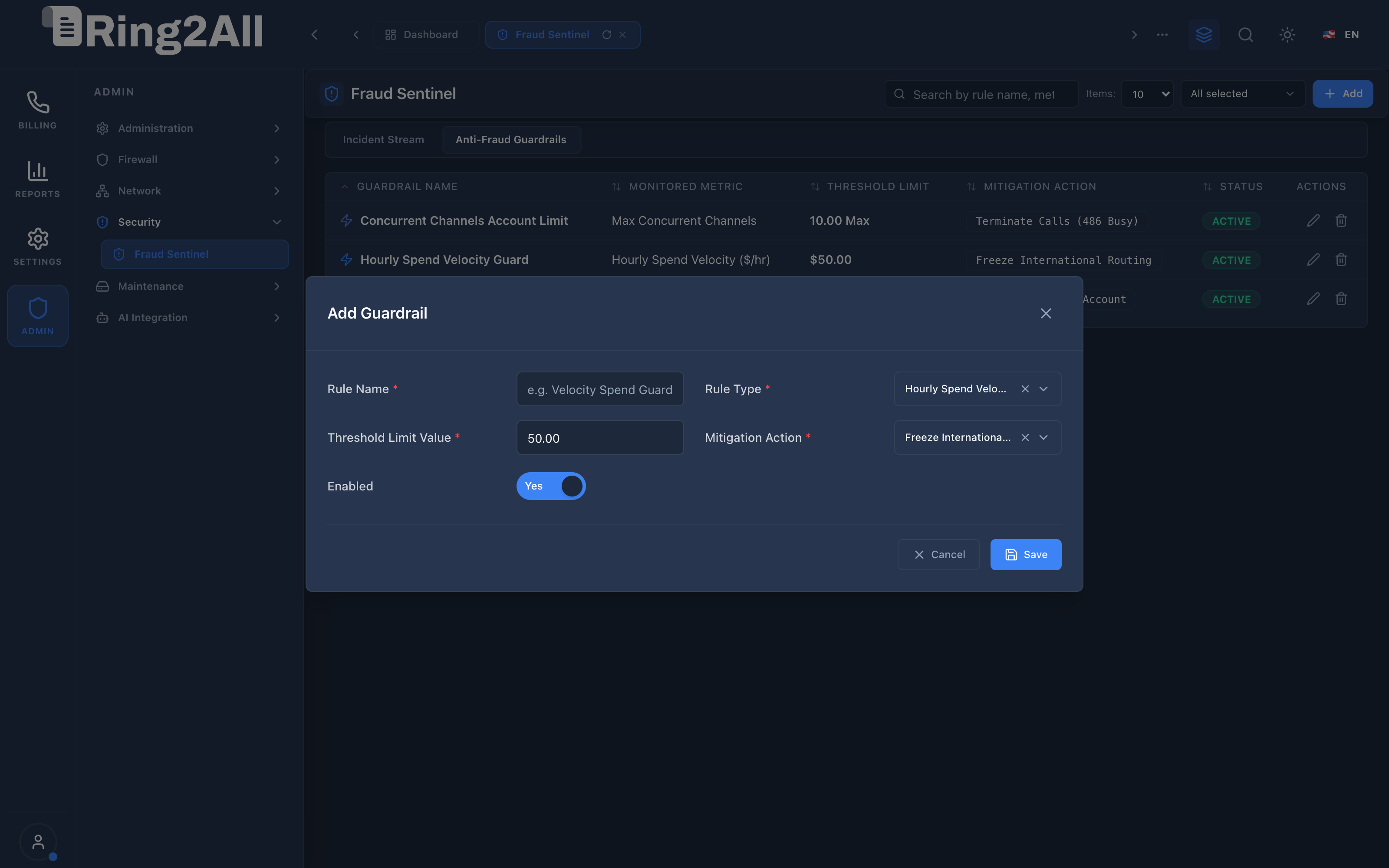
Clicking the + Add button opens the Add Guardrail modal:
- Rule Name: Descriptive title (e.g.,
Hourly Spend Velocity Guard). - Rule Type: Selects the monitored metric:
Spend Velocity ($/hr)Max Concurrent CallsMax Daily Spend ($/day)
- Threshold Limit Value: Numeric trigger limit (e.g.,
50.00). - Mitigation Action: Action executed automatically upon breach:
Terminate Calls (486 Busy)Freeze International RoutingSuspend Customer Account
- Enabled Switch: Active/inactive status toggle.
5. Architectural Flow & Security Governance
Section titled “5. Architectural Flow & Security Governance” ┌─────────────────┐ ┌─────────────────┐ ┌─────────────────┐ │ Incoming Call / │ │ OCS Rating │ │ Sentinel Rule │ │ CDR Mediation │──────▶│ Engine Core │──────▶│ Evaluation │ └─────────────────┘ └─────────────────┘ └────────┬────────┘ │ ┌────────────────────────┴────────────────────────┐ │ Threshold Exceeded? │ ▼ ▼ [ NO - Normal ] [ YES - Anomaly ] │ │ ▼ ▼ Proceed to Carrier Trunk 1. Execute Mitigation Action 2. Write public.fraud_logs 3. Notify Security Team- Ingress Call Valuation: As active SIP channels establish or rated CDRs generate, the OCS continuously computes cumulative spend velocity and active channel volume.
- Deterministic Guardrail Checking: The Sentinel worker checks current metrics against active rules in
public.fraud_rules. - Automated Containment: If a threshold is exceeded, the database issues signaling commands to Telephony Server or the SBC perimeter to drop calls or block subsequent INVITE messages.
- Audit Record Persistence: Details of the breach, including time, affected numbers, and containment codes, are written to
public.fraud_logs.
6. Common Scenarios & Operational Playbooks
Section titled “6. Common Scenarios & Operational Playbooks”Playbook A: Mitigating an Overnight International Toll Fraud Burst
Section titled “Playbook A: Mitigating an Overnight International Toll Fraud Burst”- Detection: Sentinel flags a customer account with an anomaly score of
98/100due to a sudden$85spend in 15 minutes directed towards high-cost African destinations. - Autonomous Action: Sentinel invokes
Freeze International Routing. Domestic and inbound calls continue uninterrupted, while high-risk outbound international calls are blocked. - NOC Verification: In the Incident Stream, the NOC engineer inspects the trigger reason and verifies with the customer whether this was legitimate traffic.
- Resolution: If the customer confirms unauthorized usage, the customer credentials are reset, and the NOC engineer marks the incident as Reviewed & Cleared.
Playbook B: Adding a Global Channel Ceiling for New Accounts
Section titled “Playbook B: Adding a Global Channel Ceiling for New Accounts”- Navigate to Security > Fraud Sentinel > Anti-Fraud Guardrails.
- Click + Add.
- Set Rule Name to
Max Concurrent Channels Baseline. - Set Rule Type to
Max Concurrent Calls. - Enter Threshold Limit Value as
10.00. - Select Mitigation Action as
Terminate Calls (486 Busy). - Click Save. Any call attempts beyond 10 concurrent channels are immediately released with
486 Busy.
7. Troubleshooting & Diagnostic Commands
Section titled “7. Troubleshooting & Diagnostic Commands”Inspecting Recent Fraud Incidents via SQL
Section titled “Inspecting Recent Fraud Incidents via SQL”SELECT l.id, c.name AS customer_name, l.rule_name, l.severity, l.anomaly_score, l.action_taken, l.resolved, l.created_atFROM public.fraud_logs lLEFT JOIN public.customers c ON c.id = l.customer_idORDER BY l.created_at DESCLIMIT 10;Checking Active Fraud Guardrails
Section titled “Checking Active Fraud Guardrails”SELECT id, name, rule_type, threshold_value, action, is_activeFROM public.fraud_rulesORDER BY id ASC;Manually Resolving an Incident via Terminal
Section titled “Manually Resolving an Incident via Terminal”curl -k -X POST https://192.168.10.29/api/fraud/logs/3/resolve \ -H "Authorization: Bearer <API_TOKEN>" \ -H "Content-Type: application/json"8. Model Context Protocol (MCP) AI Integration
Section titled “8. Model Context Protocol (MCP) AI Integration”The Fraud Sentinel module connects directly to the Ring2All BSS MCP Server, providing anti-fraud analysts and automated AI copilots with tools to query active alerts, evaluate risk velocity, and mark resolved incidents.
Available MCP Tools
Section titled “Available MCP Tools”| Tool Name | Access Role | Description & Primary Function | Example Arguments |
|---|---|---|---|
list_fraud_alerts |
Super Administrator / NOC |
Lists real-time fraud alerts and velocity violations detected by the Fraud Sentinel engine. | {"resolved": false, "limit": 10} |
resolve_fraud_alert |
Super Administrator |
Marks an active fraud incident alert as resolved with remediation notes. | {"alertId": 3, "resolutionNotes": "Verified customer campaign; raised limit."} |
Sample MCP Tool Execution: list_fraud_alerts
Section titled “Sample MCP Tool Execution: list_fraud_alerts”Request Payload
Section titled “Request Payload”{ "name": "list_fraud_alerts", "arguments": { "resolved": false, "limit": 5 }}Response Payload
Section titled “Response Payload”[ { "id": 3, "ruleName": "Rapid International Velocity Guard", "ruleType": "hourly_cost_limit", "severity": "CRITICAL", "anomalyScore": 92, "actionTaken": "SUSPEND_ACCOUNT", "resolved": false, "customer": { "id": 1, "name": "Rodrigo Cuadra", "company": "Cuadra Telecom Corp" }, "createdAt": "2026-09-09T04:22:15Z" }]Conversational AI Prompts for Copilot
Section titled “Conversational AI Prompts for Copilot”- “List all unresolved critical fraud alerts detected by Fraud Sentinel.”
- “Show detailed telemetry for fraud alert ID 3.”
- “Resolve fraud alert 3 with notes ‘False positive confirmed by customer’.”
9. Glossary
Section titled “9. Glossary”- IRSF (International Revenue Share Fraud): An organized telecommunications fraud scheme where attackers artificially inflate traffic volumes to premium-rate international telephone numbers.
- Spend Velocity: The rate of monetary consumption over a designated period (e.g., dollars consumed per 60-minute rolling window).
- Mitigation Action: The automated defensive command executed upon policy violation, including call termination, route freezing, or complete trunk suspension.
- Anomaly Score: An algorithmic confidence index (1–100) indicating the statistical deviation of an observed calling pattern from normal operational baselines.
- Model Context Protocol (MCP): Open protocol standard that enables secure, controlled integration between Large Language Models and external tools, databases, and telecom rating engines.