
Connection & Node Architecture
📖 Introduction
Section titled “📖 Introduction”The Connection settings module controls the underlying networking topology connecting the Switchboard web client, the backend Fastify telemetry API (softswitch-monitoring-api), and the core Ring2All telephony engines (Telephony Event Socket (ESL) and PostgreSQL).
The architecture supports both Single-Server Standalone Installations and Multi-Node Distributed Deployments, enabling organizations to scale operator consoles independently of media gateways and database clusters.
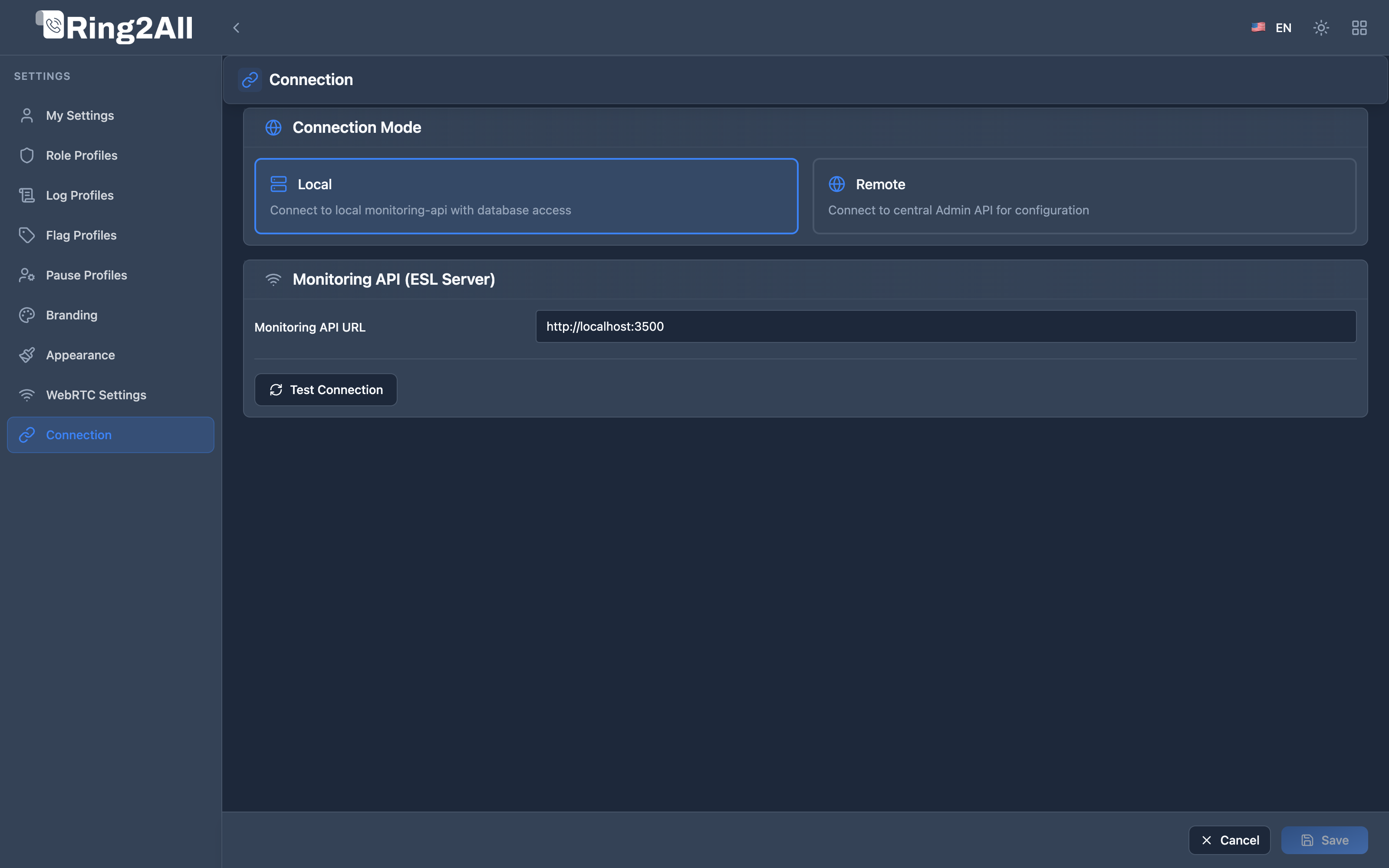
🏗️ Operational Connection Modes
Section titled “🏗️ Operational Connection Modes”| Mode | Topology Type | Network Architecture | Primary Use Case |
|---|---|---|---|
| Local Mode | Embedded PBX | Switchboard web frontend and monitoring-api run on the same physical or virtual server as Telephony Server. Communicates via Unix sockets or 127.0.0.1. |
Small-to-medium single-server deployments, branch office appliances, and lab testing. |
| Remote Mode | Distributed Cluster | The Switchboard operator cluster runs on dedicated web edge nodes, communicating with a central Ring2All SoftSwitch cluster over secure HTTPS/WSS APIs. | Enterprise call centers, MSP multi-tenant clouds, high-availability clusters. |
graph TD
    subgraph Edge Layer
        Operator[Operator Workstation] -->|HTTPS / WSS| WebNode[Switchboard Web Node]
    end

    subgraph Service Layer
        WebNode -->|REST / WebSocket| MonAPI[Monitoring API :3500]
        MonAPI -->|Admin REST API| AdminAPI[Ring2All Admin API :3000]
    end

    subgraph Telephony Core
        MonAPI -->|ESL TCP 8021| FS[Ring2All Telephony Engine]
        MonAPI -->|PostgreSQL 5432| DB[(Ring2All Database)]
        AdminAPI -->|PostgreSQL 5432| DB
    end
🔌 API Endpoints & Authentication
Section titled “🔌 API Endpoints & Authentication”1. SoftSwitch Admin API (Remote Mode)
Section titled “1. SoftSwitch Admin API (Remote Mode)”In distributed environments, the Switchboard node delegates tenant authentication, billing validation, and user directory queries to the central SoftSwitch API:
- Admin API URL: The FQDN of the primary management cluster (e.g.,
https://pbx.ring2all.com). - API Token: A high-privilege application bearer token generated under PBX Administration > Application Keys.
- Connection Status: Real-time health badge (
Connected,Disconnected, orError). - Test Connection: Triggers an on-demand HTTPS handshake verifying token validity and API reachability.
2. Monitoring Telemetry API
Section titled “2. Monitoring Telemetry API”The telemetry service (monitoring-api) bridges low-level Telephony Event Socket (ESL) events into real-time WebSockets:
- Monitoring API URL: Default:
http://localhost:3500(Local Mode) or secure public endpointhttps://monitoring.company.com. - API Token: Optional mutual authentication token securing internal event bus endpoints.
- Diagnostics: Displays instantaneous ping latency and database pool connectivity.
🩺 Diagnostic Health Checks & Reconnection Policies
Section titled “🩺 Diagnostic Health Checks & Reconnection Policies”The console enforces intelligent resilience policies to survive network blips:
- Automatic Reconnection Backoff: If a network interruption occurs, the WebSocket engine attempts reconnection using an exponential backoff curve (
1s,2s,5s,10s,30s). - State Re-Synchronization: Upon reconnection, the client automatically executes an ESL snapshot fetch to reconcile any channel terminations or new incoming calls that occurred while offline.
- Last Checked Timestamp: Displays the exact timestamp of the last successful health check ping.