

SIP Manipulation Rules (SMR)
Table of Contents
Section titled “Table of Contents”- Overview & Transformation Architecture
- Business & Operational Significance
- 🎯 User Roles & Key Capabilities
- Visual Interface & Layout
- Field Reference & Rule Parameters
- Transformation Engine Mechanics & PCRE Processing
- Standard Enterprise Use Cases
- Troubleshooting & Verification
- Model Context Protocol (MCP) AI Integration
- Glossary
1. Overview & Transformation Architecture
Section titled “1. Overview & Transformation Architecture”In Ring2All SBC, the SIP Manipulation Rules (SMR) module provides a powerful regular expression transformation engine for modifying, sanitizing, injecting, and stripping SIP headers and URIs in real time. Because different telecom carriers, PBX manufacturers, and softswitches interpret RFC 3261 standards with minor discrepancies, SMR bridges interoperability gaps dynamically without modifying core source code.
Incoming SIP Packet SMR Transformation Pipeline Outbound SIP Packet┌──────────────────────────┐ ┌─────────────────────────────┐ ┌──────────────────────────┐│ INVITE sip:+14155552671 │ │ 1. Match Target Header │ │ INVITE sip:14155552671 ││ From: "Alice" <sip:2000> │────► SMR ──►│ 2. Evaluate PCRE Regex │───► Outbound ─► From: "Alice" <sip:2000> ││ To: <sip:+14155552671> │ │ 3. Apply Replacement Pattern│ │ X-Tenant-ID: ring2all-01 ││ Contact: ... │ │ 4. Order by Execution Index │ │ Privacy: id │└──────────────────────────┘ └─────────────────────────────┘ └──────────────────────────┘Rules can target the Request-URI (R-URI), standard identity headers (From, To, Contact), diversion headers (Diversion, History-Info), authentication privacy headers (P-Asserted-Identity, Remote-Party-ID), or custom proprietary headers (X-Carrier-*).
2. Business & Operational Significance
Section titled “2. Business & Operational Significance”- Carrier Protocol Interoperability: Resolves vendor-specific incompatibilities (e.g., stripping the leading
+for legacy carriers that only accept digits, or injecting technical routing prefixes). - Identity & Privacy Compliance: Masks caller identification (
Anonymous) while preserving cryptographically asserted identities for emergency services and lawful intercept compliance. - Carrier Billing Attribution: Injects custom metadata headers (e.g.,
X-Tenant-ID,X-Account-Code) to allow downstream wholesale carrier switches to categorize and bill traffic accurately. - Dialed Number Normalization: Converts local 7-digit or 10-digit national numbers into globally recognized E.164 formats before hitting least-cost routing tables.
3. 🎯 User Roles & Key Capabilities
Section titled “3. 🎯 User Roles & Key Capabilities”| Role | Primary Use Case | Key Capabilities |
|---|---|---|
| SIP Interoperability Specialist | Vendor Dialplan Normalization | Author PCRE regex rules, test URI transformations, and align SIP headers with third-party carrier specifications. |
| Carrier Onboarding Engineer | Trunk Header Customization | Inject mandatory carrier authorization tokens and custom billing headers on egress trunk routes. |
| Security & Privacy Compliance Officer | Caller ID & CLI Masking | Enforce caller privacy regulations by stripping PAI or rewriting From display headers on outbound calls. |
| SBC Administrator | Execution Order Governance | Prioritize manipulation rule sequences and audit active header transformation filters. |
| AI Protocol Engineer / Interoperability Copilot | Regex Testing & Rule Synthesis | Synthesize PCRE regex patterns, validate SIP header manipulation rules, and dynamically apply transformations via MCP. |
4. Visual Interface & Layout
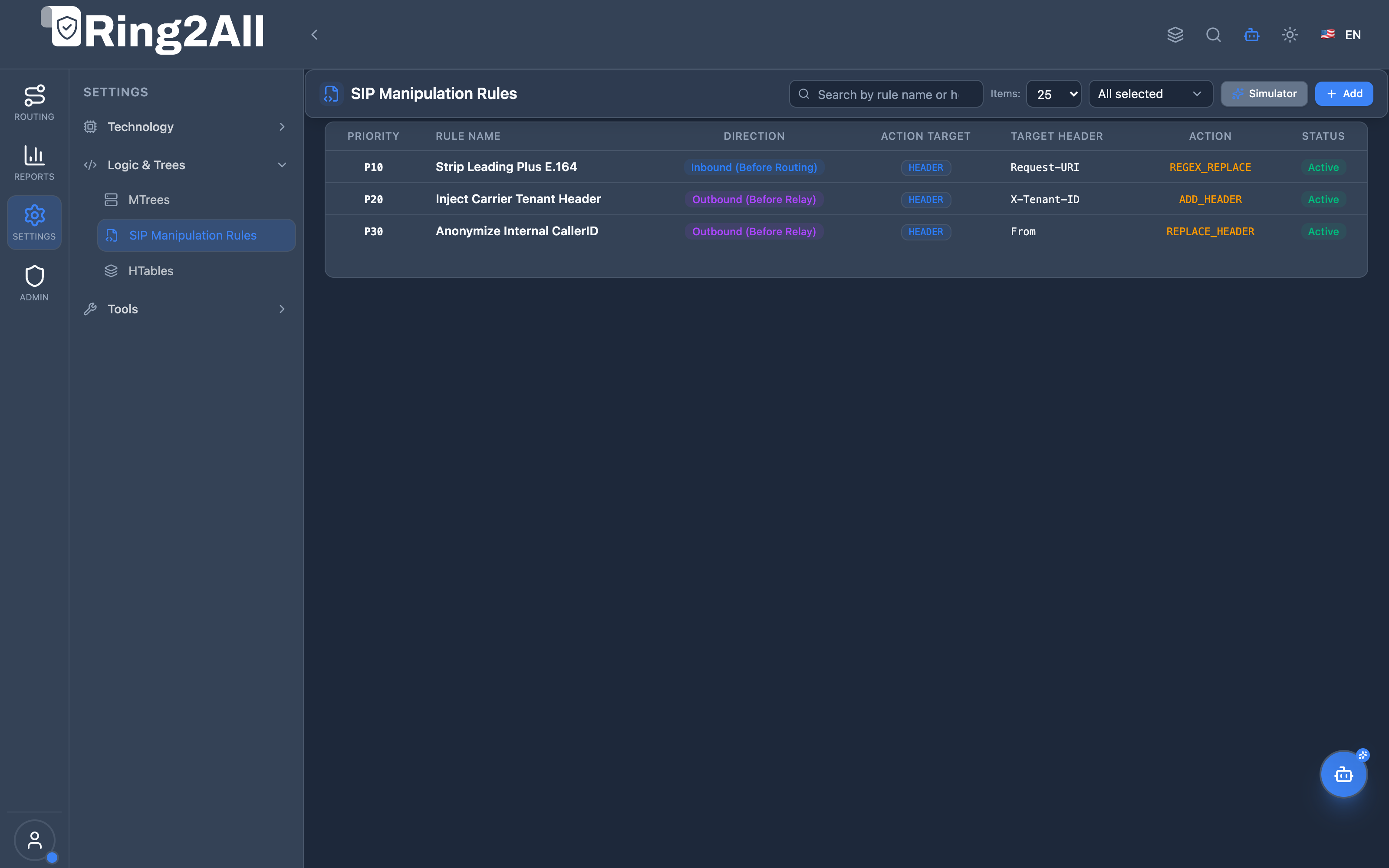
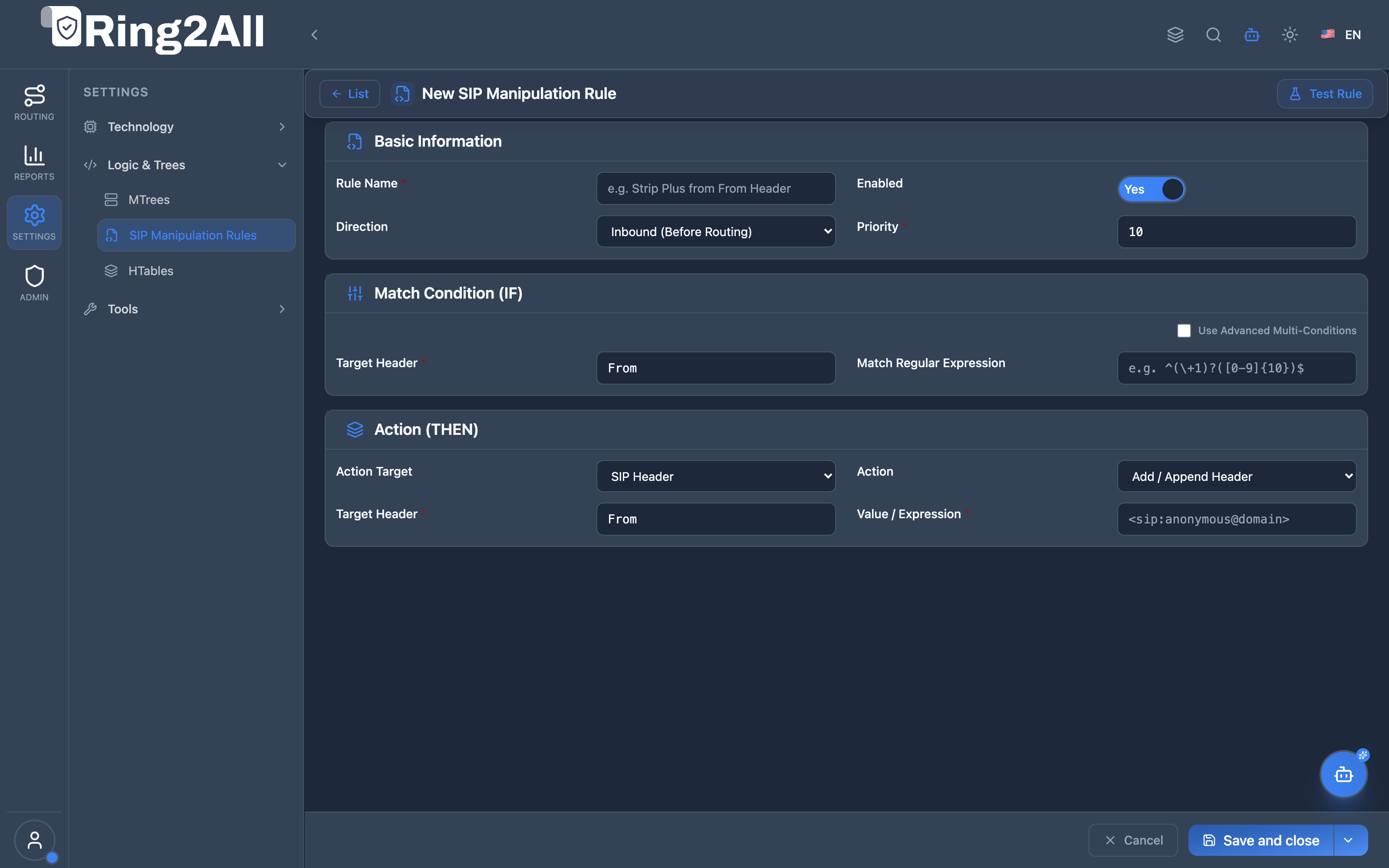
Section titled “4. Visual Interface & Layout”The SMR interface provides a list of configured transformation rules with their target headers, match patterns, and execution priorities, along with a modal editor for creating and updating rules.
4.1 SIP Manipulation Rules List View
Section titled “4.1 SIP Manipulation Rules List View”Displays all registered transformation rules, targets, direction, priority order, and operational status.
4.2 SMR Configuration Form
Section titled “4.2 SMR Configuration Form”Modal editor for defining target headers, PCRE regex patterns, replacement expressions, and directionality.
5. Field Reference & Rule Parameters
Section titled “5. Field Reference & Rule Parameters”| Parameter Name | Data Type | Options / Format | Description |
|---|---|---|---|
| Rule Name | String | Text (e.g., Strip Leading Plus E.164) |
Descriptive label explaining the intent of the manipulation rule. |
| Target Header / URI | Select | Request-URI, From, To, PAI, Custom |
The specific SIP header or message part evaluated by this rule. |
| Header Name | String | X-Tenant-ID (Conditional) |
Specific header name when Target is set to Custom Header. |
| Direction | Select | Inbound, Outbound, Both |
Traffic flow where the rule executes: upon receiving a packet or before relaying it. |
| Match Regex (PCRE) | String | ^\+([0-9]+)$ |
Perl-Compatible Regular Expression (PCRE) matched against the target string. |
| Replacement String | String | $1 or tenant-prod-100 |
Replacement pattern. Supports backreferences ($1, $2) to capture groups. |
| Execution Priority | Integer | 1 to 100 (Default 50) |
Processing order. Rules with lower numbers execute first. |
| Rule Status | Switch | Active / Disabled |
Toggle to enable or disable the rule without deleting it from the database. |
6. Transformation Engine Mechanics & PCRE Processing
Section titled “6. Transformation Engine Mechanics & PCRE Processing”Under the hood, SMR executes using Kamailio’s textops, textopsx, and uac modules:
# SMR Execution Flow in Kamailio routing scriptroute[APPLY_OUTBOUND_SMR] {    # Rule 10: Strip leading '+' from Request-URI    if ($rU =~ "^\+([0-9]+)$") {        $rU = $(rU{s.substr,1,0});        xlog("L_INFO", "[SMR] Stripped leading +: new R-URI=$rU\n");    }
    # Rule 20: Inject X-Tenant-ID Header    if (!is_present_hf("X-Tenant-ID")) {        append_hf("X-Tenant-ID: ring2all-prod\r\n");    }
    # Rule 30: Anonymize Caller ID if privacy requested    if ($hdr(Privacy) == "id") {        uac_replace_from("Anonymous", "sip:anonymous@anonymous.invalid");    }}
Because transformations operate directly on message buffers in shared memory, rule evaluation introduces zero measurable latency.
7. Standard Enterprise Use Cases
Section titled “7. Standard Enterprise Use Cases”Case 1: Strip Leading Plus (+) for Legacy Trunks
Section titled “Case 1: Strip Leading Plus (+) for Legacy Trunks”- Target:
Request-URI - Direction:
Outbound - Match Regex:
^\+([0-9]+)$ - Replacement:
$1 - Result:
+14155552671becomes14155552671.
Case 2: Inject Carrier Account Metadata
Section titled “Case 2: Inject Carrier Account Metadata”- Target:
Custom Header(X-Carrier-Account) - Direction:
Outbound - Match Regex:
.* - Replacement:
ACCT-99201 - Result: Injects
X-Carrier-Account: ACCT-99201\r\ninto the SIP request before dispatching to the carrier.
Case 3: Caller ID Anonymization for Outbound Calls
Section titled “Case 3: Caller ID Anonymization for Outbound Calls”- Target:
From Header - Direction:
Outbound - Match Regex:
^"?(.*?)"?\s*<sip:.*@(.*)>$ - Replacement:
"Anonymous" <sip:anonymous@anonymous.invalid> - Result: Masks the caller’s true display name and telephone number while preserving the internal Call-ID.
8. Troubleshooting & Verification
Section titled “8. Troubleshooting & Verification”Validating Transformations via SIP Tracing
Section titled “Validating Transformations via SIP Tracing”Capture live SIP packets using the SIP Traces & Diagnostics module (sip-traces) to confirm that headers are correctly rewritten on egress:
# Verify headers on outbound trunk interfacegrep -E "(X-Tenant-ID|From:|To:|INVITE)" /var/log/kamailio.logHot-Reloading Manipulation Rules via RPC
Section titled “Hot-Reloading Manipulation Rules via RPC”smr.reload9. Model Context Protocol (MCP) AI Integration
Section titled “9. Model Context Protocol (MCP) AI Integration”The Smart Message Routing & SIP Manipulation Rules (SMR) module integrates with the Model Context Protocol (MCP) to allow diagnostic agents to query active header modification rules, inspect regex match conditions, create new header mutations, and safely remove obsolete rules.
Available MCP Tools
Section titled “Available MCP Tools”| Tool Name | Operation Type | Risk Level | Description |
|---|---|---|---|
list_smr_rules |
Status Query | read |
List all SIP Manipulation rules (header transformations, regex filters, directions, and priorities). |
get_smr_rule_status |
Detailed Audit | read |
Get configuration, regex matching, and header actions of a specific SMR rule. |
create_smr_rule |
Configuration Mutation | operational |
Create a new SIP header manipulation rule in Kamailio (e.g. rewrite PAI, strip custom headers). |
delete_smr_rule |
Configuration Deletion | operational |
Delete a SIP manipulation rule and regenerate Kamailio SMR routing drop-in configuration. |
Tool Schemas & Payloads
Section titled “Tool Schemas & Payloads”1. list_smr_rules
Section titled “1. list_smr_rules”Input Schema
Section titled “Input Schema”{ "type": "object", "properties": { "direction": { "type": "string", "enum": ["inbound", "outbound", "both"], "description": "Filter by message direction." }, "status": { "type": "string", "enum": ["active", "disabled"], "description": "Filter by operational status." } }}Output Payload Example
Section titled “Output Payload Example”{ "success": true, "data": { "totalRules": 2, "rules": [ { "id": 1, "name": "Strip Leading Plus", "direction": "outbound", "matchHeader": "Request-URI", "matchRegex": "^\\+([0-9]+)$", "actionType": "modify", "actionValue": "$1", "priority": 10, "status": "active" }, { "id": 2, "name": "Inject Carrier Token", "direction": "outbound", "matchHeader": "X-Carrier-Token", "matchRegex": ".*", "actionType": "add", "actionValue": "SEC-TOKEN-9982", "priority": 20, "status": "active" } ] }}2. create_smr_rule
Section titled “2. create_smr_rule”Input Schema
Section titled “Input Schema”{ "type": "object", "properties": { "name": { "type": "string", "description": "Descriptive rule name (e.g. 'Strip X-Call-ID', 'Normalize E164 CLI')." }, "direction": { "type": "string", "enum": ["inbound", "outbound", "both"], "description": "Direction to apply rule." }, "matchHeader": { "type": "string", "description": "Target SIP Header (e.g. 'P-Asserted-Identity', 'X-Account-ID', 'From')." }, "matchRegex": { "type": "string", "description": "Regex pattern to match or extract (e.g. '.*', '^\\+?1([0-9]{10})$')." }, "actionType": { "type": "string", "enum": ["add", "remove", "modify", "strip_prefix"], "description": "Action to perform on the header." }, "actionValue": { "type": "string", "description": "New value or replacement expression." }, "priority": { "type": "number", "description": "Rule evaluation order (default: 10). Lower number runs first." } }, "required": ["name", "direction", "matchHeader", "actionType"]}Output Payload Example
Section titled “Output Payload Example”{ "success": true, "data": { "message": "SMR rule created successfully and Kamailio configuration reloaded.", "ruleId": 3 }}Natural Language AI Prompts
Section titled “Natural Language AI Prompts”English Examples
Section titled “English Examples”- “List all outbound SIP manipulation rules currently active on the SBC.”
- “Create an outbound SMR rule to strip the leading plus from Request-URI for legacy carrier trunks.”
- “Inspect the configuration and regex pattern of SMR rule ID 1.”
Spanish Examples (Español)
Section titled “Spanish Examples (Español)”- “Lista todas las reglas de manipulación SIP salientes actualmente activas en el SBC.”
- “Crea una regla SMR saliente para eliminar el signo más inicial del Request-URI para troncales carrier legadas.”
- “Inspecciona la configuración y el patrón regex de la regla SMR con ID 1.”
Enterprise Safeguards & Access Governance
Section titled “Enterprise Safeguards & Access Governance”- PCRE Syntax Guardrails: Regular expressions are syntax-checked prior to injection to prevent Kamailio routing script parse crashes.
- Automatic Configuration Regeneration: The
create_smr_ruletool writes drop-in configuration to/etc/kamailio/smr_rules.cfgand executeskamcmd core.reloadatomically. - Role Authorization: Rule creation and deletion require
noc_network_engineerorsbc_system_adminprivileges.
10. Glossary
Section titled “10. Glossary”- SMR (SIP Manipulation Rules): A rule-based framework for parsing and modifying SIP headers and message components in real time.
- PCRE (Perl-Compatible Regular Expressions): A standardized regular expression library providing advanced pattern matching and capture group substitution.
- Request-URI (R-URI): The first line of a SIP request indicating the destination user, host, and port where the request is being addressed.
- Backreference: A regular expression feature allowing parts of a matched string (
$1,$2) to be reused inside the replacement expression.