

Hash Tables (HTables)
Table of Contents
Section titled “Table of Contents”- Overview & In-Memory Key-Value Architecture
- Business & Operational Significance
- 🎯 User Roles & Key Capabilities
- Visual Interface & Layout
- Field Reference & Entry Parameters
- Kamailio
htableScript Mechanics & Syntax - Security & Rate Limiting Integration
- Troubleshooting & Verification
- Model Context Protocol (MCP) AI Integration
- Glossary
1. Overview & In-Memory Key-Value Architecture
Section titled “1. Overview & In-Memory Key-Value Architecture”In Ring2All SBC, the Hash Tables (HTables) module provides high-speed, in-memory key-value data structures held directly inside Kamailio shared memory (shm). Powered by the native htable module, HTables enable real-time state caching, atomic counter increments, dynamic time-to-live (TTL) expiration, and perimeter security tracking without querying persistent disk storage or external databases.
Incoming SIP Request (e.g. 192.168.11.199) │ ▼┌────────────────────────────────────────────────────────┐│ Kamailio Shared Memory (shm) ││ ││ ┌────────────────────────────────────────────────┐ ││ │ Table: ipban (Auto-expire TTL: 3600s) │ ││ │ • 192.168.11.199 => "pike_flood" (TTL: 1420s) │ │─── Matched -> Drop Immediately (403)│ │ • 10.200.5.88 => "failed_auth" (TTL: 280s) │ ││ └────────────────────────────────────────────────┘ ││ ││ ┌────────────────────────────────────────────────┐ ││ │ Table: reg_throttle (Rate Limiting) │ ││ │ • 2000@domain => 12 attempts (Counter) │ │─── Exceeded -> Reject (429)│ └────────────────────────────────────────────────┘ │└────────────────────────────────────────────────────────┘When coupled with the DMQ (Distributed Message Queue) cluster module, HTables automatically synchronize security bans and registration counters across all SBC nodes in real time.
2. Business & Operational Significance
Section titled “2. Business & Operational Significance”- Sub-Millisecond Anti-Flood Drops: Intercepts abusive IP addresses at the earliest possible routing phase, terminating malicious floods before packet processing burdens the CPU.
- Brute-Force & Password Spray Mitigation: Tracks failed SIP
REGISTERandINVITEauthentication attempts in real time, automatically imposing temporary or permanent bans. - Per-Subscriber Rate Limiting: Maintains atomic transaction counters for call setup attempts, registration frequencies, and concurrent channels without database lock contention.
- Cluster-Wide Threat Defense: Immediately synchronizes detected attackers across all active SBC cluster nodes via DMQ, ensuring that an attacker blocked on Node 1 cannot probe Node 2.
3. 🎯 User Roles & Key Capabilities
Section titled “3. 🎯 User Roles & Key Capabilities”| Role | Primary Use Case | Key Capabilities |
|---|---|---|
| SBC Security Engineer | Threat Remediation & Perimeter Defense | Inspect active IP bans, manually revoke or impose blacklists, and adjust table auto-expiration TTLs. |
| High-Throughput Dialplan Developer | Stateful Routing Logic | Utilize in-memory hash table pseudovariables ($sht) for atomic counters, quotas, and state caching. |
| Anti-Fraud Specialist | Registration Abuse Investigation | Audit registration throttle tables, track abnormal credential probe spikes, and analyze attack vectors. |
| Systems Administrator | Shared Memory Allocation Governance | Monitor hash table bucket sizing, slot utilization, and memory fragmentation via the RPC Console. |
| AI Security Analyst / SOC Automation Agent | Perimeter Threat Mitigation | Query active IP ban hash tables, inject emergency perimeter blocks, revoke false-positive bans, and reload memory tables via MCP. |
4. Visual Interface & Layout
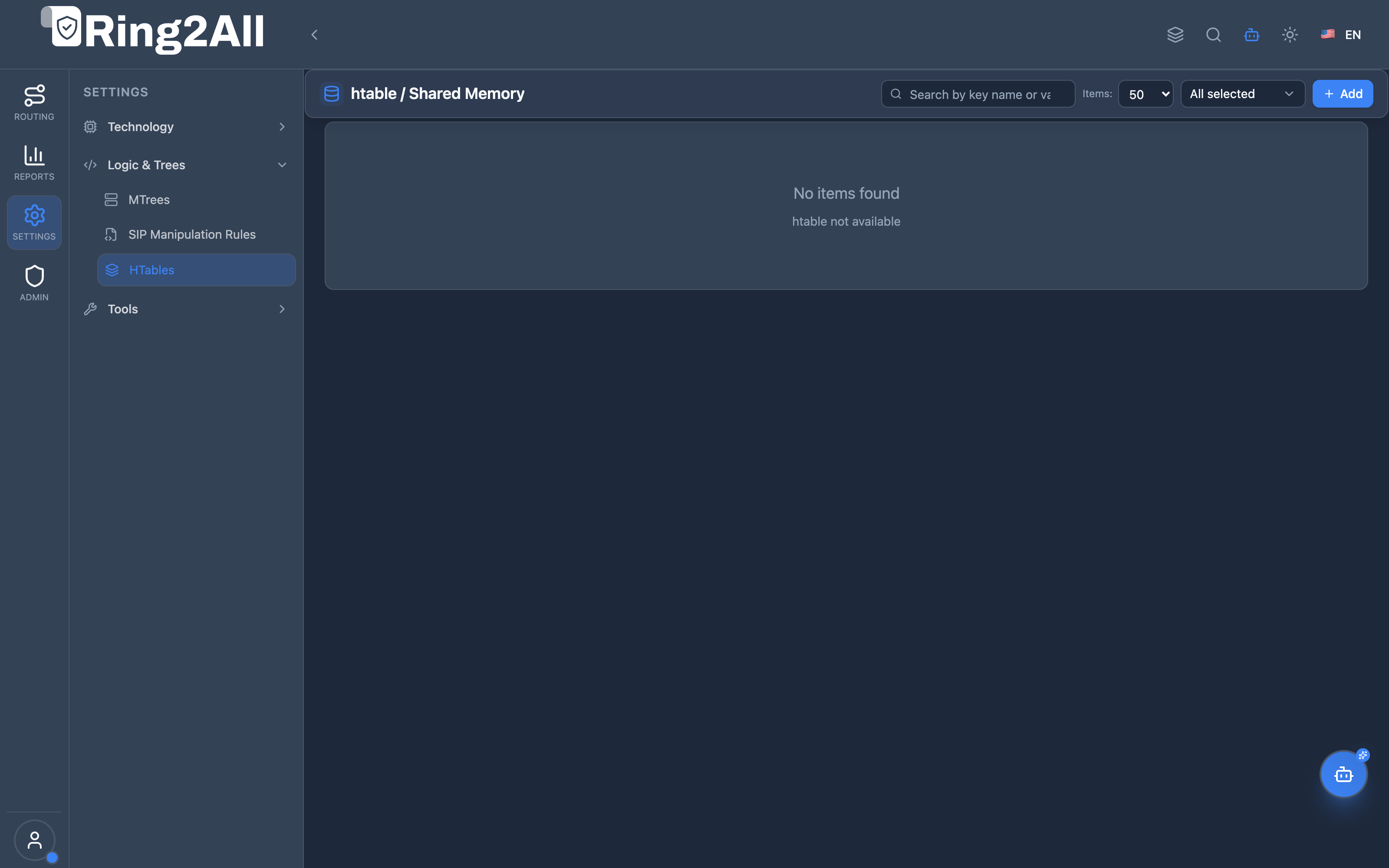
Section titled “4. Visual Interface & Layout”The HTables interface displays all active hash tables, key-value mappings, associated expiration timestamps, and cluster replication indicators.
5. Field Reference & Entry Parameters
Section titled “5. Field Reference & Entry Parameters”| Field Name | Data Type | Default | Description |
|---|---|---|---|
| Table Name | String | ipban |
Name of the defined hash table (e.g., ipban, reg_throttle, active_calls). |
| Key Identifier | String | 192.168.11.199 |
The unique lookup key (e.g., IP address, username, Call-ID, or domain string). |
| Value / Payload | String / Integer | 1 |
Stored data associated with the key (e.g., ban reason, integer counter, or timestamp). |
| TTL Remaining | Seconds / Time | 3420s |
Seconds remaining before the key is automatically purged from memory by Kamailio’s garbage collector. |
| Auto-Expire Flag | Boolean | true |
Indicates whether keys in this table expire automatically according to their configured lifetime. |
| DMQ Replicate | Boolean | true |
Specifies whether updates, additions, or deletions to this entry are broadcast across the DMQ mesh cluster. |
6. Kamailio htable Script Mechanics & Syntax
Section titled “6. Kamailio htable Script Mechanics & Syntax”In the Kamailio routing script, hash tables are accessed using the $sht(table=>key) pseudovariable family:
# Configuration Definition in kamailio.cfgmodparam("htable", "htable", "ipban=>size=12;autoexpire=3600;dmqreplicate=1")modparam("htable", "htable", "reg_throttle=>size=10;autoexpire=60")
route[CHECK_PERIMETER_IPBAN] {    # Check if the source IP address ($si) exists in the ipban table    if ($sht(ipban=>$si) != $null) {        xlog("L_WARN", "[HTABLE] Dropping packet from banned IP: $si (Reason: $sht(ipban=>$si))\n");        sl_send_reply("403", "Forbidden - IP Banned");        exit;    }}
route[RECORD_FAILED_AUTH] {    # Increment failed attempts counter    $shtinc(reg_throttle=>$si);    if ($sht(reg_throttle=>$si) > 5) {        # Ban IP for 1 hour        $sht(ipban=>$si) = "Brute Force Threshold Exceeded";        $shtex(ipban=>$si) = 3600;        xlog("L_ALERT", "[SECURITY] IP $si banned for 3600s due to failed authentications\n");    }}
7. Security & Rate Limiting Integration
Section titled “7. Security & Rate Limiting Integration”HTables serve as the real-time cache for multiple perimeter protection modules:
- Pike Anti-Flood Integration: When Pike detects a packet rate exceeding the threshold (e.g., > 30 requests within 2 seconds), it sets an entry in
$sht(ipban=>$si). - APIBAN Threat Feed Ingestion: Blacklisted IP addresses ingested from APIBAN are populated directly into HTables for instant, zero-latency rejection.
- Session Concurrency Guard: Tracks active calls per domain or subscriber, immediately returning
SIP 486 Busy Hereif a customer exceeds their contracted channel limit.
8. Troubleshooting & Verification
Section titled “8. Troubleshooting & Verification”Inspecting Table Contents via RPC Console
Section titled “Inspecting Table Contents via RPC Console”Dump all keys from the ipban table in the RPC Console:
htable.dump ipbanOutput:
{ "jsonrpc": "2.0", "result": [ { "name": "ipban", "size": 4096, "entries": [ { "key": "192.168.11.199", "value": "pike_flood", "type": "str", "expires": 3412 } ] } ], "id": 1}Manually Removing an IP Ban Entry
Section titled “Manually Removing an IP Ban Entry”To unblock a legitimate customer IP address immediately:
htable.delete ipban 192.168.11.1999. Model Context Protocol (MCP) AI Integration
Section titled “9. Model Context Protocol (MCP) AI Integration”The Hash Tables (HTables) subsystem connects with the Model Context Protocol (MCP) to allow diagnostic and incident-response agents to inspect in-memory tables, dump security ban records, inject temporary blocks, unban whitelisted addresses, and reload memory structures.
Available MCP Tools
Section titled “Available MCP Tools”| Tool Name | Operation Type | Risk Level | Description |
|---|---|---|---|
list_htables |
Status Query | read |
List all defined hash tables in Kamailio shared memory with size and auto-expire policies. |
get_htable_entries |
Content Dump | read |
Dump all active key-value entries from a specific hash table (e.g. ipban, reg_throttle). |
set_htable_entry |
Security Mutation | operational |
Set or update a key-value entry in a Kamailio hash table with optional type definition. |
delete_htable_entry |
Threat Revocation | operational |
Remove an entry or unban an IP from a Kamailio hash table immediately. |
reload_htables |
Operational Reload | operational |
Reload a database-backed hash table into Kamailio shared memory via JSON-RPC. |
Tool Schemas & Payloads
Section titled “Tool Schemas & Payloads”1. list_htables
Section titled “1. list_htables”Input Schema
Section titled “Input Schema”{ "type": "object", "properties": {}}Output Payload Example
Section titled “Output Payload Example”{ "success": true, "data": { "totalTables": 3, "tables": [ { "name": "ipban", "size": 4096, "autoexpire": 3600, "dmqreplicate": true }, { "name": "reg_throttle", "size": 1024, "autoexpire": 60, "dmqreplicate": false }, { "name": "auth_cache", "size": 2048, "autoexpire": 300, "dmqreplicate": false } ] }}2. get_htable_entries
Section titled “2. get_htable_entries”Input Schema
Section titled “Input Schema”{ "type": "object", "properties": { "table_name": { "type": "string", "description": "Name of the hash table to dump (e.g. 'ipban')." } }, "required": ["table_name"]}Output Payload Example
Section titled “Output Payload Example”{ "success": true, "data": { "tableName": "ipban", "totalEntries": 1, "entries": [ { "key": "192.168.11.199", "value": "pike_flood", "type": "str", "expires": 3412 } ] }}3. delete_htable_entry
Section titled “3. delete_htable_entry”Input Schema
Section titled “Input Schema”{ "type": "object", "properties": { "table_name": { "type": "string", "description": "Target hash table (e.g. 'ipban')." }, "key": { "type": "string", "description": "Key or IP to remove from the table (e.g. '192.168.11.199')." } }, "required": ["table_name", "key"]}Output Payload Example
Section titled “Output Payload Example”{ "success": true, "data": { "message": "Key '192.168.11.199' deleted successfully from table 'ipban'.", "rpc_response": "OK" }}Natural Language AI Prompts
Section titled “Natural Language AI Prompts”English Examples
Section titled “English Examples”- “Dump all banned IP addresses currently stored in the ‘ipban’ hash table.”
- “Unban IP address ‘192.168.11.199’ by deleting its entry from the ‘ipban’ table.”
- “List all Kamailio in-memory hash tables and their bucket configurations.”
Spanish Examples (Español)
Section titled “Spanish Examples (Español)”- “Vuelca todas las direcciones IP bloqueadas actualmente en la tabla hash ‘ipban’.”
- “Desbloquea la dirección IP ‘192.168.11.199’ eliminando su entrada de la tabla ‘ipban’.”
- “Lista todas las tablas hash en memoria de Kamailio y sus configuraciones de buckets.”
Enterprise Safeguards & Access Governance
Section titled “Enterprise Safeguards & Access Governance”- Immediate Cluster Propagation: Entry deletions in DMQ-enabled tables are propagated across the cluster to avoid inconsistent state between SBC nodes.
- Type Safety Clamping: Entry value types (
strorint) are explicitly validated prior to JSON-RPC dispatch. - Role Segregation: Unbanning IPs or mutating security tables requires
noc_network_engineerorsbc_system_adminprivileges.
10. Glossary
Section titled “10. Glossary”- HTable (Hash Table): An associative array data structure that stores key-value pairs in memory for $O(1)$ constant-time lookup performance.
- TTL (Time-To-Live): A timer mechanism that automatically deletes an entry from memory after a predetermined duration.
- Atomic Increment (
$shtinc): A thread-safe operation that increases an integer counter without risk of race conditions between worker processes. - DMQ Replication: Automatic synchronization of hash table keys, values, and expiration timers across multiple SBC nodes.