
Users & Identity Governance
Table of Contents
Section titled “Table of Contents”- Overview & Identity Architecture
- Business & Operational Significance
- 🎯 User Roles & Key Capabilities
- Visual Interface & Layout
- Field Reference & User Configuration Parameters
- Cryptographic Security & Session Governance
- The Four-Pillar Access Control Binding
- Troubleshooting & Verification
- Model Context Protocol (MCP) AI Integration
- Glossary
1. Overview & Identity Architecture
Section titled “1. Overview & Identity Architecture”In Ring2All SBC, the Users module provides enterprise-grade identity lifecycle management, zero-trust authentication, and administrative access governance across the session border controller. Every administrative identity in the platform is anchored by an immutable identifier (numeric id and uuid) and governed by an orthogonal access framework that separates UI permissions, audit logging, and artificial intelligence capabilities.
┌─────────────────────────────────────────────────┐ │ USER ACCOUNT │ │ (Auth: Argon2id, JWT, MFA, Multi-Tenant) │ └────────┬────────────────┬────────────────┬──────┘ │ │ │ ┌────────────────▼───┐ ┌─────────▼──────────┐ ┌──▼────────────────┐ │ ROLE PROFILE │ │ LOG PROFILE │ │ MCP TOOL ROLE │ │ (RBAC Modules) │ │ (Audit & Notif.) │ │ (AI Tools RBAC) │ ├────────────────────┤ ├────────────────────┤ ├───────────────────┤ │ • Read / List │ │ • Log Create │ │ • Kamailio RPC │ │ • Create / Insert │ │ • Log Edit │ │ • RTPEngine QoS │ │ • Edit / Update │ │ • Log Delete │ │ • Dispatchers │ │ • Delete / Destroy │ │ • Push / Email Not.│ │ • CDR Telemetry │ └────────────────────┘ └────────────────────┘ └───────────────────┘Authentication credentials are encrypted using the Argon2id password hashing algorithm (64 MB RAM, 3 iterations), offering state-of-the-art resistance against GPU-accelerated brute force attacks and side-channel vulnerabilities.
2. Business & Operational Significance
Section titled “2. Business & Operational Significance”- Zero-Trust Administrative Perimeter: Restricts access to sensitive telecom routing tables, TLS private keys, and Kamailio memory registers to explicitly authenticated and authorized staff.
- Segregation of Duties (SoD): Ensures that network engineers can manage SIP trunks and carriers without granting them permission to alter audit log profiles or generate administrative API keys.
- Non-Repudiation & Audit Attribution: Binds every SIP routing modification, dispatcher reload, or IP unban action directly to a verifiable user account, satisfying telecom compliance mandates (SOX, ISO 27001, PCI-DSS).
- Immutable Identity Governance: Strictly utilizes immutable numeric IDs (
user_id) and UUIDs rather than mutable usernames or slugs, preventing permission inheritance errors and privilege escalation during administrative updates.
3. 🎯 User Roles & Key Capabilities
Section titled “3. 🎯 User Roles & Key Capabilities”| Role | Primary Use Case | Key Capabilities |
|---|---|---|
| SBC Super Administrator | Global Identity & Security Oversight | Provision administrative accounts, assign root role profiles, reset multi-factor credentials, and revoke sessions. |
| NOC Team Lead | Operational Workforce Onboarding | Create operator accounts for Tier-1/2 engineers, assign standard telemetry view roles, and monitor shift logins. |
| Security & Compliance Auditor | Access Governance & Credential Auditing | Inspect inactive accounts, enforce password expiration policies, and verify orthogonal profile allocations. |
| Systems Administrator | Multi-Tenant Partitioning | Assign tenant scopes to accounts, restricting visibility to dedicated carrier trunks and private domain groups. |
| AI Platform Copilot / Administration Agent | Automated Identity Governance & Status Auditing | Programmatically query operator accounts, audit role mappings, verify superuser segregation, and toggle compromised accounts via MCP. |
4. Visual Interface & Layout
Section titled “4. Visual Interface & Layout”The Users interface consists of a centralized DataGrid view showing all platform users and their profile assignments, along with a high-density configuration form for user onboarding.
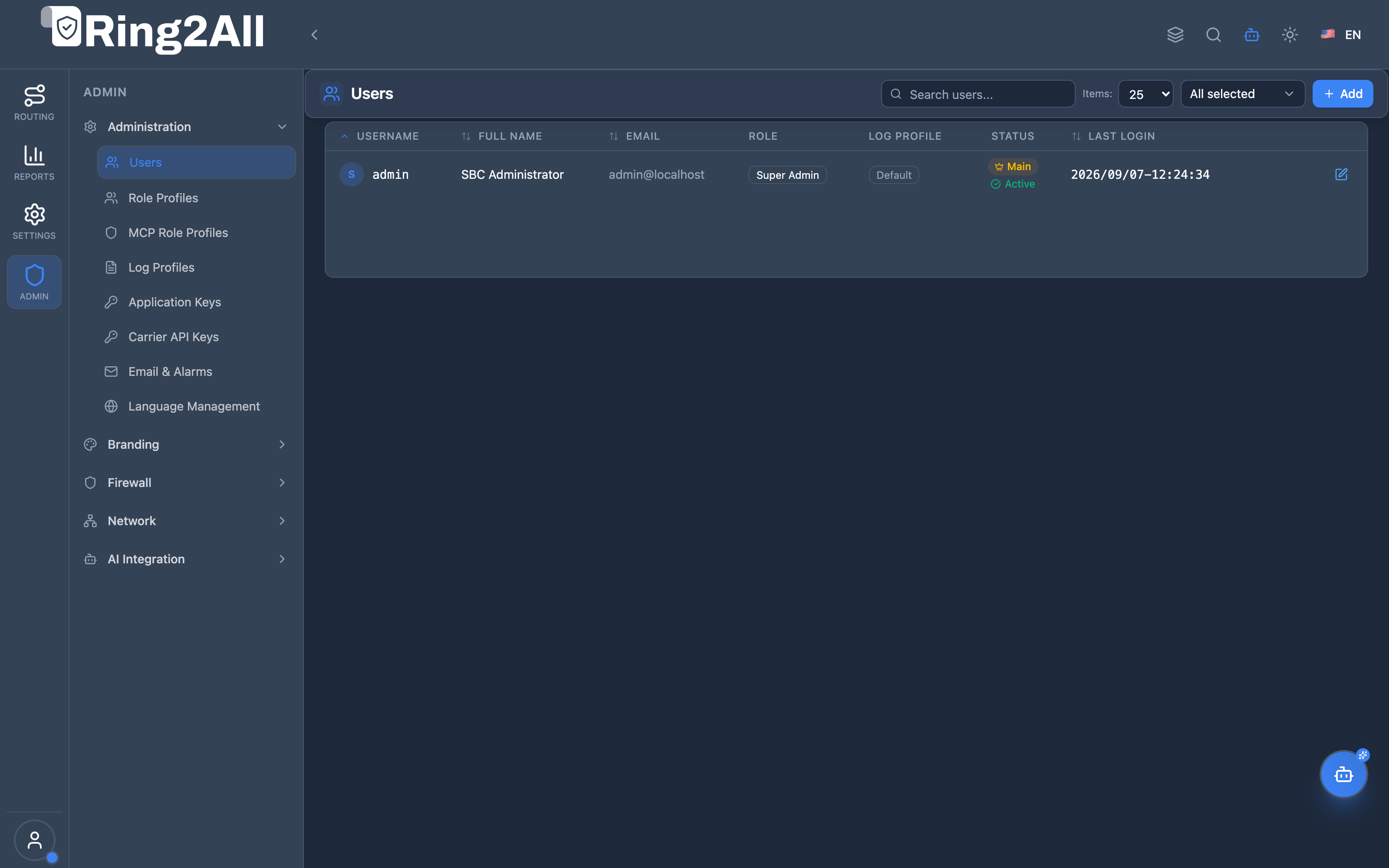
4.1 Users Management List View
Section titled “4.1 Users Management List View”Displays all registered user accounts, active statuses, assigned role profiles, log profiles, MCP roles, and last login timestamps.
4.2 User Configuration Form
Section titled “4.2 User Configuration Form”Presents account identity fields, Argon2id password controls, and dropdown selectors for the three orthogonal security profiles.
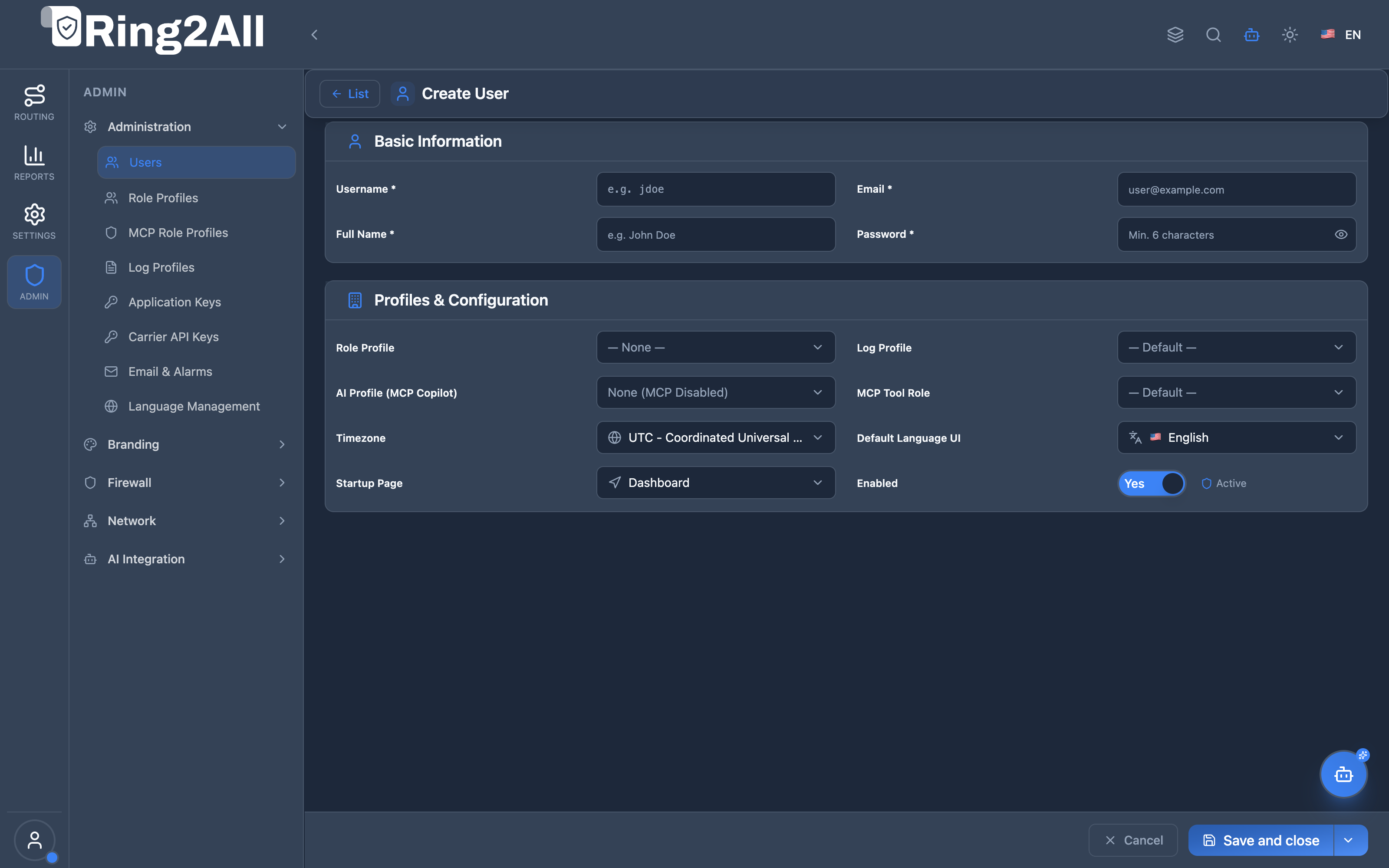
5. Field Reference & User Configuration Parameters
Section titled “5. Field Reference & User Configuration Parameters”| Field Name | Type | Options / Format | Description |
|---|---|---|---|
| Username | String | Alphanumeric (e.g., admin, noc_tier2) |
Unique login identifier used during authentication. |
| Email Address | Standard email format | Official contact address used for system alarm notifications and password resets. | |
| Password | Password | Strong password format | Plaintext password input, automatically hashed with Argon2id upon form submission. |
| Account Status | Switch | Active / Disabled |
Toggle to immediately permit or suspend system access without deleting historical records. |
| Role Profile | Select | Foreign Key (role_profiles.id) |
Assigns the RBAC module permission profile determining accessible menus and CRUD actions. |
| Log Profile | Select | Foreign Key (log_profiles.id) |
Assigns the audit logging policy determining which actions by this user are recorded in audit_log. |
| MCP Tool Role | Select | Foreign Key (mcp_roles.id) |
Assigns the AI copilot governance role restricting which telephony tools an assistant can call. |
| Tenant ID | Select / Int | Nullable Integer | Multi-tenant partition. NULL grants global superadmin scope across all SBC domains and trunks. |
| Timezone | Select | Standard IANA (e.g., UTC, America/New_York) |
Localizes timestamps across CDRs, SIP trace ladder diagrams, and system audit views. |
6. Cryptographic Security & Session Governance
Section titled “6. Cryptographic Security & Session Governance”Ring2All SBC enforces strict cryptographic standards across the authentication pipeline:
// Argon2id Password Hashing Standardexport async function hashPassword(password: string): Promise<string> { return await argon2.hash(password, { type: argon2.argon2id, memoryCost: 65536, // 64 MB timeCost: 3, // 3 iterations parallelism: 1, });}- Stateless JWT Authorization: API sessions utilize signed JSON Web Tokens (JWT) containing user UUID, role permissions, and tenant scope.
- Token Rotation: Refresh tokens are stored with one-way SHA-256 hashes and rotated upon every renewal cycle.
- Slug Prohibition: User identification in SQL queries and API middleware is executed strictly via numeric
idoruuid. Mutable fields (username) are strictly prohibited as database foreign keys.
7. The Four-Pillar Access Control Binding
Section titled “7. The Four-Pillar Access Control Binding”Every account created on the SBC must link to four discrete authorization pillars:
- Identity & Tenant Pillar (
users.tenant_id): Isolates database queries and SIP routing policies so operators only see their assigned domains and carrier groups. - RBAC Module Pillar (
users.role_profile_id): Dictates front-end UI element rendering and REST endpoint authorization (GET,POST,PUT,DELETE). - Audit Logging Pillar (
users.log_profile_id): Determines whether routine actions (viewing a CDR or toggling a carrier) trigger detailed database audit entries or email alerts. - AI Tool Governance Pillar (
users.mcp_role_id): Dictates the tool execution boundaries of the AI NOC Copilot when operating in the user’s context.
8. Troubleshooting & Verification
Section titled “8. Troubleshooting & Verification”Inspecting User Accounts via Database Console
Section titled “Inspecting User Accounts via Database Console”To verify user profile mappings on the SBC host:
sudo -u postgres psql -d sbc_admin -c "SELECT u.id, u.username, u.email, u.is_active, r.name AS role_profile, l.name AS log_profile, m.name AS mcp_roleFROM users uLEFT JOIN role_profiles r ON r.id = u.role_profile_idLEFT JOIN log_profiles l ON l.id = u.log_profile_idLEFT JOIN mcp_roles m ON m.id = u.mcp_role_id;"Resetting Administrator Credentials via CLI
Section titled “Resetting Administrator Credentials via CLI”If the master administrative password is lost:
node -e "const argon2 = require('argon2');argon2.hash('NewSecurePassword123!', { type: argon2.argon2id, memoryCost: 65536, timeCost: 3 }) .then(h => console.log('UPDATE users SET password_hash = \'' + h + '\' WHERE username = \'admin\';'));" | sudo -u postgres psql -d sbc_admin9. Model Context Protocol (MCP) AI Integration
Section titled “9. Model Context Protocol (MCP) AI Integration”Ring2All SBC exposes dedicated Model Context Protocol (MCP) tools enabling AI agents, autonomous NOC bots, and administrative copilot assistants to query, audit, and manage user operator accounts securely.
Available MCP Tools
Section titled “Available MCP Tools”| Tool Name | Operation | Risk Level | Description |
|---|---|---|---|
list_sbc_users |
Read | Low (read) |
List operator user accounts in Ring2All SBC with assigned role profiles, log profiles, MCP tool profiles, status, and last login. |
get_sbc_user |
Read | Low (read) |
Retrieve comprehensive profile, timezone, language, and permission matrix for a specific user by UUID or username. |
update_sbc_user_status |
Mutate | High (operational) |
Enable or disable an administrative operator account to immediately grant or revoke SBC management access. |
Tool Schemas & Parameter Definitions
Section titled “Tool Schemas & Parameter Definitions”list_sbc_users
Section titled “list_sbc_users”{ "name": "list_sbc_users", "description": "List operator user accounts in Ring2All SBC, including assigned role profiles, log profiles, MCP tool profiles, account status, and last login timestamps.", "inputSchema": { "type": "object", "properties": { "search": { "type": "string", "description": "Optional filter by username, email, or full name" }, "limit": { "type": "number", "description": "Maximum number of users to return (default 50)" }, "offset": { "type": "number", "description": "Pagination offset (default 0)" } } }}get_sbc_user
Section titled “get_sbc_user”{ "name": "get_sbc_user", "description": "Get detailed profile and permission settings for a specific SBC user by UUID or username.", "inputSchema": { "type": "object", "properties": { "identifier": { "type": "string", "description": "User UUID or username to query" } }, "required": ["identifier"] }}update_sbc_user_status
Section titled “update_sbc_user_status”{ "name": "update_sbc_user_status", "description": "Enable or disable an administrative operator user account in Ring2All SBC.", "inputSchema": { "type": "object", "properties": { "identifier": { "type": "string", "description": "User UUID or username" }, "isActive": { "type": "boolean", "description": "True to activate, false to suspend/disable" } }, "required": ["identifier", "isActive"] }}Realistic Payload Examples
Section titled “Realistic Payload Examples”Query Request (get_sbc_user)
Section titled “Query Request (get_sbc_user)”{ "identifier": "admin"}Successful Response (get_sbc_user)
Section titled “Successful Response (get_sbc_user)”{ "success": true, "data": { "user": { "uuid": "4f18d7a3-b09e-4a6f-99c7-542e7b89d102", "username": "admin", "email": "admin@ring2all.com", "full_name": "SBC Super Administrator", "is_active": true, "is_superuser": true, "timezone": "America/New_York", "language": "en", "last_login_at": "2026-09-08T11:20:00Z", "created_at": "2026-01-15T08:00:00Z", "updated_at": "2026-09-08T11:20:00Z", "role_uuid": "e2a1b94d-1763-4cbb-9271-9dfa542b01c3", "role_name": "Super Administrator", "role_slug": "super-admin", "log_uuid": "b8f41029-47aa-4831-a068-3e5fa809d841", "log_name": "Full Verbose Audit", "log_level": "DEBUG", "mcp_role_uuid": "d3b4e720-c9fa-47eb-9403-99b821a8cd34", "mcp_role_name": "SBC NOC Super Administrator (Full Access)", "mcp_role_slug": "super-admin" } }}Natural Language Prompt Scenarios
Section titled “Natural Language Prompt Scenarios”English (NOC Security Audit)
Section titled “English (NOC Security Audit)”“Check the list of all active operator accounts on Ring2All SBC and verify if any account has been inactive for more than 30 days or is lacking a role profile assignment.”
Spanish (Mitigación Inmediata de Cuenta Comprometida)
Section titled “Spanish (Mitigación Inmediata de Cuenta Comprometida)”“Desactiva de inmediato la cuenta del operador ‘noc_guest’ debido a múltiples intentos fallidos de autenticación detectados en el firewall perimetral.”
Enterprise AI Safety Guardrails
Section titled “Enterprise AI Safety Guardrails”- Zero Credential Exposure: Password hashes (
password_hash, Argon2id salts) and raw session tokens are strictly omitted from all MCP data serialization pipelines. - Superuser Deactivation Immunity: The system prevents autonomous agents from disabling the final active superuser account, guaranteeing that human administrators can never be locked out of SBC governance.
10. Glossary
Section titled “10. Glossary”- Argon2id: The winner of the Password Hashing Competition (PHC), combining resistance against side-channel and GPU cracking attacks.
- RBAC (Role-Based Access Control): An access security mechanism that restricts system access to authorized users based on their organizational roles.
- MCP (Model Context Protocol): An open standard protocol that enables AI models to interact securely with local telephony tools and databases.
- Immutable Identifier: A database key (such as an integer sequence or UUID v4) that remains constant throughout an entity’s lifecycle.