

SIP Accounts & Wholesale Trunks
Table of Contents
Section titled “Table of Contents”- Overview & Architecture
- Business & Operational Significance
- 🎯 User Roles & Key Capabilities
- Visual Interface & Form Layout
- Field & Configuration Reference
- Kamailio Authentication Pipeline & Security Engine
- Security Best Practices & Operational Hardening
- Model Context Protocol (MCP) AI Integration
- Troubleshooting & Verification
- Glossary
1. Overview & Architecture
Section titled “1. Overview & Architecture”In Ring2All SBC, the SIP Accounts module (public.sip_accounts) represents incoming and bidirectional wholesale carrier trunks, enterprise customer SIP peers, and authenticated SIP clients terminating onto the carrier perimeter.
Each SIP Account acts as a boundary gateway profile that authenticates inbound SIP requests, enforces real-time rate limits (Calls Per Second and Concurrent Channels), maps source traffic to specific SIP Domains, binds default Outbound Routes, and manages encrypted media policies (SRTP).
┌────────────────────────────────────────────────────────────────────────┐ │ Incoming SIP Request (INVITE) │ └───────────────────────────────────┬────────────────────────────────────┘ │ Source IP & Port / Digest Auth Header │ ┌───────────────────────────────────▼────────────────────────────────────┐ │ Kamailio Authentication Pipeline (Route AUTH) │ │ │ │ ┌───────────────────────────────┐ ┌──────────────────────────────┐ │ │ │ IP Whitelist (Address GRP) │ │ Digest Auth (Subscriber DB) │ │ │ │ • Subnet CIDR / IPv4 / IPv6 │ │ • HA1 MD5 (user:domain:pwd) │ │ │ │ • Tag: sip_account:<id> │ │ • HA1B (user@domain:pwd) │ │ │ └───────────────┬───────────────┘ └──────────────┬───────────────┘ │ │ │ │ │ │ └─────────────────┬────────────────┘ │ │ │ Account Matched & Authorized │ │ ┌─────────────────────────────────▼────────────────────────────────┐ │ │ │ Traffic Shaping & Limit Enforcement (htable & dialog) │ │ │ │ • Max Concurrent Channels (atomic counter increment) │ │ │ │ • Calls Per Second (CPS sliding window check) │ │ │ │ • Reject if exceeded (SIP 503 Channel / Rate Limit Exceeded) │ │ │ └─────────────────────────────────┬────────────────────────────────┘ │ └────────────────────────────────────┼───────────────────────────────────┘ │ Routing & Media Anchor (RTPEngine) ▼ Outbound Route / Ring2All PBXWhen an external customer PBX or wholesale carrier sends a SIP INVITE, the SBC determines account identity using one of three authentication strategies:
- IP-Based Authentication: The source IP address is matched against an access control list (CIDR / subnet) managed in Kamailio’s
permissionstable. - Digest Authentication: Kamailio challenges the client with a
401 Unauthorized/407 Proxy Authentication Requiredchallenge using pre-shared username and password credentials stored in thesubscribertable. - Both (Dual Authentication): Requires both a recognized source IP address and valid Digest credentials, offering high security for multi-tenant wholesale trunking.
2. Business & Operational Significance
Section titled “2. Business & Operational Significance”- Wholesale Carrier Interconnect: Enables enterprise voice providers, contact centers, and multi-tenant resellers to peer directly with Ring2All SBC without registering individual handsets.
- Granular SLA & Capacity Protection: Prevents noisy neighbor denial-of-service conditions by strictly enforcing atomic channel caps and CPS ceilings per tenant.
- Automated DID Association: Inbound phone numbers can be assigned directly to specific SIP accounts, ensuring clean tenant isolation and inbound delivery.
- Flexible Topology Traversal: Supports direct URI destination relay, native dispatching into Ring2All PBX clusters, or peering out to external Class 4 carriers.
- Secure Media Enforcement: Allows per-account SRTP policies (
none,preferred,required) to guarantee media encryption compliance for enterprise clients.
3. 🎯 User Roles & Key Capabilities
Section titled “3. 🎯 User Roles & Key Capabilities”| Role | Primary Use Case | Key Capabilities |
|---|---|---|
| SBC Administrator | Carrier & Account Provisioning | Create, edit, and suspend SIP Accounts; configure IP whitelists, Digest credentials, concurrent channel quotas, CPS limits, and SRTP policies. |
| Carrier NOC Engineer | Peering Diagnostics & Tracing | Inspect live active channel counts, investigate rejected calls due to authentication failure or limit breach, and view associated DIDs. |
| Compliance Auditor | Security & Traffic Auditing | Verify cryptographic media requirements (SRTP enforcement), IP whitelist CIDR boundaries, and billing account associations. |
| AI Platform Copilot / NOC Diagnostic Agent | Trunk Telemetry & Provisioning | Execute list_sip_accounts, get_sip_account_status, create_sip_account, and delete_sip_account to audit wholesale trunks, verify IP/Digest auth modes, and enforce channel capacity limits. |
4. Visual Interface & Form Layout
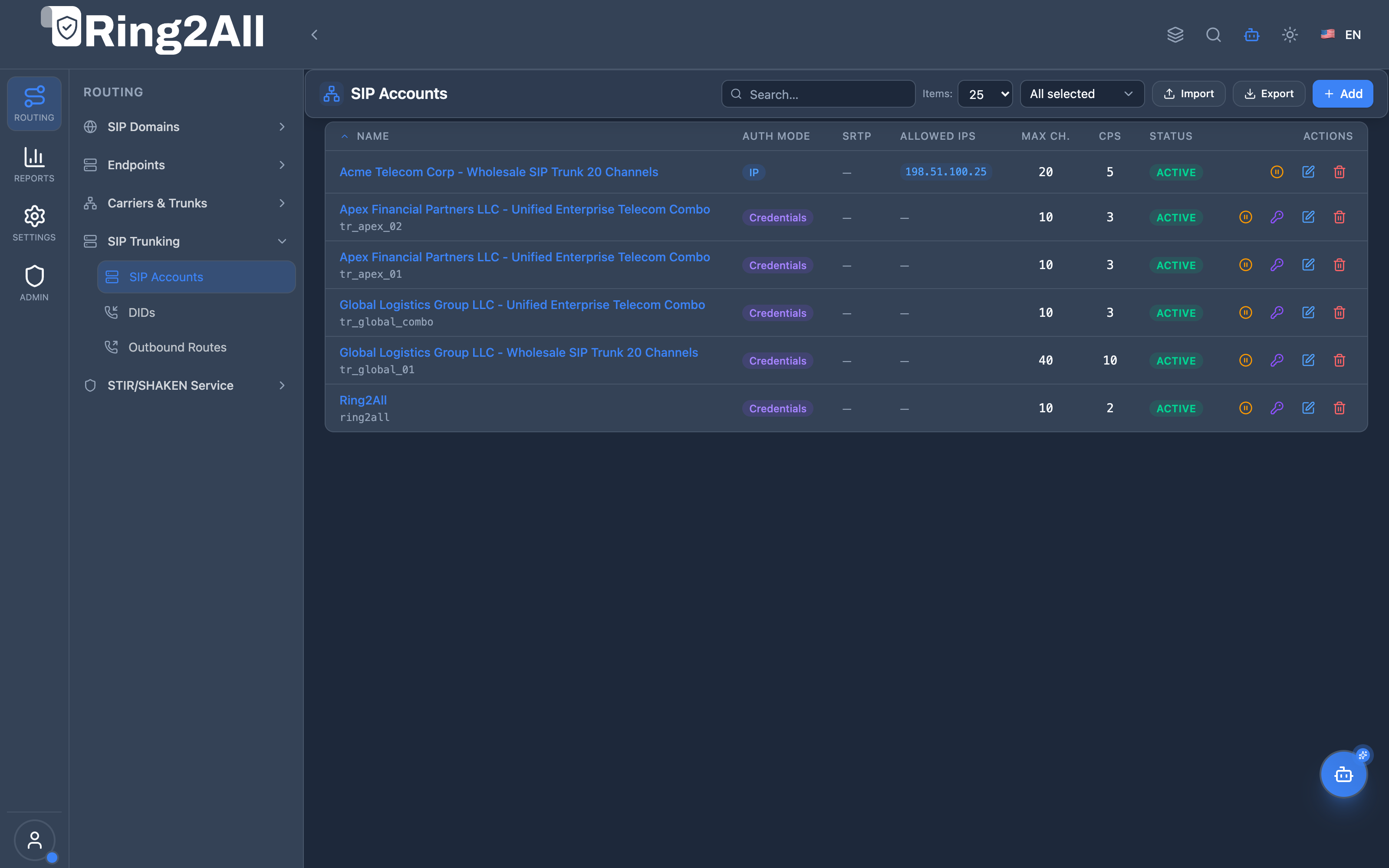
Section titled “4. Visual Interface & Form Layout”SIP Accounts List View
Section titled “SIP Accounts List View”The list view displays all configured SIP accounts with their authentication type, allowed IPs, channel limits, CPS rate, outbound route association, and operational status.
SIP Account Configuration Form
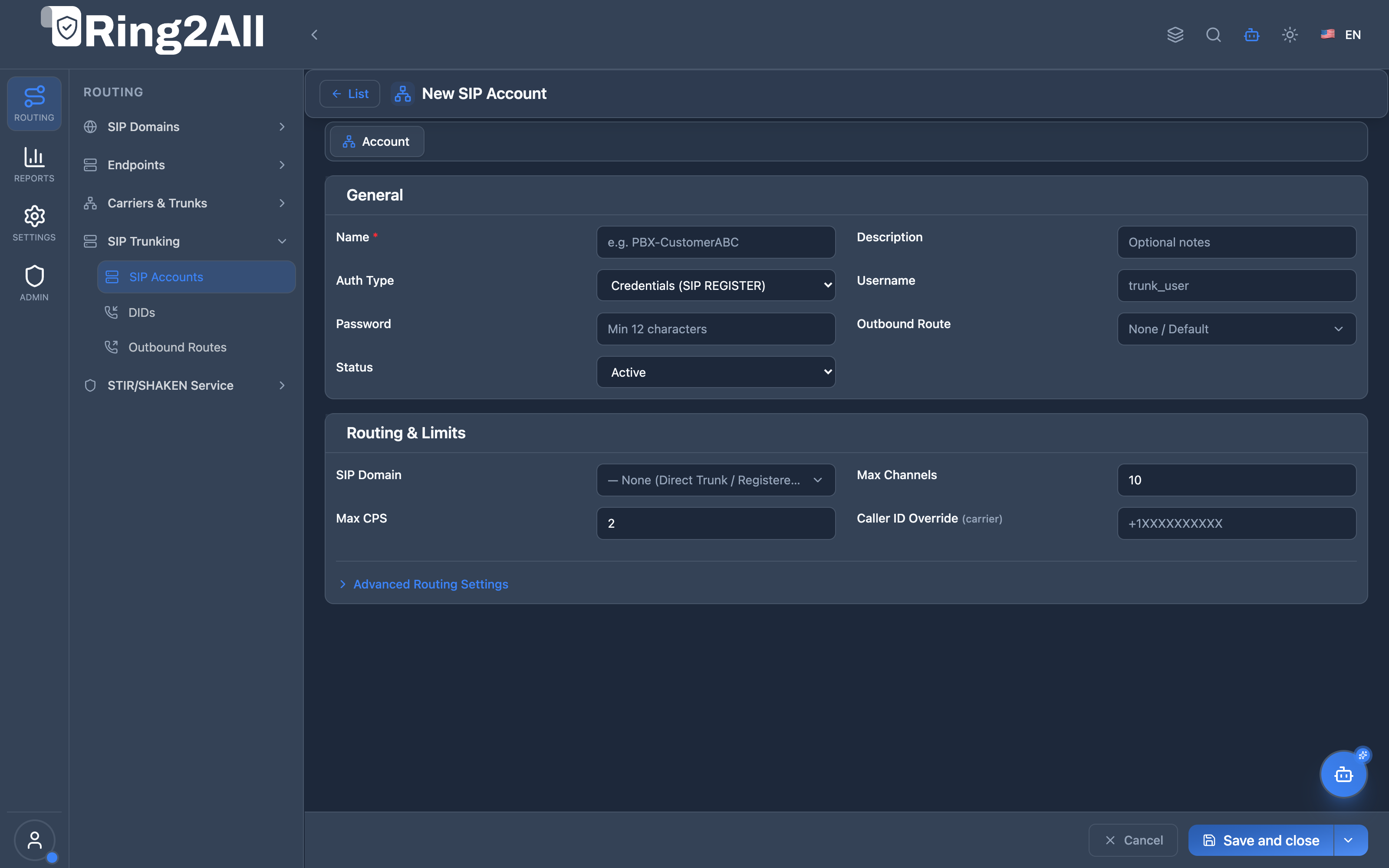
Section titled “SIP Account Configuration Form”The configuration form features a clean two-box layout under the Account tab, with an optional DIDs tab available in edit mode to inspect assigned telephone numbers.
5. Field & Configuration Reference
Section titled “5. Field & Configuration Reference”Box 1: General Information & Authentication
Section titled “Box 1: General Information & Authentication”| Field | Type | Constraints / Format | Description |
|---|---|---|---|
| Account Name * | Text | 3–64 characters | Unique human-readable label identifying the customer, PBX, or carrier trunk. |
| Description | Text | Max 255 characters | Optional operational notes, client identifier, or service contract reference. |
| Authentication Type * | Dropdown | credentials, ip, both |
Method used to validate inbound traffic from this account. |
| Username | Text | Alphanumeric (if credentials/both) | SIP username presented in Digest authorization headers. |
| Password | Password | Min 8 characters (if credentials/both) | SIP password used to generate HA1/HA1B MD5 authentication hashes. |
| Outbound Route | Dropdown | Configured Outbound Routes | The default outbound routing profile used when calls originate from this account. |
| Allowed IPs | Multiline Text | Valid IPv4/IPv6 or CIDR (one per line) | List of authorized IP subnets (e.g. 203.0.113.0/24, 198.51.100.5). Active when ip or both is selected. |
| Status * | Dropdown | active, suspended, disabled |
Administrative state. Suspended accounts are immediately rejected with SIP 403 Forbidden. |
Box 2: Routing & Capacity Limits
Section titled “Box 2: Routing & Capacity Limits”| Field | Type | Constraints / Format | Description |
|---|---|---|---|
| SIP Domain | Searchable Select | Active SIP Domains | Binds this account to a multi-tenant SIP Domain namespace for Request-URI routing. |
| Max Concurrent Channels * | Number | Integer $\ge 0$ (0 = unlimited) | Maximum simultaneous active bidirectional calls permitted before returning SIP 503. |
| Max Calls Per Second (CPS) * | Number | Integer $\ge 0$ (0 = unlimited) | Burst signaling rate limit enforced via Kamailio sliding window algorithms. |
| Caller ID Override | Text | E.164 or numeric string | Forcefully sets the outbound Calling Line Identification (CLI) for calls passing through this account. |
Advanced Routing Settings (Collapsible)
Section titled “Advanced Routing Settings (Collapsible)”| Field | Type | Constraints / Format | Description |
|---|---|---|---|
| Forward Destination | Text | SIP URI (e.g., sip:pbx.customer.com:5060) |
Custom downstream SIP destination to relay inbound calls received on this account. |
| Tech Prefix | Text | Numeric string (e.g., 9901*) |
Dialed digits prefix prepended to outbound traffic or stripped from incoming calls. |
| SRTP Policy | Dropdown | none, preferred, required |
Media encryption requirement (none = plain RTP, preferred = offer SAVP, required = enforce SAVP). |
6. Kamailio Authentication Pipeline & Security Engine
Section titled “6. Kamailio Authentication Pipeline & Security Engine”Database Schema & Synchronization
Section titled “Database Schema & Synchronization”SIP Accounts synchronize between the PostgreSQL ss_telephony database and Kamailio memory tables:
-- Core SIP Account definition in PostgreSQLCREATE TABLE public.sip_accounts ( id SERIAL PRIMARY KEY, name VARCHAR(64) NOT NULL UNIQUE, description VARCHAR(255), auth_type VARCHAR(20) NOT NULL DEFAULT 'credentials', -- credentials, ip, both username VARCHAR(64), password_hash VARCHAR(128), allowed_ips TEXT, -- Comma-separated or newline CIDR list max_channels INT NOT NULL DEFAULT 10, cps INT NOT NULL DEFAULT 2, tech_prefix VARCHAR(32), caller_id_override VARCHAR(64), destination VARCHAR(255), sip_domain VARCHAR(255), outbound_route_id INT REFERENCES public.outbound_routes(id) ON DELETE SET NULL, srtp_policy VARCHAR(20) NOT NULL DEFAULT 'none', status VARCHAR(20) NOT NULL DEFAULT 'active', created_at TIMESTAMPTZ NOT NULL DEFAULT NOW(), updated_at TIMESTAMPTZ NOT NULL DEFAULT NOW());Kamailio Routing Script Mechanics
Section titled “Kamailio Routing Script Mechanics”- IP Authentication (
permissionsmodule):route[AUTH_IP] {# Check if source IP is within allowed subnetif (allow_source_address("10")) {$var(sip_account_id) = $sht(ip_to_account=>$si);return(1);}return(-1);} - Digest Authentication (
auth_dbmodule):route[AUTH_DIGEST] {if (!auth_check("$fd", "subscriber", "1")) {auth_challenge("$fd", "0");exit;}consume_credentials();return(1);} - Capacity & CPS Throttling (
htable&dialog):route[CHECK_LIMITS] {$var(cur_calls) = $sht(account_calls=>$var(sip_account_id));if ($var(cur_calls) >= $var(max_channels)) {sl_send_reply("503", "Maximum Concurrent Channels Exceeded");exit;}# Atomic CPS sliding window incrementif (!sht_rm_name_re("cps_.*")) {# rate limit logic}}
7. Security Best Practices & Operational Hardening
Section titled “7. Security Best Practices & Operational Hardening”- Enforce Complex Digest Secrets: If using
credentialsorboth, use generated passwords of 24+ alphanumeric characters to prevent brute-force SIP scanning. - Combine IP Whitelisting with Credentials (
both): For mission-critical trunks, require dual verification so compromised credentials cannot be used from unauthorized IPs. - Strict CPS Limits on New Accounts: Start new accounts with conservative CPS limits (2–5 CPS) to contain automated dialing storms or compromised PBX loops.
- Mandate SRTP for Remote Cloud Connections: For trunks operating over the public Internet, set SRTP Policy to
requiredand ensure signaling uses TLS on port 5061.
Model Context Protocol (MCP) AI Integration
Section titled “Model Context Protocol (MCP) AI Integration”The SIP Accounts & Wholesale Trunks module integrates with the Ring2All SBC Model Context Protocol (MCP) server, allowing AI Copilots, automated onboarding workflows, and NOC diagnostics to inspect wholesale trunk profiles, verify Digest authentication credentials, configure IP access control lists, and monitor capacity quotas.
MCP Tools Catalog
Section titled “MCP Tools Catalog”| Tool Name | Type | Access | Description |
|---|---|---|---|
list_sip_accounts |
Query | sip_accounts / Read |
List all Class 4 Customer SIP Accounts and Trunks registered in Ring2All SBC (username, auth method: IP/credentials, concurrent call limits, and status). |
get_sip_account_status |
Query | sip_accounts / Read |
Get detailed configuration, authentication mode, IP whitelists, and limits of a specific SIP account. |
create_sip_account |
Mutation | sip_accounts / Write |
Create a new Class 4 Customer SIP Account with Digest Authentication (HA1) and optional IP ACL authorization. |
delete_sip_account |
Mutation | sip_accounts / Delete |
Delete a customer SIP account and trunk profile from the SBC. |
Tool Schemas & Execution Responses
Section titled “Tool Schemas & Execution Responses”list_sip_accounts
Section titled “list_sip_accounts”{ "name": "list_sip_accounts", "description": "List all Class 4 Customer SIP Accounts and Trunks registered in Ring2All SBC (username, auth method: IP/credentials, concurrent call limits, and status).", "parameters": { "type": "object", "properties": { "search": { "type": "string", "description": "Filter by username or name." }, "status": { "type": "string", "enum": ["active", "suspended", "disabled"], "description": "Filter by status." } } }}Realistic Execution Response:
{ "success": true, "data": { "total": 2, "accounts": [ { "id": 101, "username": "trunk_apex_voice", "name": "Apex Enterprise Trunk", "authType": "both", "allowedIps": "203.0.113.10,203.0.113.11", "maxChannels": 100, "cps": 25, "status": "active", "createdAt": "2026-09-05T11:20:00Z" }, { "id": 102, "username": "cust_novatel_sip", "name": "NovaTel Reseller SIP", "authType": "credentials", "allowedIps": null, "maxChannels": 50, "cps": 10, "status": "active", "createdAt": "2026-09-06T15:10:00Z" } ] }}get_sip_account_status
Section titled “get_sip_account_status”{ "name": "get_sip_account_status", "description": "Get detailed configuration, authentication mode, IP whitelists, and limits of a specific SIP account.", "parameters": { "type": "object", "properties": { "username": { "type": "string", "description": "SIP account username (e.g. \"trunk_cust_1001\")." } }, "required": ["username"] }}Realistic Execution Response:
{ "success": true, "data": { "account": { "id": 101, "username": "trunk_apex_voice", "name": "Apex Enterprise Trunk", "authType": "both", "allowedIps": "203.0.113.10,203.0.113.11", "maxChannels": 100, "cps": 25, "outboundRouteId": 5, "srtpPolicy": "required", "status": "active", "assignedDidsCount": 12, "updatedAt": "2026-09-08T08:00:00Z" } }}create_sip_account
Section titled “create_sip_account”{ "name": "create_sip_account", "description": "Create a new Class 4 Customer SIP Account with Digest Authentication (HA1) and optional IP ACL authorization.", "parameters": { "type": "object", "properties": { "username": { "type": "string", "description": "SIP username." }, "password": { "type": "string", "description": "SIP secret password." }, "name": { "type": "string", "description": "Friendly name of the customer." }, "authType": { "type": "string", "enum": ["credentials", "ip", "both"] }, "ips": { "type": "string", "description": "Comma-separated IP addresses or subnets." }, "maxChannels": { "type": "number", "description": "Maximum concurrent calls." } }, "required": ["username", "password", "name"] }}Realistic Execution Response:
{ "success": true, "data": { "message": "SIP Account \"cust_quantum_voice\" created successfully.", "accountId": 103, "username": "cust_quantum_voice", "authType": "both", "status": "active" }}Bilingual Natural Language Prompt Examples
Section titled “Bilingual Natural Language Prompt Examples”English Prompts
Section titled “English Prompts”- “NOC Copilot, list all active customer SIP Accounts and their concurrent channel limits.”
- “Show me the configuration and IP whitelist for account ‘trunk_apex_voice’.”
- “Create a new SIP trunk account ‘cust_quantum_voice’ with authType ‘both’ and allowed IP ‘198.51.100.40’.”
- “Verify if any customer SIP accounts are currently exceeding their configured CPS quota.”
Spanish Prompts
Section titled “Spanish Prompts”- “Copilot NOC, lista todas las cuentas SIP de clientes activas y sus límites de canales simultáneos.”
- “Muéstrame la configuración y lista blanca de IPs de la cuenta ‘trunk_apex_voice’.”
- “Crea una nueva cuenta de troncal SIP ‘cust_quantum_voice’ con autenticación ‘both’ e IP permitida ‘198.51.100.40’.”
- “Comprueba si alguna cuenta SIP de cliente está superando actualmente su cuota de CPS configurada.”
Enterprise Safeguards & Execution Boundaries
Section titled “Enterprise Safeguards & Execution Boundaries”- Cryptographic Credential Protection (HA1 MD5): Passwords are computed into HA1 hashes (
username:realm:password) before storage in Kamailiosubscribertables, preventing plaintext exposure. - Atomic IP Address Permissions Synchronization: Updating IP whitelist addresses triggers
permissions.addressReloadvia Kamailio RPC without disconnecting active calls. - Channel Overrun & CPS Protection: Real-time channel concurrency is tracked via Kamailio
dialogprofiles (dlg.profile_get_size sip_account), instantly returningSIP 503 Channel Limit Exceededwhen thresholds are breached.
8. Troubleshooting & Verification
Section titled “8. Troubleshooting & Verification”Inspect Account Configuration via PostgreSQL
Section titled “Inspect Account Configuration via PostgreSQL”# Verify SIP Account settings and authentication modepsql -U softswitch -d ss_telephony -c "SELECT id, name, auth_type, username, allowed_ips, max_channels, cps, statusFROM public.sip_accounts ORDER BY id DESC;"Check In-Memory Subscriber Credentials
Section titled “Check In-Memory Subscriber Credentials”# Reload Kamailio subscriber authentication tablekamcmd auth_db.reload
# Verify IP permissions address tablekamcmd permissions.addressDumpMonitor Live Active Dialogs per Account
Section titled “Monitor Live Active Dialogs per Account”# Check active dialogs tracked by Kamailiokamcmd dlg.profile_get_size sip_accountView Real-Time SIP Signaling Traces
Section titled “View Real-Time SIP Signaling Traces”# Filter live SIP traffic for a specific SIP Account IPsngrep host 203.0.113.109. Glossary
Section titled “9. Glossary”- AS (Authentication Service): The perimeter gateway subsystem that validates incoming SIP user agents.
- Digest Authentication: Challenge-response protocol (RFC 2617 / RFC 3261) using MD5 or SHA-256 hashes to verify caller identity without transmitting plaintext passwords.
- IP Whitelist: Firewall/ACL rules matching source IPv4 or IPv6 addresses against allowed subnets.
- CPS (Calls Per Second): The signaling transaction rate representing new call setup attempts per second.
- SRTP (Secure Real-Time Transport Protocol): RFC 3711 encryption providing confidentiality and message authentication for audio and video media streams.