

Anti-Flood Protection & Rate Limiting (Pike)
Table of Contents
Section titled “Table of Contents”- Overview & Traffic Shaping Architecture
- Business & Operational Significance
- 🎯 User Roles & Key Capabilities
- Visual Interface & Layout
- Pike Heuristic Parameters & Sliding Window Math
- Rate Limit Exceptions (CPS Tuning)
- Kamailio Integration & RPC Management
- Operational Best Practices & Anti-DoS Hardening
- Verification & Diagnostics
- Model Context Protocol (MCP) AI Integration
- Glossary
1. Overview & Traffic Shaping Architecture
Section titled “1. Overview & Traffic Shaping Architecture”In Ring2All SBC, the Anti-flood / Pike module provides automated protection against high-velocity SIP floods, volumetric denial-of-service (DoS) attacks, and rogue user agents attempting registration or call brute-forcing. Driven by Kamailio’s native pike module and shared memory hash tables, the engine maintains dynamic moving-window request counters per source IP address in kernel-adjacent memory.
┌─────────────────────────────────────────────────────────────┐ │ INCOMING SIP TRAFFIC STREAM │ │ (INVITE, REGISTER, OPTIONS) │ └──────────────────────────────┬──────────────────────────────┘ │ ┌──────────────────────────────▼──────────────────────────────┐ │ PIKE SLIDING WINDOW EVALUATION │ │ (sampling_time_unit: 2s | reqs_density_per_unit: 16) │ └──────────────────────────────┬──────────────────────────────┘ │ ┌───────────────────────┴───────────────────────┐ ▼ (Density <= 16 reqs / 2s) ▼ (Density > 16 reqs / 2s) ┌──────────────────────────────┐ ┌──────────────────────────────┐ │ NORMAL TRAFFIC │ │ FLOOD THRESHOLD BREACH │ ├──────────────────────────────┤ ├──────────────────────────────┤ │ • Check Rate Limit Exception │ │ • Check Group 9 CPS Override │ │ • Proceed to SIP routing │ │ • If exceeded: AUTO-BLOCK IP │ │ • Forward to Core PBX/Trunk │ │ • Add to pike.top_list table │ └──────────────────────────────┘ └──────────────────────────────┘ │ ▼ ┌──────────────────────────────┐ │ SILENT PACKET DROP │ │ (drop; during remove_latency)│ └──────────────────────────────┘When an unpeered source IP exceeds the allowable request density, the Pike engine transitions the IP to a temporary blocked state, silently dropping subsequent packets for the duration of the cooldown window without consuming CPU or generating SIP rejection traffic that could amplify the attack.
2. Business & Operational Significance
Section titled “2. Business & Operational Significance”- Autonomous Denial-of-Service Defense: Defends SIP signaling ports from volumetric INVITE or REGISTER floods that would otherwise saturate Kamailio worker processes and exhaust database connection pools.
- Granular Carrier CPS Exceptions: Allows wholesale carriers and high-capacity PSTN trunks to operate at elevated rates (e.g., 50 or 100 CPS) through explicit rate limit exception rules while maintaining strict limits on untrusted sources.
- Amplification Attack Mitigation: Silently discards offending packets with
drop;rather than sending SIP 4xx/5xx responses, preventing the SBC from acting as a reflector in spoofed-IP reflection attacks. - Real-Time RPC Telemetry & Unbanning: Provides operators with live inspection of currently blocked IPs via Kamailio’s binary RPC interface (
pike.top_list), enabling instant, one-click manual unbanning.
3. 🎯 User Roles & Key Capabilities
Section titled “3. 🎯 User Roles & Key Capabilities”| Role | Primary Use Case | Key Capabilities |
|---|---|---|
| SBC Security Administrator | Volumetric Flood Defense | Review Pike live blocked IPs, inspect request densities, calibrate kamailio.cfg parameters, and execute manual IP releases. |
| Carrier Interconnect Engineer | Trunk CPS Capacity Provisioning | Author rate limit exceptions for wholesale carrier gateways, assigning custom Max CPS thresholds to prevent inadvertent carrier throttling. |
| NOC Systems Operator | Real-Time DoS Monitoring | Monitor active blocked host lists during traffic spikes and verify recovery following network attacks. |
| Compliance & Performance Auditor | Service Level Governance | Ensure DDoS mitigation mechanisms comply with telecom service-level agreements (SLAs) without impacting legitimate call completion rates. |
| AI Anti-Flood & Rate Limiting Agent / NOC Copilot | Volumetric DoS Inspection & Rapid Unblocking | Inspect live Pike request velocities, query memory ban lists, audit carrier CPS limits, and execute verified unban actions via MCP. |
4. Visual Interface & Layout
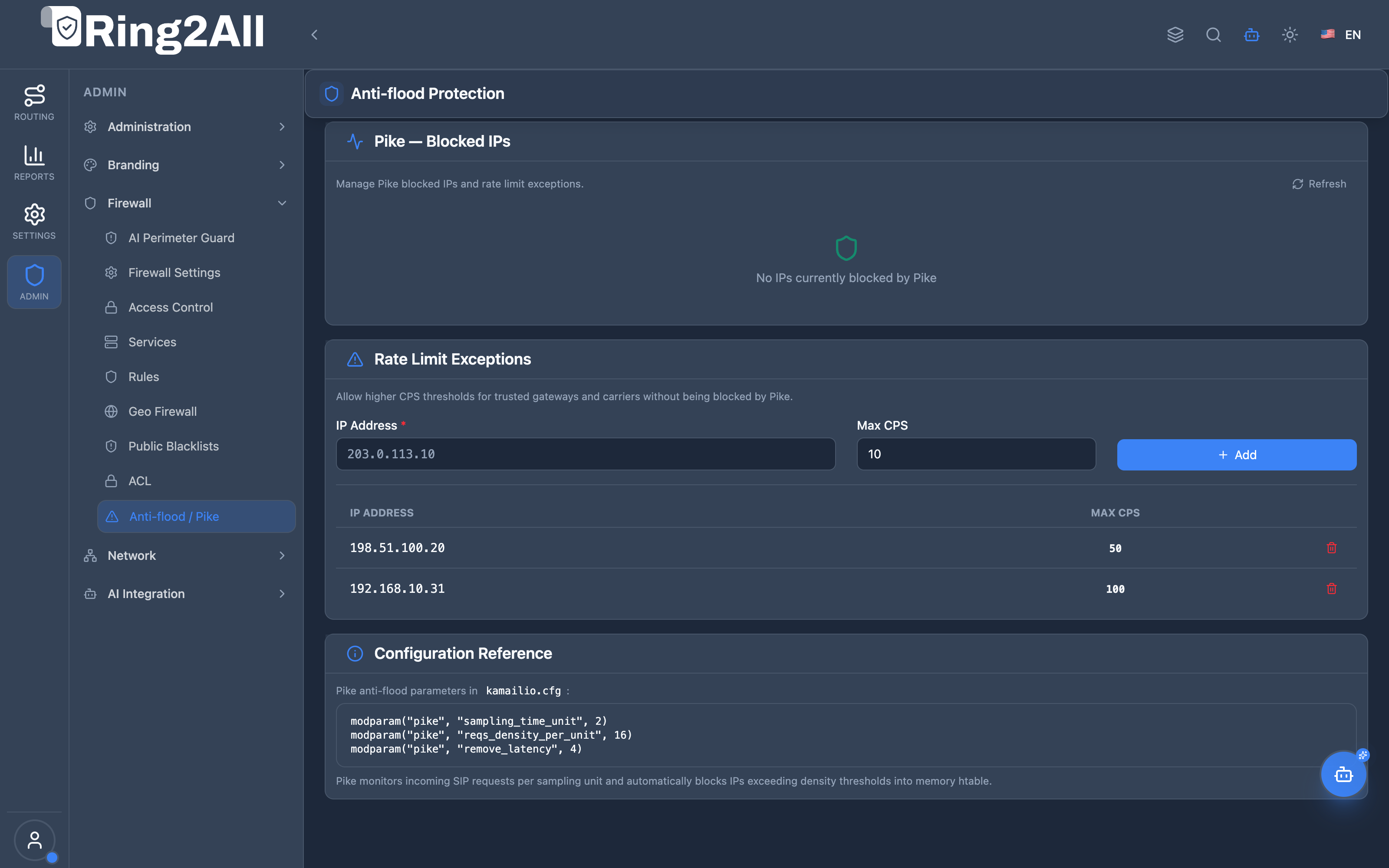
Section titled “4. Visual Interface & Layout”The Anti-flood Protection interface provides real-time RPC monitoring of active blocked hosts, a configuration dialogue for carrier CPS rate limit exceptions, and a configuration reference guide.
4.1 Anti-flood Protection & Rate Limiting View
Section titled “4.1 Anti-flood Protection & Rate Limiting View”Displays Pike blocked IPs, active carrier CPS exceptions (e.g., Tier 1 Wholesale Carrier at 50 CPS, Core PBX Cluster at 100 CPS), and kamailio.cfg parameter references.
5. Pike Heuristic Parameters & Sliding Window Math
Section titled “5. Pike Heuristic Parameters & Sliding Window Math”Pike evaluates incoming SIP request velocity using three core configuration parameters:
modparam("pike", "sampling_time_unit", 2)modparam("pike", "reqs_density_per_unit", 16)modparam("pike", "remove_latency", 4)5.1 Parameter Definitions & Impact
Section titled “5.1 Parameter Definitions & Impact”| Parameter | Default | Unit | Description |
|---|---|---|---|
sampling_time_unit |
2 |
Seconds | The time interval over which incoming requests from a single IP address are aggregated into a density bucket. |
reqs_density_per_unit |
16 |
Requests | The maximum number of requests allowed within the sampling_time_unit before an IP is marked as a flood source (~8 CPS). |
remove_latency |
4 |
Seconds | The cooldown window during which an IP remains blocked. If new packets arrive during this window, the cooldown timer resets. |
5.2 Mathematical Evaluation Formula
Section titled “5.2 Mathematical Evaluation Formula”An IP is blocked when: $$\text{Request Density} > \frac{\text{reqs_density_per_unit}}{\text{sampling_time_unit}} = \frac{16 \text{ requests}}{2 \text{ seconds}} = 8 \text{ CPS}$$
6. Rate Limit Exceptions (CPS Tuning)
Section titled “6. Rate Limit Exceptions (CPS Tuning)”Wholesale carrier interconnects, high-volume call centers, and core PBX nodes naturally exceed default consumer rate limits (8 CPS). To prevent false-positive blocks, administrators create Rate Limit Exceptions:
| Field | Type | Example | Description |
|---|---|---|---|
| IP Address | String (IPv4) | 198.51.100.20 |
The static IP address of the trusted wholesale gateway or core PBX node. |
| Max CPS | Number | 50 |
Maximum allowable Calls-Per-Second threshold before traffic throttling is considered. |
| Operational Tag | String | cps:50 (Tier 1 Wholesale) |
Internal metadata stored in kamailio.address (Group 9) informing the routing logic of the elevated threshold. |
7. Kamailio Integration & RPC Management
Section titled “7. Kamailio Integration & RPC Management”Pike evaluation is embedded in the initial request routing block of kamailio.cfg:
route[PIKE_CHECK] {    # 1. Skip Pike for trusted addresses in Group 9 (Custom CPS handled separately)    if (check_source_address("9")) {        return;    }
    # 2. Evaluate Pike density    if (!pike_check_req()) {        xlog("L_ALERT", "PIKE: High traffic flood detected from $si - dropping packet\n");        drop;    }}
7.1 Real-Time RPC Commands
Section titled “7.1 Real-Time RPC Commands”- List Blocked Hosts:
Terminal window kamcmd pike.top_list 50 - Manually Unblock an IP:
Terminal window kamcmd pike.unblock_ip "198.51.100.45"
8. Operational Best Practices & Anti-DoS Hardening
Section titled “8. Operational Best Practices & Anti-DoS Hardening”- Always Whitelist Core PBX Clusters: Ensure that all Telephony Server media and signaling nodes are registered in the Rate Limit Exceptions table with generous CPS allowances (>=100 CPS) to prevent internal cluster traffic from triggering flood filters.
- Calibrate for SIP Registration Bursts: In deployments serving large numbers of remote desk phones or softphones, power outages or network reconnects can cause thousands of simultaneous REGISTER messages. Keep
reqs_density_per_unitcalibrated accordingly. - Combine Pike with Kernel nftables: For sustained volumetric attacks exceeding 50,000 packets per second, ensure the AI Perimeter Guard or Fail2Ban pushes the offending IP down to the kernel
nftableslevel to spare userspace CPU cycles. - Avoid Sending SIP 503 or 403 Replies to Flooders: Always use
drop;in Kamailio routing logic whenpike_check_req()fails; responding to thousands of malicious packets per second doubles outbound bandwidth consumption.
9. Verification & Diagnostics
Section titled “9. Verification & Diagnostics”9.1 Query Live Pike Blocked Hosts via CLI
Section titled “9.1 Query Live Pike Blocked Hosts via CLI”Inspect the live top list of IPs currently flagged or throttled by Pike:
kamcmd pike.top_list 209.2 Inspect Rate Limit Exceptions in PostgreSQL
Section titled “9.2 Inspect Rate Limit Exceptions in PostgreSQL”Query all configured CPS rate limit exceptions in kamailio.address:
sudo -u postgres psql -d kamailio -c "SELECT id, ip_addr, mask, port, tagFROM addressWHERE grp = 9ORDER BY id ASC;"9.3 Test Manual Unblock Execution
Section titled “9.3 Test Manual Unblock Execution”Test clearing a specific IP from Pike’s memory table:
kamcmd pike.unblock_ip "198.51.100.20"10. Model Context Protocol (MCP) AI Integration
Section titled “10. Model Context Protocol (MCP) AI Integration”The Ring2All SBC MCP Server exposes dedicated volumetric defense and anti-flood tools under the antiflood_pike and security categories. Autonomous SecOps agents and the Ring2All SBC NOC Copilot can inspect real-time request density metrics, identify top traffic generators, and quickly release legitimate IP addresses accidentally throttled during sudden call surges.
10.1 Available MCP Tools
Section titled “10.1 Available MCP Tools”| Tool Name | Operation Type | Risk Level | Description |
|---|---|---|---|
get_sbc_pike_status |
Read-only | read_only |
Retrieves the real-time operational status of the Kamailio Pike engine, including sliding window settings, active memory ban counts, and top flagged IP entries. |
get_banned_ips |
Read-only | read_only |
Lists and counts all IP addresses currently blocked in Kamailio anti-flood (pike), threat intelligence (apiban), or all tables. |
unban_ip_address |
Mutating / Operational | critical |
Immediately unblocks a throttled IP address from Kamailio’s memory tables and restores SIP traffic processing. |
10.2 Tool Schemas & Parameter Definitions
Section titled “10.2 Tool Schemas & Parameter Definitions”get_sbc_pike_status
Section titled “get_sbc_pike_status”- Description: Get live Kamailio Pike anti-flood engine status, current request density metrics, and blocked IP records.
- Input Schema:
{ "type": "object", "properties": {}}get_banned_ips
Section titled “get_banned_ips”- Description: List and count all IP addresses currently blocked by Kamailio anti-flood (Pike) and APIBAN threat intelligence htables.
- Input Schema:
{ "type": "object", "properties": { "table": { "type": "string", "enum": ["all", "pike", "apiban"], "description": "Filter by protection table: 'pike' (rate limits), 'apiban' (global threat intelligence), or 'all' (default)" } }}unban_ip_address
Section titled “unban_ip_address”- Description: Unblock a banned IP address from the Kamailio security table immediately.
- Input Schema:
{ "type": "object", "properties": { "ipAddress": { "type": "string", "description": "The IP address to remove from the ban table (e.g., '198.51.100.45')" }, "reason": { "type": "string", "description": "Reason for unbanning the IP" } }, "required": ["ipAddress"]}10.3 Sample Tool Execution Payloads
Section titled “10.3 Sample Tool Execution Payloads”Example 1: Querying Pike Status & Memory Ban Counts
Section titled “Example 1: Querying Pike Status & Memory Ban Counts”Request Payload:
{ "tool": "get_sbc_pike_status", "parameters": {}}Response Payload:
{ "success": true, "data": { "module": "pike", "status": "operational", "samplingTimeUnitSec": 2, "reqsDensityPerUnit": 16, "removeLatencySec": 4, "activePikeBans": 3, "topOffenders": [ { "ip": "198.51.100.45", "hits": 48 }, { "ip": "203.0.113.19", "hits": 34 } ] }}Example 2: Releasing an Accidental Carrier Ban
Section titled “Example 2: Releasing an Accidental Carrier Ban”Request Payload:
{ "tool": "unban_ip_address", "parameters": { "ipAddress": "198.51.100.45", "reason": "Carrier burst completed; legitimate high-volume traffic" }}Response Payload:
{ "success": true, "data": { "message": "IP 198.51.100.45 unbanned successfully from Kamailio tables", "ipAddress": "198.51.100.45", "unbannedAt": "2026-09-08T11:54:00Z" }}10.4 Bilingual Natural Language Copilot Prompts
Section titled “10.4 Bilingual Natural Language Copilot Prompts”English Prompts
Section titled “English Prompts”- “Check the status of the Pike anti-flood engine and show me any IPs currently being throttled.”
→ Agent calls
get_sbc_pike_status(). - “Show all IP addresses currently blocked by the Pike module.”
→ Agent calls
get_banned_ips({"table": "pike"}). - “Unban carrier IP 198.51.100.45 because they experienced a temporary marketing campaign burst.”
→ Agent calls
unban_ip_address({"ipAddress": "198.51.100.45", "reason": "Marketing campaign traffic burst"}).
Spanish Prompts (Español)
Section titled “Spanish Prompts (Español)”- “Revisa el estado del motor anti-flood Pike y muéstrame las IPs que están siendo limitadas.”
→ Agente invoca
get_sbc_pike_status(). - “Muéstrame todas las direcciones IP bloqueadas por el módulo Pike.”
→ Agente invoca
get_banned_ips({"table": "pike"}). - “Desbloquea la IP del carrier 198.51.100.45 debido a una ráfaga legítima de tráfico.”
→ Agente invoca
unban_ip_address({"ipAddress": "198.51.100.45", "reason": "Ráfaga legítima de tráfico"}).
10.5 Enterprise Security & Execution Safeguards
Section titled “10.5 Enterprise Security & Execution Safeguards”- Microsecond Binary RPC: Pike inspections execute via
/var/run/kamailio/kamailio_ctlbinary RPC with strict 3000ms timeouts, avoiding kernel lock contention during active volumetric floods. - Wholesale Exception Verification: Before an operator or agent unbans an IP repeatedly flagged by Pike, the copilot recommends adding the host to Group 9 (
kamailio.address) with a calibrated Max CPS threshold. - Audit Journaling: Manual unbans through
unban_ip_addressrequire mandatory operational justification strings and are committed to the security audit log.
11. Glossary
Section titled “11. Glossary”- Pike: Native Kamailio traffic-shaping module designed to detect and block IP addresses generating abnormal request velocity.
- CPS (Calls Per Second): Telecommunications metric quantifying the rate of new call setups initiated per second across a trunk or interface.
- Sliding Window: Algorithmic technique that evaluates incoming event frequency over moving, overlapping time intervals rather than static clock boundaries.
- Silent Drop (
drop;): Discarding a network packet without sending an ICMP unreachable or SIP error response back to the originator. - Model Context Protocol (MCP): An open standard enabling autonomous AI assistants and NOC copilots to securely discover and invoke SBC operational tools.