

Rated CDRs & Profit Margin Analytics Module Documentation
Table of Contents
Section titled “Table of Contents”- Module Overview (Technical)
- Module Overview (Commercial & Business Value)
- 🎯 User Roles & Key Capabilities
- Visual Interface & Form Structure
- Architectural Flow & Real-Time Rating Pipeline
- Common Scenarios & Operational Playbooks
- Troubleshooting & Diagnostic Commands
- Model Context Protocol (MCP) AI Integration
- Glossary
1. Module Overview (Technical)
Section titled “1. Module Overview (Technical)”The Rated CDRs & Profit Margin Analytics module (public.cdrs_rated) acts as the high-throughput financial auditing ledger for all voice traffic traversing Ring2All Billing. Whenever a call session completes on Ring2All SBC or Ring2All PBX, the rating engine computes two parallel financial calculations:
- Retail Customer Cost: Calculated against the customer’s assigned retail Rate Card, factoring in initial/increment billing intervals (e.g., 30/6, 60/60, 1/1) and connect fees.
- Wholesale Vendor Cost: Calculated against the terminating carrier provider’s wholesale Rate Card.
- Gross Profit Margin: Derived in real time (
margin = customer_cost - vendor_cost,margin_percent = (margin / customer_cost) * 100).
PostgreSQL Schema Architecture (public.cdrs_rated)
Section titled “PostgreSQL Schema Architecture (public.cdrs_rated)”CREATE TABLE public.cdrs_rated ( id BIGSERIAL PRIMARY KEY, uuid UUID NOT NULL DEFAULT gen_random_uuid(), call_uuid VARCHAR(64) NOT NULL UNIQUE, customer_id BIGINT REFERENCES customers(id) ON DELETE SET NULL, did_provider_id BIGINT REFERENCES did_providers(id) ON DELETE SET NULL, caller_number VARCHAR(50) NOT NULL, destination_number VARCHAR(50) NOT NULL, destination_name VARCHAR(100), prefix VARCHAR(32), duration_seconds INTEGER NOT NULL, billed_seconds INTEGER NOT NULL, rate_per_minute NUMERIC(10,4) NOT NULL, cost NUMERIC(10,4) NOT NULL, vendor_rate_per_minute NUMERIC(10,4) NOT NULL, vendor_cost NUMERIC(10,4) NOT NULL, margin NUMERIC(10,4) NOT NULL, hangup_cause VARCHAR(64), status VARCHAR(20) NOT NULL DEFAULT 'completed', invoice_id BIGINT REFERENCES invoices(id) ON DELETE SET NULL, created_at TIMESTAMPTZ NOT NULL DEFAULT NOW());2. Module Overview (Commercial & Business Value)
Section titled “2. Module Overview (Commercial & Business Value)”- Instant Financial Visibility: Eliminates waiting for end-of-month carrier statements. Billing managers can monitor gross revenue, net carrier COGS (Cost of Goods Sold), and profit margins by second, minute, and day.
- Negative Margin Detection: Alerts operators when misconfigured retail rate cards or carrier price changes result in loss-making traffic, enabling immediate LCR routing adjustments on Ring2All SBC.
- Carrier Dispute Reconciliation: Detailed records capturing caller CLI, dialed destination, connect timestamp, duration, and vendor rate provide indisputable evidence during wholesale carrier billing disputes.
- Enterprise CSV Data Feeds: One-click streaming export generates comprehensive CSV summaries ready for integration with external business intelligence dashboards and ERP databases.
3. 🎯 User Roles & Key Capabilities
Section titled “3. 🎯 User Roles & Key Capabilities”| User Role | Key Permissions | Core Responsibilities & Workflows |
|---|---|---|
| Super Administrator | Full Control & Re-rating Triggers | Oversees macro financial margins, triggers batch re-rating upon retroactive rate changes, and sets system-wide margin alert thresholds. |
| Billing & Financial Analyst | Read, Filter, Export CSV | Audits traffic profitability by destination and customer, investigates zero-duration or failed call anomalies, and generates customer CDR reports. |
| Carrier Relations Manager | Vendor Cost Audit | Compares vendor cost against upstream carrier invoices, validates carrier billing increments, and negotiates wholesale volume discounts. |
| Enterprise Customer | Self-Care Read-Only CDRs | Inspects company-wide call usage, analyzes department calling spend, and downloads monthly call detail spreadsheets. |
4. Visual Interface & Form Structure
Section titled “4. Visual Interface & Form Structure”4.1 Rated CDRs Management (List View)
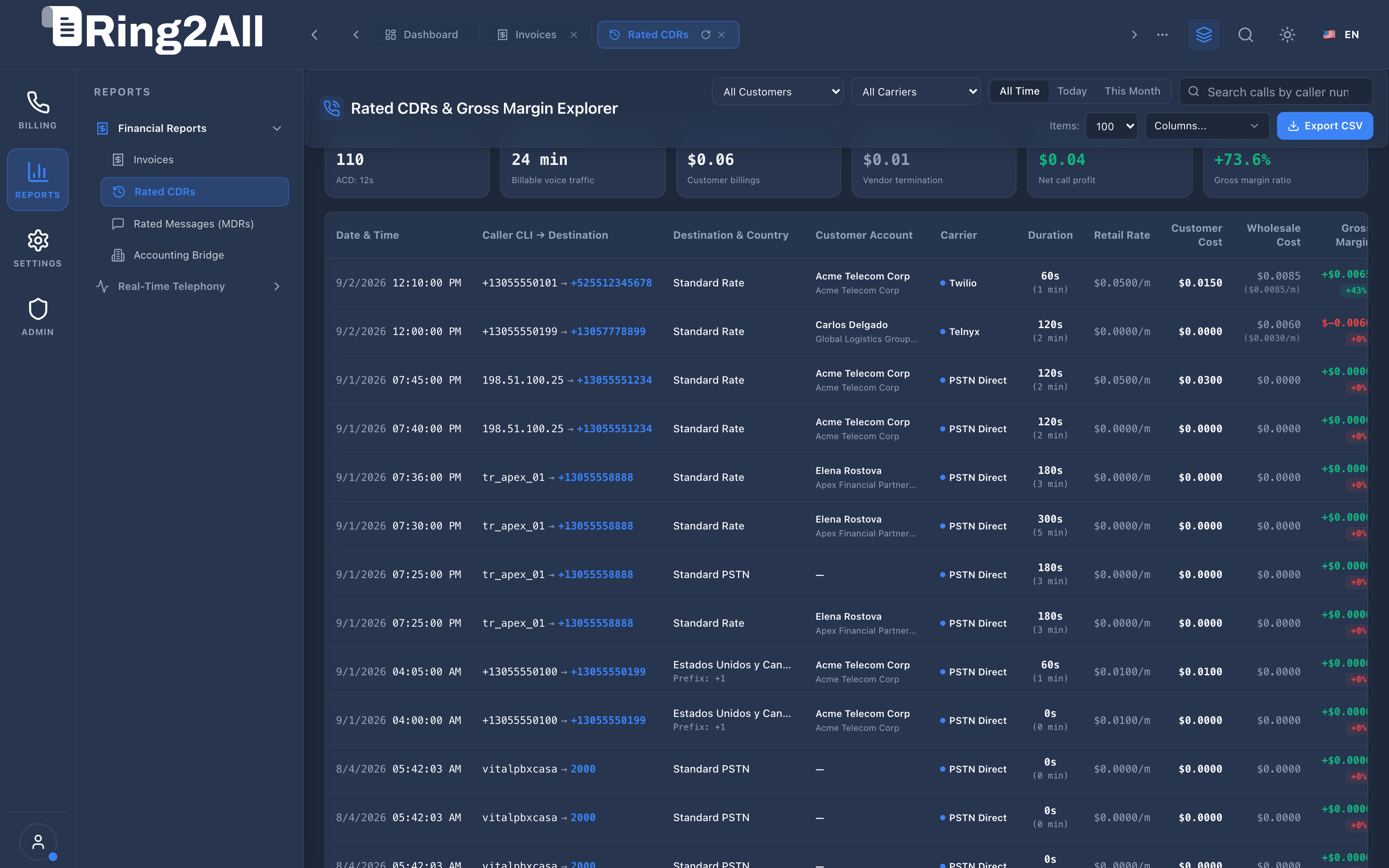
Section titled “4.1 Rated CDRs Management (List View)”The Rated CDRs Explorer provides a high-density, real-time DataGrid with KPI metric ribbons (Total Billed Calls, Total Retail Revenue, Total Vendor Cost, and Net Profit Margin), customer/carrier dropdown filters, date range selectors, and instant CSV export.
4.2 DataGrid Field Reference
Section titled “4.2 DataGrid Field Reference”| Column Header | Data Source | Format | Description & Financial Significance |
|---|---|---|---|
| Call UUID & Time | call_uuid, created_at |
Monospace String / Timestamp | Unique telecom session identifier and UTC start time. |
| Caller (CLI) | caller_number |
E.164 String | Originating phone number presented to the network. |
| Destination Number | destination_number |
E.164 String | Dialed target number with detected national/international country code. |
| Destination Name | destination_name |
String | Geographical routing tag (e.g. USA California San Francisco, United Kingdom Mobile). |
| Customer Account | customer_id |
String / Account Code | Name and account ID of the enterprise customer charged for the call. |
| Carrier Provider | did_provider_id |
String | Terminating carrier used for outbound completion (e.g. Telnyx, Twilio). |
| Duration (Sec) | duration_seconds / billed_seconds |
Integer (s) | Raw call duration alongside billed billable duration after applying increment rounding. |
| Customer Cost | cost |
$0.0000 |
Net monetary amount debited from the customer wallet or billed on invoice. |
| Vendor Cost | vendor_cost |
$0.0000 |
Wholesale cost charged by the terminating carrier provider. |
| Gross Margin | margin |
$0.0000 (%) |
Gross dollar profit and percentage margin generated by the call. |
| Hangup Cause | hangup_cause |
Monospace String | Q.850 / SIP release code (e.g. NORMAL_CLEARING, USER_BUSY, NO_ANSWER). |
5. Architectural Flow & Real-Time Rating Pipeline
Section titled “5. Architectural Flow & Real-Time Rating Pipeline” ┌────────────────────────────────────────────────────────────────────────┐ │ Call Termination on Ring2All SBC / Telephony Core │ └───────────────────────────────────┬────────────────────────────────────┘ │ (JSON CDR Event / Socket Hook) ▼ ┌────────────────────────────────────────────────────────────────────────┐ │ Step 1: Prefix Matching & Rate Resolution │ │ • Longest-prefix match against Customer Retail Rate Card │ │ • Longest-prefix match against Carrier Wholesale Rate Card │ └───────────────────────────────────┬────────────────────────────────────┘ │ ▼ ┌────────────────────────────────────────────────────────────────────────┐ │ Step 2: Interval Rounding & Rating Calculations │ │ • Apply initial/increment rule (e.g., 30s minimum + 6s steps) │ │ • Compute: `Customer Cost = Connect Fee + (Billed Min * Retail Rate)` │ │ • Compute: `Carrier Cost = (Billed Min * Wholesale Rate)` │ │ • Compute: `Margin = Customer Cost - Carrier Cost` │ └───────────────────────────────────┬────────────────────────────────────┘ │ ▼ ┌────────────────────────────────────────────────────────────────────────┐ │ Step 3: Atomic Ingestion & Balance Deduction │ │ • Insert rated record into `public.cdrs_rated` │ │ • Deduct `cost` from Customer wallet balance if Prepaid │ │ • Update real-time KPI metrics cache in Redis │ └────────────────────────────────────────────────────────────────────────┘6. Common Scenarios & Operational Playbooks
Section titled “6. Common Scenarios & Operational Playbooks”Scenario A: Identifying and Mitigating Negative Margin Routes
Section titled “Scenario A: Identifying and Mitigating Negative Margin Routes”- On the Rated CDRs page, filter by Date Range: This Month.
- Click the Gross Margin column header to sort ascending.
- If any calls display negative margin values (colored red), inspect the destination prefix and terminating carrier.
- Update the customer’s Rate Card to increase retail rates, or adjust LCR routing on Ring2All SBC to route the destination via a lower-cost carrier.
Scenario B: Generating an Audited CSV Export for Carrier Billing Reconciliation
Section titled “Scenario B: Generating an Audited CSV Export for Carrier Billing Reconciliation”- Filter the DataGrid by the target wholesale carrier (e.g.
Telnyx Wholesale Carrier) and target date range. - Click Export CSV in the toolbar.
- The browser downloads an institutional CSV file
ring2all-billing-cdrs-YYYY-MM-DD.csvcontaining raw timestamps, prefixes, exact billed seconds, and vendor costs for line-by-line comparison with the carrier’s invoice.
7. Troubleshooting & Diagnostic Commands
Section titled “7. Troubleshooting & Diagnostic Commands”Query High-Volume Low-Margin Destinations
Section titled “Query High-Volume Low-Margin Destinations”SELECT destination_name, prefix, count(*) as total_calls, sum(duration_seconds) / 60 as total_minutes, sum(cost) as total_revenue, sum(vendor_cost) as total_cogs, sum(margin) as gross_profit, round((sum(margin) / NULLIF(sum(cost), 0)) * 100, 2) as margin_percentFROM cdrs_ratedWHERE created_at >= NOW() - INTERVAL '7 days'GROUP BY destination_name, prefixORDER BY total_calls DESCLIMIT 15;Check Zero-Duration or Unbilled Rating Discrepancies
Section titled “Check Zero-Duration or Unbilled Rating Discrepancies”SELECT count(*) as unbilled_calls, sum(cost) as unbilled_totalFROM cdrs_ratedWHERE invoice_id IS NULL;8. Model Context Protocol (MCP) AI Integration
Section titled “8. Model Context Protocol (MCP) AI Integration”The Rated CDRs & Profit Margin Analytics module connects directly to the Ring2All BSS MCP Server, empowering AI data analysts and finance copilots to query call detail records, compute destination margins, and detect low-margin traffic.
Available MCP Tools
Section titled “Available MCP Tools”| Tool Name | Access Role | Description & Primary Function | Example Arguments |
|---|---|---|---|
query_rated_cdrs |
Billing Operations / Admin |
Searches and analyzes rated Call Detail Records (CDRs) with margins, duration, destination, and customer details. | {"customerId": 1, "destination": "+1305", "limit": 10} |
diagnose_unrated_cdrs |
Billing Operations / Admin |
Scans CDRs for unbilled or zero-cost calls ($0.00 with duration > 0s), aggregates unbilled minutes, potential revenue loss, and identifies unrated destination prefixes. | {"timeframeHours": 24, "limit": 10} |
diagnose_margin_leakage |
Billing Operations / Admin |
Audits carrier route margins and vendor wholesale costs to detect negative margins, financial deficits, and unprofitable termination routes. | {"minMarginPercent": 10, "timeframeHours": 24} |
diagnose_ocs_realtime_pipeline |
Telecom Engineer / Admin |
Runs deep latency and health check on the Online Charging System (OCS): database latency, balance locks, and registered voice node connectivity (PBX and SBC). | {} |
Sample MCP Tool Execution: query_rated_cdrs
Section titled “Sample MCP Tool Execution: query_rated_cdrs”Request Payload
Section titled “Request Payload”{ "name": "query_rated_cdrs", "arguments": { "customerId": 1, "limit": 5 }}Response Payload
Section titled “Response Payload”[ { "id": 48201, "callerNumber": "+13055550199", "destinationNumber": "+442079460991", "destinationName": "United Kingdom - London", "durationSeconds": 184, "customerCost": 0.0368, "vendorCost": 0.0150, "grossMargin": 0.0218, "hangupCause": "NORMAL_CLEARING", "customer": { "id": 1, "name": "Rodrigo Cuadra" }, "createdAt": "2026-09-09T04:45:10Z" }]Conversational AI Prompts for Copilot
Section titled “Conversational AI Prompts for Copilot”- “Diagnose if there are unrated CDRs or unbilled calls in the last 24 hours.”
- “Scan for margin leakage and negative profit routes with margins below 15%.”
- “Run a health check on the real-time OCS charging pipeline and telecom nodes.”
- “Show the last 10 rated calls placed by customer ID 1.”
- “Find all calls to international destinations with gross margins below 10%.”
- “What is our total call volume and revenue generated over the last 24 hours?”
9. Glossary
Section titled “9. Glossary”- Billed Seconds: The billable call duration resulting from applying contractual interval rules (e.g. 30s minimum followed by 6s increments).
- COGS (Cost of Goods Sold): The direct wholesale expenses incurred from upstream carrier providers for terminating voice minutes.
- Gross Margin: The monetary difference between what the customer was billed and what the carrier charged.
- Q.850 Hangup Cause: International telecom signaling standard defining how a call was disconnected (e.g., Code 16
NORMAL_CLEARING). - Model Context Protocol (MCP): Open protocol standard that enables secure, controlled integration between Large Language Models and external tools, databases, and telecom rating engines.