

Numbers & SIP Trunks (Client Self-Care) Module Documentation
Module Code:
billing/client/numbers-trunks
Route:/portal/telephony
Backend Service:clientService.ts(ring2all-billing-api)
Database Tables:dids,customer_ip_endpoints,customers
Brand Purity: 100% White-Label Compliant (Ring2All Billing)
Table of Contents
Section titled “Table of Contents”- Executive Summary & Commercial Autonomy
- Technical Architecture & Real-Time Sync Pipeline
- 🎯 User Roles & Key Capabilities
- Visual Interface & Screen Breakdown
- Inbound DID Routing Engine & Features
- SBC IP Whitelist & Trunk Peering Security
- Database Schema & Data Dictionary
- Diagnostic CLI & Operational Playbooks
- Domain Glossary
1. Executive Summary & Commercial Autonomy
Section titled “1. Executive Summary & Commercial Autonomy”The Numbers & SIP Trunks module provides enterprise PBX clients, wholesale VoIP aggregators, and commercial subscribers with total self-service sovereignty over their inbound telephone numbers (DIDs), outbound SIP trunk authentication credentials, and SBC IP whitelist endpoints.
+-------------------------------------------------------------------------------+| COMMERCIAL & OPERATIONAL IMPACT |+-------------------------------------------------------------------------------+| • Zero-Touch Trunk Turnup: Customers whitelist office IP addresses instantly || without engineering intervention or provisioning delays. || • Granular DID Routing: Dynamically route calls to hosted PBX extensions, || external SIP URIs, or PSTN failover destinations in real time. || • Multi-Channel Capacity: Real-time channel burst limits per number. || • Regulatory Compliance: Self-service E911 emergency registration and CNAM. |+-------------------------------------------------------------------------------+2. Technical Architecture & Real-Time Sync Pipeline
Section titled “2. Technical Architecture & Real-Time Sync Pipeline”The client portal interacts with the Ring2All Billing core API to inspect leased DIDs and manage IP-authenticated SIP trunks. When a client adds an IP endpoint, it is instantaneously committed to PostgreSQL and synced to the perimeter SBC cluster:
┌────────────────────────────────────────────────────────────────────────┐ │ Client Browser (Ring2All Billing Client Portal) │ │ Route: /portal/telephony │ └───────────────────────────────────┬────────────────────────────────────┘ │ HTTPS / JWT Auth ▼ ┌────────────────────────────────────────────────────────────────────────┐ │ Ring2All Billing API Engine (Fastify 5 / Node.js 22) │ │ Endpoints: GET /api/client/dids, POST /ip-endpoints │ └─────────────────┬──────────────────────────────────┬───────────────────┘ │ │ SQL (Atomic) │ RPC Dispatch │ (kamcmd / BINRPC) ▼ ▼ ┌───────────────────────────────────┐ ┌─────────────────────────────────┐ │ PostgreSQL 17 (ss_billing) │ │ Ring2All Perimeter SBC │ │ • public.dids │ │ • Kamailio 6.1 permissions │ │ • public.customer_ip_endpoints │ │ • Real-Time Address Reload │ │ • public.customers │ │ • Sub-millisecond Anti-Fraud │ └───────────────────────────────────┘ └─────────────────────────────────┘3. 🎯 User Roles & Key Capabilities
Section titled “3. 🎯 User Roles & Key Capabilities”The module enforces strict multi-tenant customer isolation, ensuring each subscriber only inspects and mutates their assigned telephone numbers and gateway endpoints.
| User Role | Access Level | Primary Operational Capabilities |
|---|---|---|
| Enterprise Telecom Manager | Full Access | Whitelists IP PBX addresses, routes inbound DIDs to extensions or ring groups, activates E911 and CNAM caller ID listings. |
| Wholesale Carrier Interconnect | Trunk Configuration | Configures SIP credentials, verifies IP trunk peering status, monitors channel allocations and concurrent call quotas. |
| NOC / Technical Administrator | Diagnostic & Audit | Inspects active SIP registrar URIs, reviews porting lock status, audits IP endpoint synchronization against SBC address tables. |
| Financial / Billing Auditor | Read-Only | Inspects leased DID monthly fees, setup fees, and channel surcharge metrics for accounting reconciliation. |
4. Visual Interface & Screen Breakdown
Section titled “4. Visual Interface & Screen Breakdown”4.1 Numbers & SIP Trunks Inventory Overview
Section titled “4.1 Numbers & SIP Trunks Inventory Overview”The primary interface organizes numbers, credentials, and IP endpoints into structured, responsive data cards:
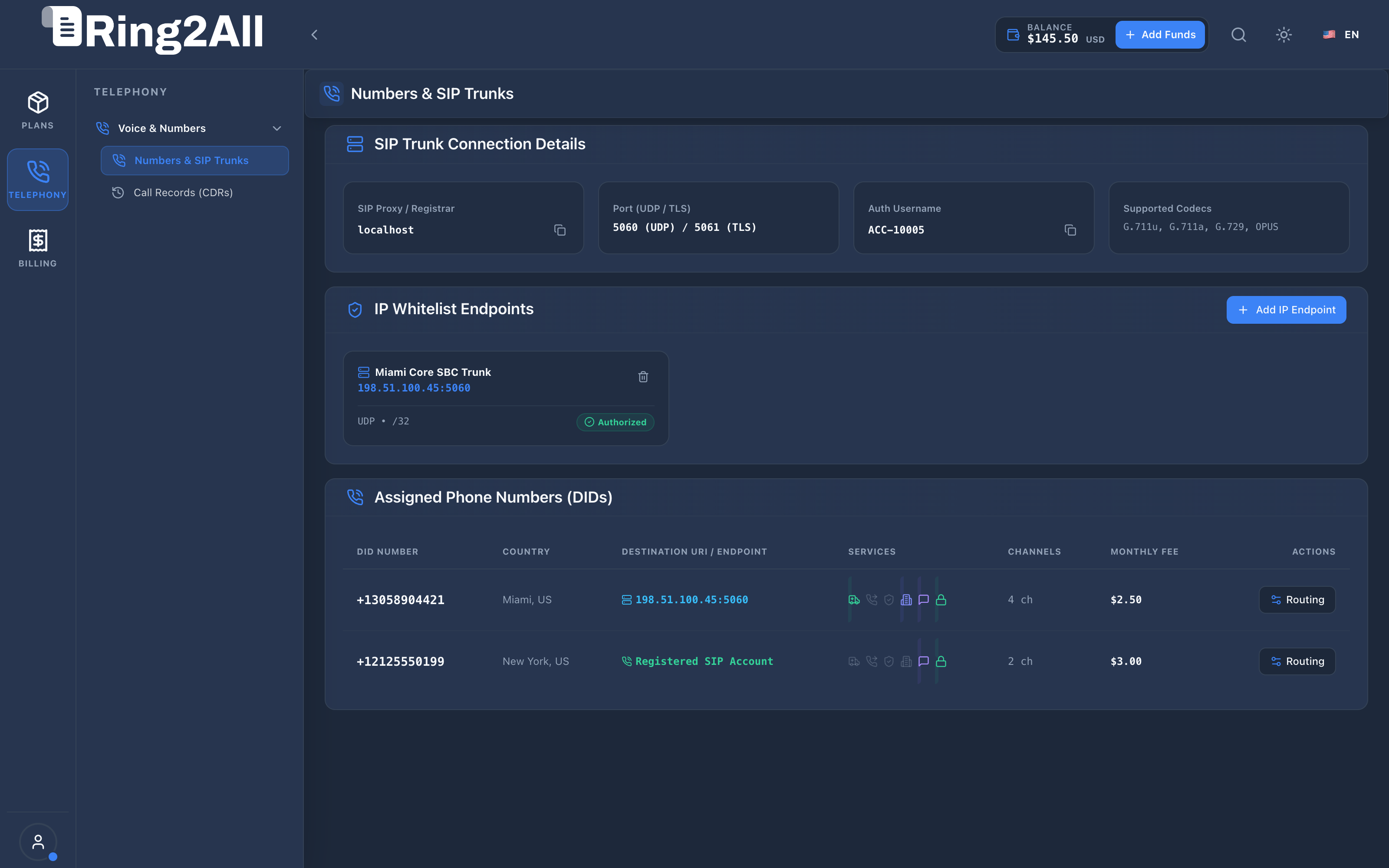
- Leased DIDs Table: Displays formatted telephone numbers, state/city location, allocated channel capacity, current routing target (e.g., Mini-PBX, IP Endpoint), and action buttons.
- SIP Credentials Card: Outlines the primary SIP Registrar host (
sbc.carrier.com), port (5060), SIP username, and interactive copy/reveal controls. - SBC IP Whitelist: Lists authorized customer PBX IP addresses with active sync status badges.
4.2 SBC IP Whitelist Provisioning Modal
Section titled “4.2 SBC IP Whitelist Provisioning Modal”Customers click Add IP Endpoint to whitelist an on-premise PBX or remote cloud gateway:
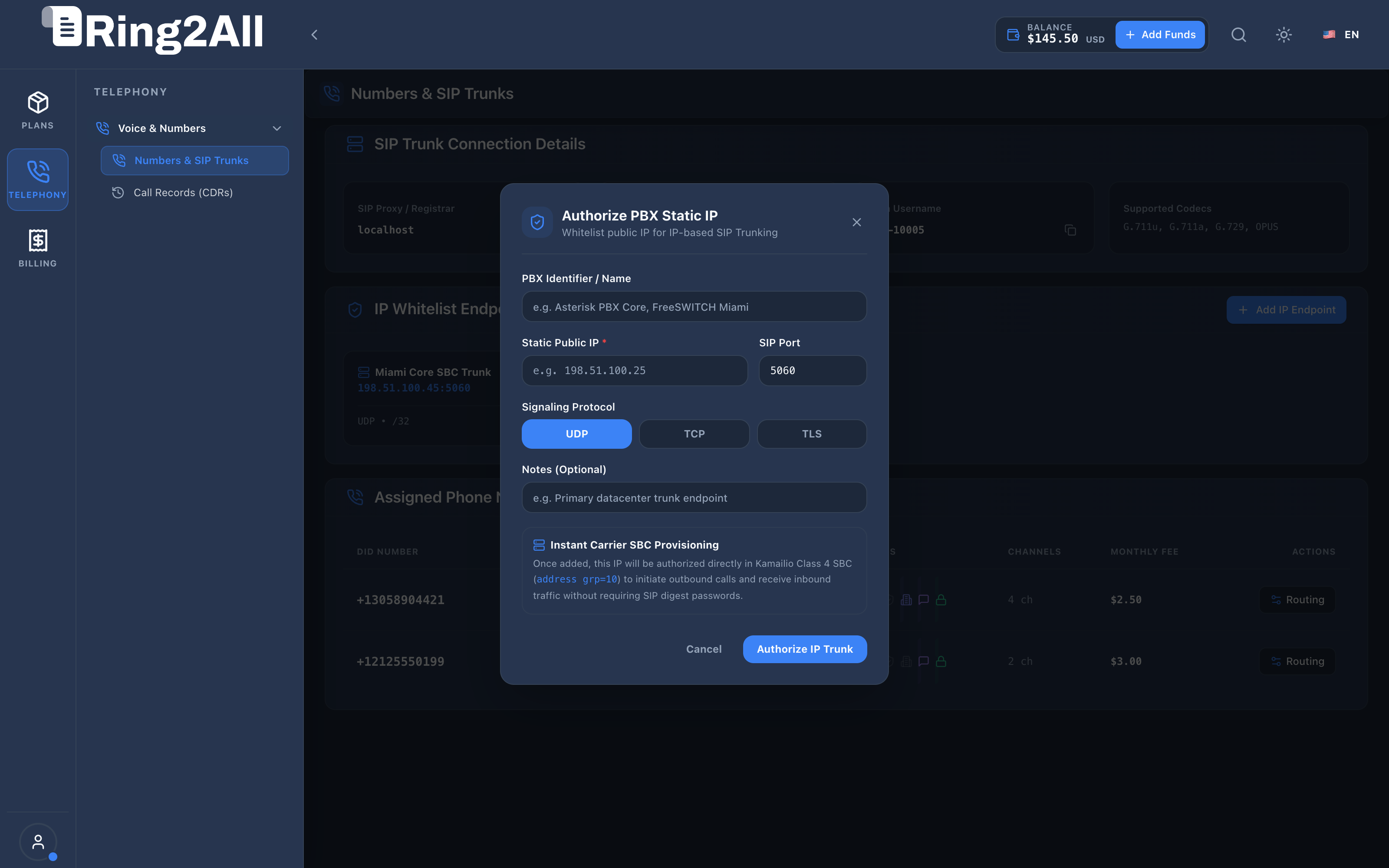
- Endpoint Name: Friendly identifier (e.g.,
Miami Core SBC Trunk). - IP Address & Port: Public IPv4 address and signaling port (default
5060). - Signaling Protocol: Protocol selection between
UDP,TCP, orTLS. - Subnet Mask: Prefix bitmask (default
/32for single host).
5. Inbound DID Routing Engine & Features
Section titled “5. Inbound DID Routing Engine & Features”The routing modal offers 4 deterministic delivery paths:
┌───────────────────────────────┐ │ Incoming Call on Leased DID │ └───────────────┬───────────────┘ │ ┌────────────────────────────┼────────────────────────────┐ │ │ │ ▼ ▼ ▼ ┌───────────────────┐ ┌───────────────────┐ ┌───────────────────┐ │ Hosted PBX │ │ Customer Trunk │ │ External SIP URI │ │ Delivered to │ │ Dispatched to │ │ Forwarded via SIP │ │ Cloud Extension │ │ Whitelisted IP │ │ Proxy to URI │ └───────────────────┘ └───────────────────┘ └───────────────────┘- Route to Hosted PBX Domain: Directly hands the call off to Ring2All PBX routing scripts for extension, IVR, or call center queue processing.
- Route to IP Trunk Endpoint: Bypasses PBX IVR logic and sends SIP INVITE directly to the customer’s on-premise SBC or IP PBX.
- Route to Smart DID (Línea Plus / AI Line): Hands the call to the stateless smart line engine (
smart-lines.ring2all.internal) for autonomous call screening, interactive mini-IVR, call forwarding, and real-time voice AI. - Emergency Failover Forwarding: If the primary IP PBX returns SIP
503 Service Unavailableor fails to respond within 20 seconds, the call automatically diverts to an external PSTN mobile number. - E911 & CNAM Services: Includes self-service address provisioning for North American emergency caller location identification.
5.1 Smart DIDs: Línea Plus vs. Línea Plus + AI (Autonomous Virtual Lines)
Section titled “5.1 Smart DIDs: Línea Plus vs. Línea Plus + AI (Autonomous Virtual Lines)”For businesses, professionals, and remote agents who do not require a complex multi-tenant PBX with dozens of extensions, Ring2All BSS provides Smart DIDs (Autonomous Virtual Lines). These lines eliminate the need to provision dedicated subdomains, Nginx SSL certificates, or heavy PBX configurations.
┌────────────────────────────────────────────────────────────────────────┐│ Smart Line Delivery & Fallback Architecture │└───────────────────────────────────┬────────────────────────────────────┘ │ Inbound PSTN Call ▼┌────────────────────────────────────────────────────────────────────────┐│ Ring2All SBC (Kamailio 6.1) ││ Dispatches to: smart-lines.ring2all.internal │└───────────────────────────────────┬────────────────────────────────────┘ │ Stateless Load Balancing ▼┌────────────────────────────────────────────────────────────────────────┐│ FreeSWITCH Smart Router (Lua Engine) ││ • Time Schedule Filter (e.g. 09:00 - 18:00) ││ • Personal Assistant (Interactive Mini-IVR DTMF) │└───────────────────┬────────────────────────────────┬───────────────────┘ │ │ [Plan: Línea Plus + AI] [Plan: Línea Plus] ▼ ▼┌───────────────────────────────────┐ ┌─────────────────────────────────┐│ RealTime Voice AI Agent │ │ Direct Telecom Routing ││ • OpenAI Natural Speech (Alloy) │ │ • 100% Traditional Telephony ││ • RAG Knowledge Base Injection │ │ • 0 Tokens / $0.00 AI Cost ││ • Assisted Transfer to Mobile │ │ • Low-latency Local Bridging │└───────────────────┬───────────────┘ └─────────────────┬───────────────┘ │ │ └─────────────────┬──────────────────┘ │ Call Bridge to Destination ▼ ┌─────────────────────────────────────────────────┐ │ Target 1: Registered Softphone (SBC) │ │ Target 2: Customer IP PBX (SIP URI) │ │ Target 3: Mobile Phone (PSTN Cellular) │ └────────────────────────┬────────────────────────┘ │ Unanswered / Busy / Offline ▼ ┌─────────────────────────────────────────────────┐ │ Cloud Smart Voicemail Rescue │ │ • Audio WAV saved in BSS Cloud Portal │ │ • Instant Voicemail Transcription (AI) │ └─────────────────────────────────────────────────┘Commercial Tiers
Section titled “Commercial Tiers”- 📦 Línea Plus (Standard Telecom):
- Included Capabilities: Personal Assistant (Mini-IVR with custom DTMF options), Follow-Me call forwarding with customizable ring timeouts (5-60s), time-of-day scheduling, and digital Cloud Voicemail (WAV audio player in client portal).
- Resource Consumption: 100% native FreeSWITCH/Kamailio processing with $0.00 OpenAI cost and 0 tokens consumed.
- 🤖 Línea Plus + AI (Pro AI Assistant):
- Included Capabilities: Everything in Línea Plus plus the RealTime Voice AI Agent (OpenAI), selectable neural voices, natural conversation pacing, document knowledge base injection (RAG with vector embeddings), live transfer to mobile, and automated voicemail transcription.
Terminal & Forwarding Flexibility
Section titled “Terminal & Forwarding Flexibility”A Smart DID is not restricted to cell phones; subscribers can choose how they answer incoming calls:
- Registered Mobile Softphone / IP Deskphone: The user registers any SIP terminal (Zoiper, Grandstream Wave, Yealink) against the Ring2All SBC. When a call arrives, the softphone rings directly.
- Customer On-Premise PBX: Bridges directly via SIP URI (e.g.,
sip:sales@pbx.customer.com). - PSTN Cellular Phone: Rings the user’s mobile cellular number directly.
- Cloud Voicemail Rescue Fallback: In all three options, if the softphone is asleep/offline, the PBX is down, or the mobile user does not answer within the configured timeout, Ring2All retrieves the call immediately and sends the caller to the Cloud Voicemail box.
5.2 Zero-Touch Softphone Connectivity (RFC 3263)
Section titled “5.2 Zero-Touch Softphone Connectivity (RFC 3263)”Subscribers do not need to enter an Outbound Proxy in their softphones or IP hardware. Thanks to RFC 3263 DNS discovery and Kamailio SBC routing:
- SIP Domain:
sip.ring2all.com - Username / Account: Provided in the SIP Trunk Connection Details card.
- Password: Generated securely in the client portal.
- Outbound Proxy: (Leave Blank)
6. SBC IP Whitelist & Trunk Peering Security
Section titled “6. SBC IP Whitelist & Trunk Peering Security”To prevent unauthorized call termination and toll fraud:
- Carrier SBC Enforcement: Every outbound call arriving at the SBC is cross-checked against
customer_ip_endpoints. If the source IP does not match the customer’s registered trunk, the call is rejected immediately withSIP/2.0 403 Forbidden. - Zero Registration Overhead: IP-authenticated trunks require no SIP REGISTER packets, eliminating CPU overhead on Telephony Server and Kamailio.
- Instant In-Memory Invalidation: When a customer deletes an IP endpoint in the portal, an atomic RPC command deletes the IP from Kamailio’s
permissionshtable in less than 50 milliseconds.
7. Database Schema & Data Dictionary
Section titled “7. Database Schema & Data Dictionary”Table: public.dids
Section titled “Table: public.dids”CREATE TABLE public.dids ( id BIGSERIAL PRIMARY KEY, uuid UUID NOT NULL DEFAULT gen_random_uuid(), number VARCHAR(32) NOT NULL UNIQUE, customer_id BIGINT REFERENCES customers(id) ON DELETE SET NULL, country VARCHAR(2) NOT NULL DEFAULT 'US', area_code VARCHAR(10), city VARCHAR(100), setup_fee NUMERIC(10,2) NOT NULL DEFAULT 0.00, monthly_rate NUMERIC(10,2) NOT NULL DEFAULT 0.00, channels INTEGER NOT NULL DEFAULT 2, route_type VARCHAR(30) NOT NULL DEFAULT 'sip_account', route_target VARCHAR(255), status VARCHAR(20) NOT NULL DEFAULT 'available', assigned_at TIMESTAMPTZ, e911_enabled BOOLEAN NOT NULL DEFAULT false, e911_caller_name VARCHAR(100), e911_address TEXT, ip_endpoint_id BIGINT REFERENCES customer_ip_endpoints(id) ON DELETE SET NULL, cnam_listing_enabled BOOLEAN NOT NULL DEFAULT false, messaging_enabled BOOLEAN NOT NULL DEFAULT false, is_porting_locked BOOLEAN NOT NULL DEFAULT true, created_at TIMESTAMPTZ NOT NULL DEFAULT NOW(), updated_at TIMESTAMPTZ NOT NULL DEFAULT NOW());Table: public.customer_ip_endpoints
Section titled “Table: public.customer_ip_endpoints”CREATE TABLE public.customer_ip_endpoints ( id BIGSERIAL PRIMARY KEY, uuid UUID NOT NULL DEFAULT gen_random_uuid(), customer_id BIGINT NOT NULL REFERENCES customers(id) ON DELETE CASCADE, name VARCHAR(100) NOT NULL DEFAULT 'Main PBX', ip_address VARCHAR(45) NOT NULL, port INTEGER NOT NULL DEFAULT 5060, transport VARCHAR(10) NOT NULL DEFAULT 'udp', mask INTEGER NOT NULL DEFAULT 32, description TEXT, status VARCHAR(20) NOT NULL DEFAULT 'active', sbc_synced BOOLEAN NOT NULL DEFAULT false, created_at TIMESTAMPTZ NOT NULL DEFAULT NOW(), updated_at TIMESTAMPTZ NOT NULL DEFAULT NOW(), CONSTRAINT uq_customer_ip UNIQUE (customer_id, ip_address, port));8. Diagnostic CLI & Operational Playbooks
Section titled “8. Diagnostic CLI & Operational Playbooks”Verify SBC Address Table Reload
Section titled “Verify SBC Address Table Reload”To verify that a customer’s IP endpoint has been pushed to Kamailio SBC memory:
# Execute on Perimeter SBC hostkamcmd permissions.addressDumpTrace Inbound Routing on Telephony Server
Section titled “Trace Inbound Routing on Telephony Server”# Filter ESL events for customer DIDfs_cli -x "sofia status profile external"fs_cli -x "luarun show_did_routing.lua +13058904421"9. Domain Glossary
Section titled “9. Domain Glossary”- DID (Direct Inward Dialing): Virtual telephone number routed over IP to a subscriber terminal.
- IP Endpoint: Public IP address authorized to peer with the SBC without digest authentication.
- CNAM: Caller ID Name database lookup protocol providing 15-character caller names.
- E911: Enhanced 911 location identification protocol transmitting physical address data to PSAP dispatchers.