

ERP Accounting Bridge & Cryptographic Webhooks Module Documentation
Table of Contents
Section titled “Table of Contents”- Module Overview (Technical)
- Module Overview (Commercial & Business Value)
- 🎯 User Roles & Key Capabilities
- Visual Interface & Form Structure
- Architectural Flow & Double-Entry Accounting Engine
- Common Scenarios & Operational Playbooks
- Troubleshooting & Diagnostic Commands
- Model Context Protocol (MCP) AI Integration
- Glossary
1. Module Overview (Technical)
Section titled “1. Module Overview (Technical)”The ERP Accounting Bridge & Cryptographic Webhooks module (public.accounting_mappings, public.webhook_endpoints, and public.webhook_logs) bridges the operational telecom revenue engine of Ring2All Billing with institutional Enterprise Resource Planning (ERP) accounting platforms (such as QuickBooks Online, Xero, Odoo, SAP, and NetSuite).
Core Components & Subsystems
Section titled “Core Components & Subsystems”- Chart of Accounts Mapping (
public.accounting_mappings): Maps internal billing transaction categories directly to standard general ledger account codes (Assets, Liabilities, Equity, Revenue, COGS, and Expenses). - Double-Entry General Journal Export: Generates balanced debit and credit journal entry exports adhering to standard GAAP and IFRS accrual accounting principles.
- Cryptographic Webhooks Engine (
public.webhook_endpoints): Dispatches real-time HTTPS webhooks signed with HMAC-SHA256 cryptographic signatures to external ERP listeners upon key financial events.
-- Chart of Accounts Mapping SchemaCREATE TABLE public.accounting_mappings (    id BIGSERIAL PRIMARY KEY,    category VARCHAR(50) NOT NULL UNIQUE,    account_code VARCHAR(50) NOT NULL,    account_name VARCHAR(100) NOT NULL,    description TEXT,    updated_at TIMESTAMPTZ NOT NULL DEFAULT NOW());
-- Cryptographic Webhooks SchemaCREATE TABLE public.webhook_endpoints (    id BIGSERIAL PRIMARY KEY,    uuid UUID NOT NULL DEFAULT gen_random_uuid(),    url VARCHAR(255) NOT NULL,    secret VARCHAR(100) NOT NULL,    events TEXT[] NOT NULL,    is_active BOOLEAN NOT NULL DEFAULT true,    created_at TIMESTAMPTZ NOT NULL DEFAULT NOW(),    updated_at TIMESTAMPTZ NOT NULL DEFAULT NOW());
Cryptographic Webhook Security Specification
Section titled “Cryptographic Webhook Security Specification”All outbound HTTP POST payloads include an HMAC-SHA256 signature in the HTTP header:
POST /api/billing/webhook HTTP/1.1Host: erp.acmetelecom.comContent-Type: application/jsonX-Ring2All-Signature: sha256=4f5a6b7c8d9e0f1a2b3c4d5e6f7a8b9c0d1e2f3a4b5c6d7e8f9a0b1c2d3e4f5aX-Ring2All-Event: invoice.paidX-Ring2All-Timestamp: 1788806400External ERP receivers verify message integrity and authenticity by computing hmac_sha256(payload, webhook_secret).
2. Module Overview (Commercial & Business Value)
Section titled “2. Module Overview (Commercial & Business Value)”- Elimination of Double-Entry Bookkeeping: Automatically translates thousands of metered telecom micro-transactions into summarized, balanced General Journal entries, eliminating human bookkeeping errors.
- Instant Financial Closing: Enables financial controllers to close monthly books in minutes rather than weeks through one-click CSV journal export and live webhook reconciliation.
- Zero-Trust Enterprise Security: Cryptographic HMAC-SHA256 request signing ensures that external accounting systems only process legitimate, unaltered financial transactions originating from the authenticated billing platform.
- Real-Time Event Notification: Financial webhooks allow downstream CRM, ERP, and payment management software to respond immediately when payments clear or accounts fall into delinquency.
3. 🎯 User Roles & Key Capabilities
Section titled “3. 🎯 User Roles & Key Capabilities”| User Role | Key Permissions | Core Responsibilities & Workflows |
|---|---|---|
| Super Administrator | Full Control & Webhook Secret Management | Configures ERP endpoints, manages HMAC signing secrets, and configures automated retry policies. |
| Chief Financial Officer / Lead Accountant | Chart of Accounts & Journal Export | Configures general ledger account codes, audits balanced debit/credit reconciliations, and downloads monthly ERP journal exports. |
| Integration Engineer | Webhook Debugging & Payload Inspection | Inspects HTTP response statuses in the delivery log, diagnoses endpoint timeouts, and verifies payload schema structures. |
| Financial Auditor | Read-Only Ledger Verification | Inspects audit trails, verified delivery timestamps, and general ledger journal accuracy. |
4. Visual Interface & Form Structure
Section titled “4. Visual Interface & Form Structure”4.1 Chart of Accounts Configuration (Tab 1)
Section titled “4.1 Chart of Accounts Configuration (Tab 1)”The Chart of Accounts tab allows accountants to map platform revenue streams, carrier costs, and sales tax liabilities to their corporate ERP ledger codes.
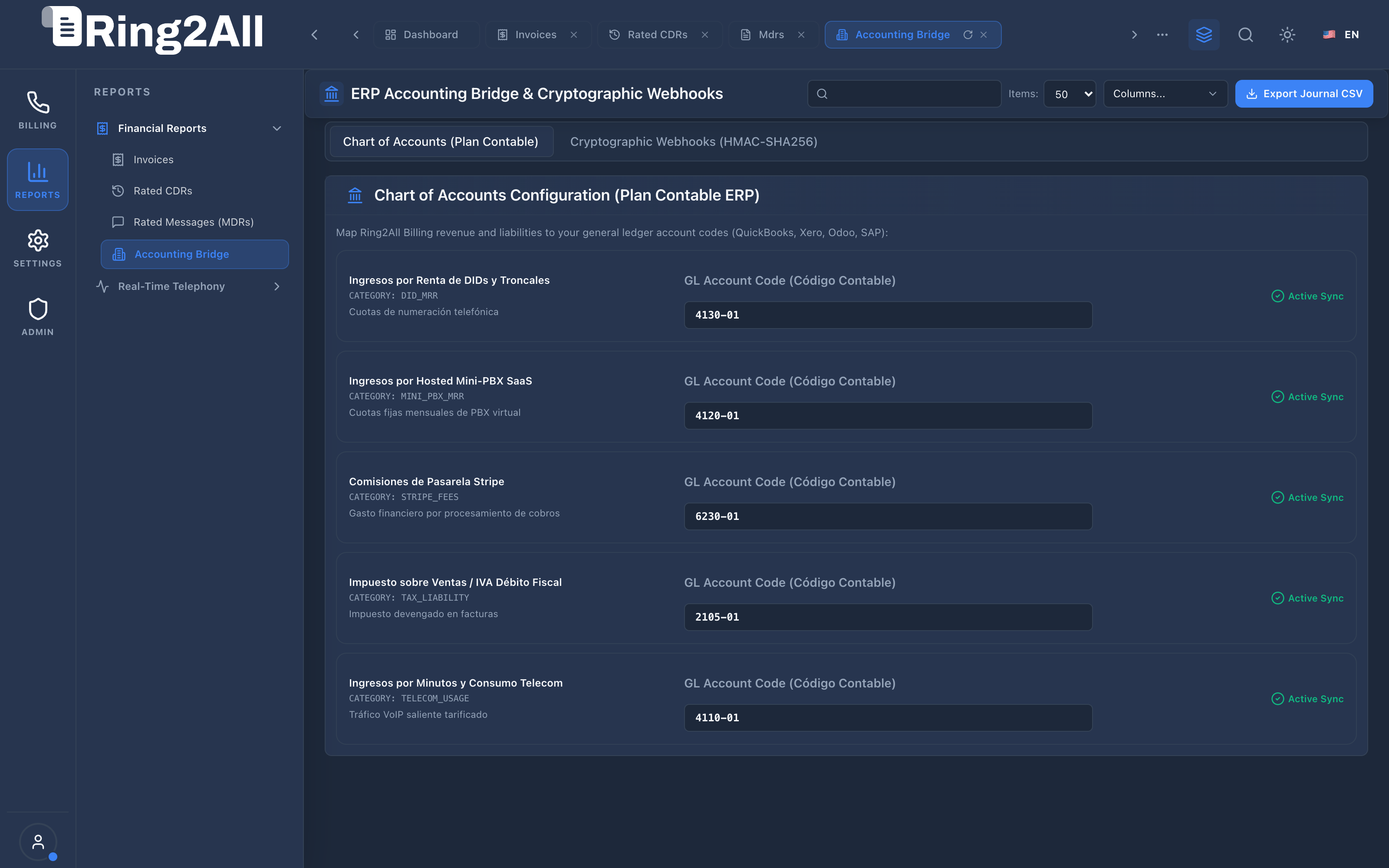
4.2 Cryptographic Webhooks & Delivery Logs (Tab 2)
Section titled “4.2 Cryptographic Webhooks & Delivery Logs (Tab 2)”The Webhooks tab manages active HTTPS webhook endpoints, secret keys, subscribed events, and an interactive real-time inspection log tracking HTTP response codes and retry counts.
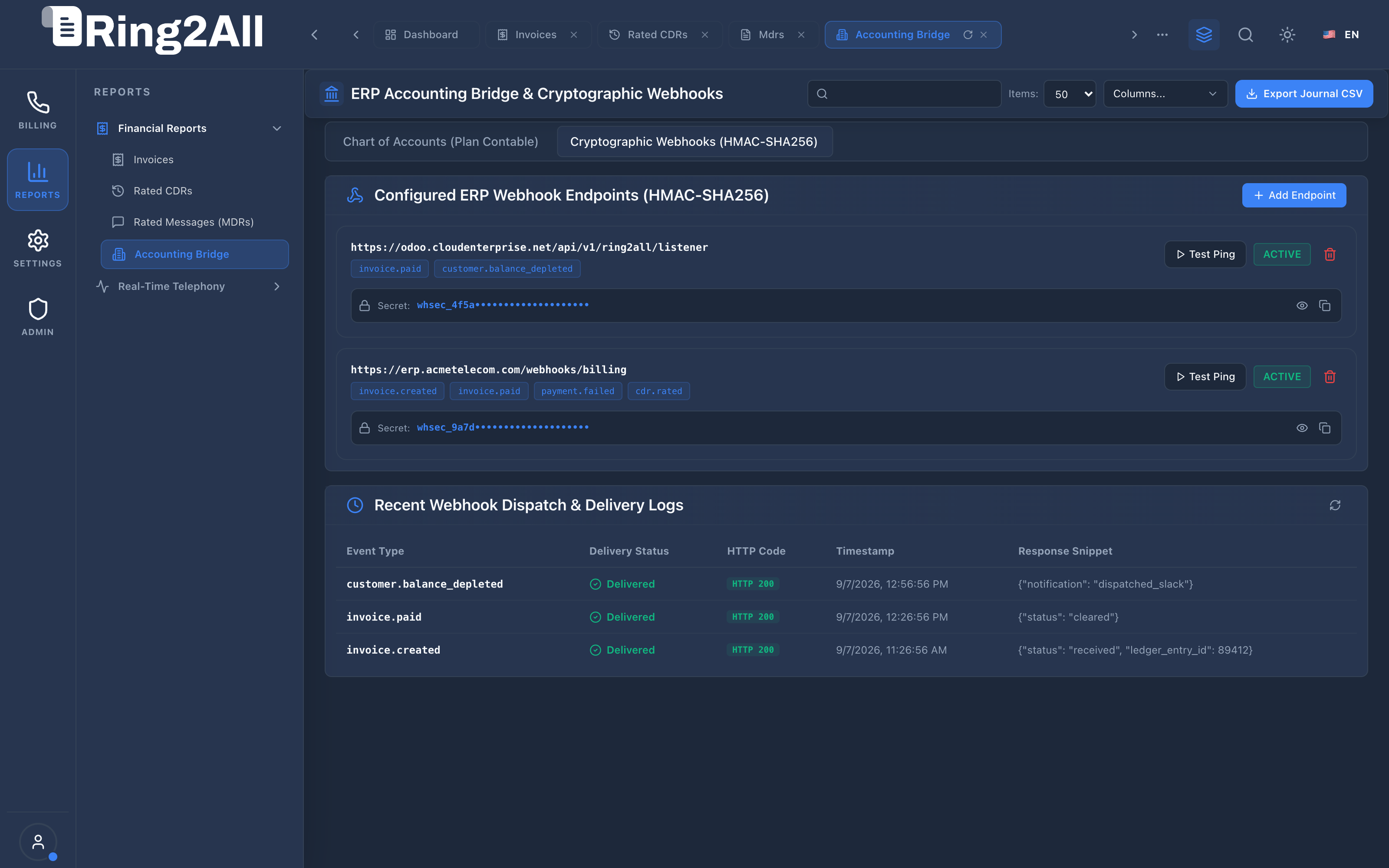
4.3 General Journal CSV Export Modal
Section titled “4.3 General Journal CSV Export Modal”Operators can export balanced general ledger journal entries for any historical date range, configured specifically for import into QuickBooks, Xero, Odoo, or SAP.
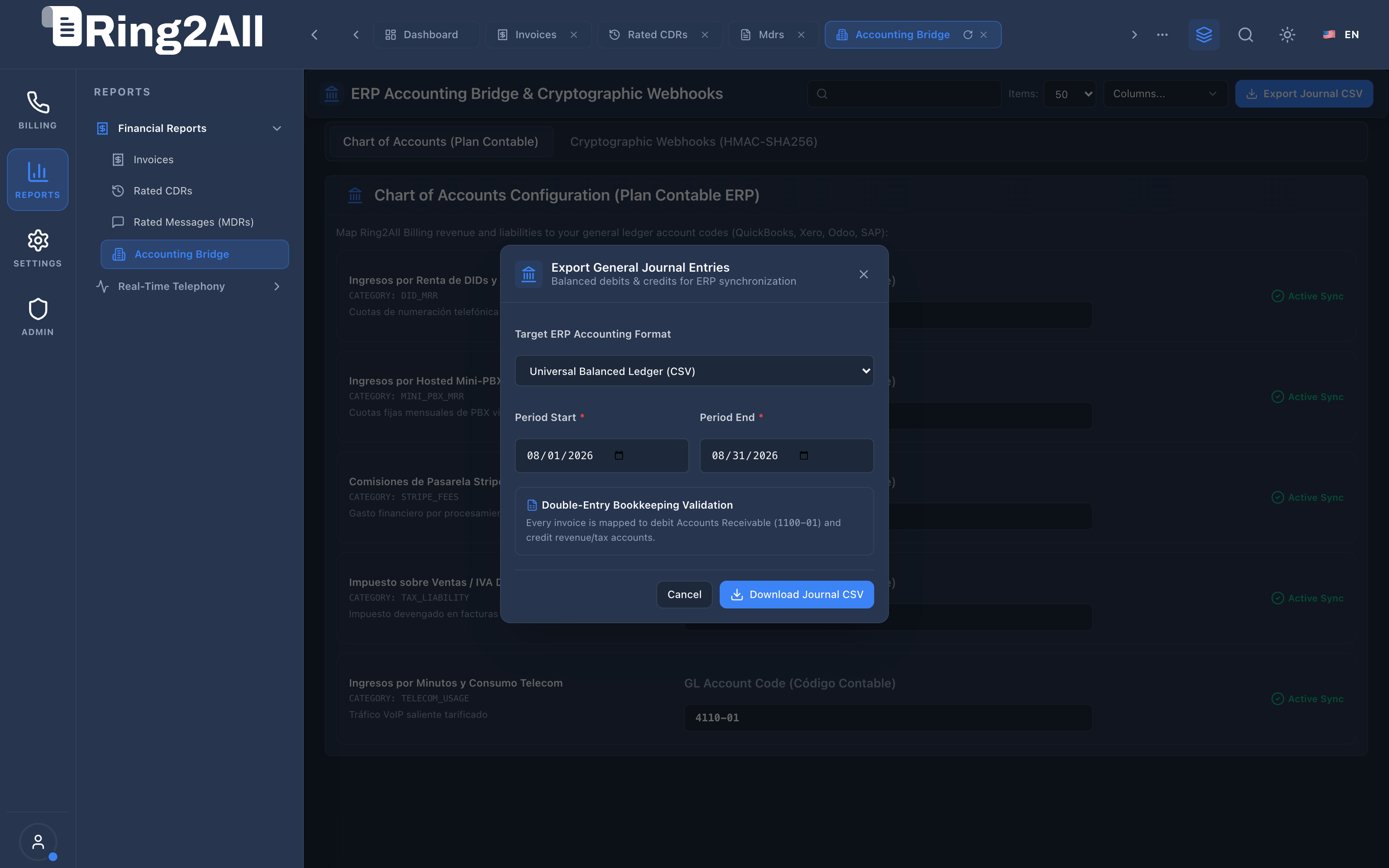
4.4 Default Chart of Accounts Categories
Section titled “4.4 Default Chart of Accounts Categories”| Financial Category | Default Account Code | Default Account Name | Normal Balance | Description |
|---|---|---|---|---|
voice_revenue |
4000 |
Voice Usage Revenue | Credit | Metered outbound and inbound voice call usage revenue from rated CDRs. |
subscription_revenue |
4100 |
Plan Subscription Revenue | Credit | Recurring monthly subscription fees billed for hosted PBX and trunk plans. |
did_revenue |
4200 |
DID & Number Revenue | Credit | Recurring and setup fees collected for wholesale and retail DID numbers. |
sales_tax_payable |
2100 |
Sales & Telecom Tax Payable | Credit | Collected municipal, state, and federal telecom taxes and regulatory fees. |
carrier_cogs |
5000 |
Carrier Termination COGS | Debit | Direct wholesale costs incurred from terminating carrier providers. |
customer_wallet_liability |
2200 |
Customer Prepaid Liability | Credit | Unearned customer prepaid deposits held in wallets prior to usage. |
5. Architectural Flow & Double-Entry Accounting Engine
Section titled “5. Architectural Flow & Double-Entry Accounting Engine” ┌────────────────────────────────────────────────────────────────────────┐ │ Billing Event (e.g. Invoice Finalized) │ └───────────────────────────────────┬────────────────────────────────────┘ │ ┌────────────────────────┴────────────────────────┐ │ │ ▼ (Batch General Journal) ▼ (Real-Time Webhook) ┌───────────────────────────────────────┐ ┌───────────────────────────────────────┐ │ Double-Entry Ledger Balancing │ │ Cryptographic Signing Engine │ │ • Debit: Accounts Receivable (1200) │ │ • Generate payload JSON string │ │ • Credit: Voice Revenue (4000) │ │ • Compute HMAC-SHA256 with secret │ │ • Credit: Sales Tax Payable (2100) │ │ • Set `X-Ring2All-Signature` header │ └──────────────────┬────────────────────┘ └──────────────────┬────────────────────┘ │ │ ▼ ▼ ┌───────────────────────────────────────┐ ┌───────────────────────────────────────┐ │ Export Balanced Journal CSV │ │ HTTPS POST to External ERP Listener │ │ • Compatible with QuickBooks / Odoo │ │ • Log HTTP response status in DB │ └───────────────────────────────────────┘ └───────────────────────────────────────┘6. Common Scenarios & Operational Playbooks
Section titled “6. Common Scenarios & Operational Playbooks”Scenario A: Adding an Odoo ERP Webhook Listener
Section titled “Scenario A: Adding an Odoo ERP Webhook Listener”- Navigate to REPORTS / Financial Reports / Account Bridge.
- Select the Cryptographic Webhooks tab.
- Click Add Webhook Endpoint.
- Enter your ERP listener URL (e.g.
https://erp.yourcompany.com/api/v1/billing/webhook). - Select target events:
invoice.created,invoice.paid, andcustomer.balance_depleted. - Copy the generated HMAC secret key into your ERP webhook signature verifier and click Save Endpoint.
Scenario B: Exporting Monthly Journal Entries for Financial Closing
Section titled “Scenario B: Exporting Monthly Journal Entries for Financial Closing”- In the Account Bridge module, click Export Journal CSV in the top action toolbar.
- Select the Period Start and Period End dates (e.g., first and last day of the target month).
- Click Download Journal CSV. The system generates a balanced double-entry spreadsheet where Total Debits equal Total Credits.
7. Troubleshooting & Diagnostic Commands
Section titled “7. Troubleshooting & Diagnostic Commands”Inspect Failed Webhook Delivery Logs
Section titled “Inspect Failed Webhook Delivery Logs”SELECT l.id, e.url, l.event_type, l.response_status, l.attempts, l.created_atFROM webhook_logs lJOIN webhook_endpoints e ON e.id = l.endpoint_idWHERE l.response_status IS NULL OR l.response_status >= 400ORDER BY l.created_at DESCLIMIT 10;Verify Chart of Accounts Completeness
Section titled “Verify Chart of Accounts Completeness”SELECT category, account_code, account_nameFROM accounting_mappingsORDER BY account_code ASC;8. Model Context Protocol (MCP) AI Integration
Section titled “8. Model Context Protocol (MCP) AI Integration”The ERP Accounting Bridge & Cryptographic Webhooks module connects directly to the Ring2All BSS MCP Server, enabling financial copilots and accounting auditors to inspect chart of accounts mappings and retrieve summarized double-entry ledger totals.
Available MCP Tools
Section titled “Available MCP Tools”| Tool Name | Access Role | Description & Primary Function | Example Arguments |
|---|---|---|---|
get_accounting_journal_summary |
Billing Operations / Admin |
Retrieves summary of double-entry general ledger journal entries and mapped accounts for finance reconciliation. | {"startDate": "2026-09-01", "endDate": "2026-09-30"} |
Sample MCP Tool Execution: get_accounting_journal_summary
Section titled “Sample MCP Tool Execution: get_accounting_journal_summary”Request Payload
Section titled “Request Payload”{ "name": "get_accounting_journal_summary", "arguments": { "startDate": "2026-09-01", "endDate": "2026-09-30" }}Response Payload
Section titled “Response Payload”{ "period": { "startDate": "2026-09-01", "endDate": "2026-09-30" }, "totalDebits": 14520.80, "totalCredits": 14520.80, "isBalanced": true, "mappedAccountsCount": 8, "mappings": [ { "category": "voice_usage_revenue", "accountCode": "4000", "accountName": "Voice Usage Revenue" }, { "category": "carrier_cogs", "accountCode": "5000", "accountName": "Carrier Termination Expense" } ]}Conversational AI Prompts for Copilot
Section titled “Conversational AI Prompts for Copilot”- “Provide the accounting journal summary and trial balance for September 2026.”
- “Are all revenue and expense categories mapped to active General Ledger accounts?”
- “Verify if total debits match total credits for the current billing cycle.”
9. Glossary
Section titled “9. Glossary”- Account Bridge: The integration layer linking telecom rating transactions to institutional accounting general ledgers.
- COGS (Cost of Goods Sold): Direct variable wholesale carrier fees incurred in delivering telephony minutes.
- Double-Entry Bookkeeping: Accounting standard requiring every transaction to record equal and offsetting debit and credit entries.
- HMAC-SHA256: Keyed-hash message authentication code ensuring payload integrity and origin authenticity.
- Webhook: An automated HTTP callback triggered by an event in Ring2All Billing and dispatched to an external server.
- Model Context Protocol (MCP): Open protocol standard that enables secure, controlled integration between Large Language Models and external tools, databases, and telecom rating engines.