

Media Engines (RTPEngine)
Table of Contents
Section titled “Table of Contents”- Overview & Media Plane Architecture
- Business & Operational Significance
- 🎯 User Roles & Key Capabilities
- Visual Interface & Layout
- Field Reference & Media Node Parameters
- Kamailio RTPEngine NG Protocol Mechanics
- Kernel-Space Forwarding (
xt_RTPENGINE) Performance - Troubleshooting & Verification
- Model Context Protocol (MCP) AI Integration
- Glossary
1. Overview & Media Plane Architecture
Section titled “1. Overview & Media Plane Architecture”In Ring2All SBC, the Media Engines module coordinates, load-balances, and monitors the distributed cluster of RTPEngine media proxy daemons. While Kamailio manages the SIP signaling plane, RTPEngine anchors the voice and video media streams, performing NAT traversal, kernel-level packet forwarding, WebRTC DTLS-SRTP bridging, audio transcoding, and real-time RTCP XR quality telemetry.
┌─────────────────────────────────────────────────────────────┐ │ Kamailio Core Signaling Plane │ └──────────────────────────────┬──────────────────────────────┘ │ Bencode NG Protocol (UDP/TCP 2223) │ ┌────────────────────────┴────────────────────────┐ │ │┌────────────▼──────────────┐ ┌─────────────▼─────────────┐│ RTPEngine Node 01 (Local)│ │ RTPEngine Node 02 (Remote)││ 127.0.0.1:2223 (Wt 10) │ │ 192.168.10.35:2223 (Wt 10)│└────────────┬──────────────┘ └─────────────┬─────────────┘ │ │ │ Dual-Homed RTP / SRTP Media Streams │ │◄═══════════════════════════════════════════════►│ Subscribers (WebRTC / SIP) Carrier Trunks (G.711 / G.729)Communication between the signaling core and the media engines occurs via the high-speed Bencode NG protocol, enabling sub-millisecond port allocation and dynamic SDP rewriting during call setup.
2. Business & Operational Significance
Section titled “2. Business & Operational Significance”- Complete NAT Traversal & Topology Hiding: Bridges audio between private LAN endpoints, public Internet subscribers, and carrier interconnect networks without leaking internal IP architecture.
- Seamless WebRTC Interoperability: Transcodes ICE, DTLS-SRTP, and Opus media from browser-based WebRTC endpoints into standard RTP and PCMA/PCMU for legacy PSTN trunks.
- Carrier-Grade Throughput with Kernel Module: Leverages the Linux kernel module (
xt_RTPENGINE) to route RTP packets directly in kernel space, bypassing user-space context switching to sustain tens of thousands of concurrent calls. - Real-Time Call Quality Telemetry: Continuously extracts RTCP Extended Reports (XR) to calculate Mean Opinion Scores (MOS), jitter, packet loss, and round-trip delay for the CDR and QoS reporting modules.
3. 🎯 User Roles & Key Capabilities
Section titled “3. 🎯 User Roles & Key Capabilities”| Role | Primary Use Case | Key Capabilities |
|---|---|---|
| Voice Media Engineer | Media Cluster Balancing & Topology | Configure RTPEngine node sockets, assign distribution weights, and define network interface pairs (internal vs external). |
| SBC Infrastructure Specialist | High-CPS Throughput Optimization | Validate xt_RTPENGINE kernel module binding, adjust UDP buffer pools, and monitor media relay CPU utilization. |
| WebRTC Solutions Architect | Browser Media Bridging | Configure DTLS certificate profiles, ICE gathering timeouts, and SRTP cipher negotiation for WebRTC clients. |
| Quality of Service (QoS) Analyst | Media Health Governance | Audit media node operational states, track packet drop counters, and investigate MOS degradations. |
| AI Media Plane Copilot / QoS Diagnostics Agent | Real-Time Media Telemetry | Probe RTPEngine node health, inspect active media streams, diagnose audio packet degradation, and tune QoS thresholds via MCP. |
4. Visual Interface & Layout
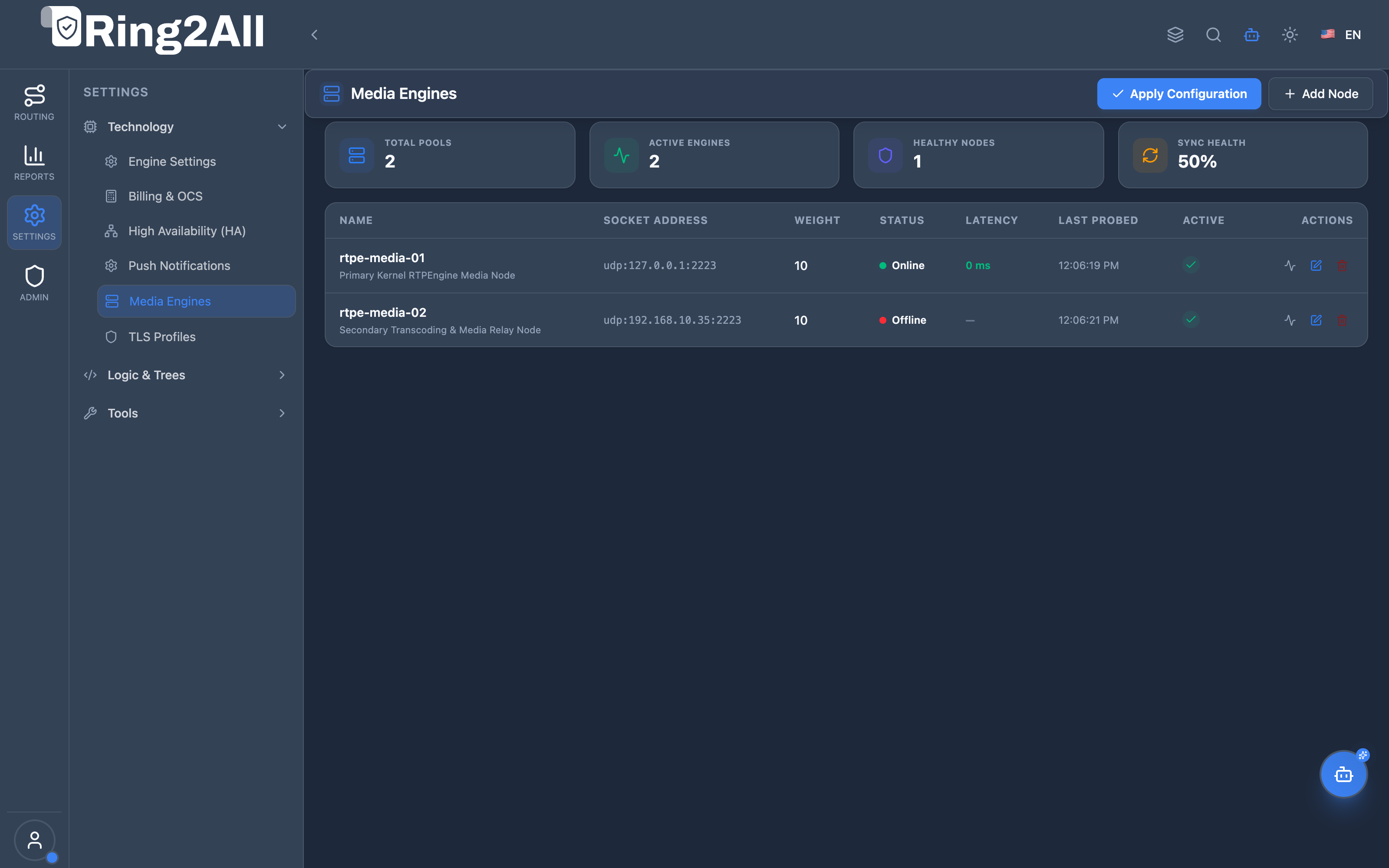
Section titled “4. Visual Interface & Layout”The Media Engines interface displays all registered RTPEngine instances, their control socket URIs, distribution weights, active sessions, and live health metrics.
5. Field Reference & Media Node Parameters
Section titled “5. Field Reference & Media Node Parameters”| Parameter | Data Type | Default | Description |
|---|---|---|---|
| Node Name | String | rtpe-media-01 |
Unique administrative label for the media engine instance. |
| Control Socket | String / URI | udp:127.0.0.1:2223 |
Bencode NG protocol socket (udp:<ip>:<port> or tcp:<ip>:<port>). |
| Weight | Integer | 10 |
Relative distribution weight for round-robin and least-loaded load-balancing across the media cluster. |
| Interfaces | String | internal/external |
Declared IP address interfaces configured in rtpengine.conf for bridging different network zones. |
| Kernel Mode | Badge | Enabled |
Indicates whether the node is utilizing the high-performance xt_RTPENGINE netfilter kernel module. |
| Active Sessions | Counter | 0 |
Real-time count of concurrent two-way media dialogs anchored on this specific media node. |
| Health Status | Badge | Active |
Health state evaluated via periodic NG ping probes (Active Green, Probing Amber, Disabled Red). |
6. Kamailio RTPEngine NG Protocol Mechanics
Section titled “6. Kamailio RTPEngine NG Protocol Mechanics”The Kamailio signaling script controls media streams using the rtpengine module functions:
# Intercept SDP Offer on Inbound INVITEroute[RELAY_MEDIA_OFFER] {    if (proto == WSS || proto == WS) {        # Bridge WebRTC to standard SIP Trunk        rtpengine_offer("direction=webrtc direction=external ICE=remove RTP/AVP replace-origin replace-session-connection");    } else {        # Standard SIP to Carrier Trunk        rtpengine_offer("direction=internal direction=external replace-origin replace-session-connection");    }}
# Intercept SDP Answer on 200 OK / 183 Session Progressroute[RELAY_MEDIA_ANSWER] {    rtpengine_answer("direction=external direction=internal replace-origin replace-session-connection");}
# Teardown Media on BYE / CANCELroute[TEARDOWN_MEDIA] {    rtpengine_delete();}
7. Kernel-Space Forwarding (xt_RTPENGINE) Performance
Section titled “7. Kernel-Space Forwarding (xt_RTPENGINE) Performance”When xt_RTPENGINE is loaded, audio packets are intercepted directly by the Linux iptables/nftables packet filtering framework:
- User Space (NG Control Only): The user-space daemon handles SDP negotiation, ICE candidate validation, and DTLS key exchange.
- Kernel Table (
xt_RTPENGINE): Once keys are established, the daemon installs routing table entries directly into kernel memory. - Zero Copy Forwarding: Voice packets entering the network interface card (NIC) are rewritten and dispatched out the outbound NIC without copying memory buffers into user space.
Incoming RTP Packet ───► NIC ───► [xt_RTPENGINE Kernel Module] ───► NIC ───► Outbound RTP Packet │ (Only control messages pass up) ▼ [RTPEngine User Daemon]This architecture allows a single quad-core host to sustain over 15,000 concurrent G.711 voice calls with less than 1% CPU utilization.
8. Troubleshooting & Verification
Section titled “8. Troubleshooting & Verification”Validating RTPEngine Node Availability via RPC
Section titled “Validating RTPEngine Node Availability via RPC”In the RPC Console, inspect active media nodes and their responsiveness:
rtpengine.show allOutput confirms socket latency and operational status:
{ "jsonrpc": "2.0", "result": { "total_nodes": 2, "nodes": [ { "url": "udp:127.0.0.1:2223", "weight": 10, "recheck_ticks": 0, "disabled": 0, "in_use": 14 } ] }, "id": 1}Inspecting Local RTPEngine Sessions via CLI
Section titled “Inspecting Local RTPEngine Sessions via CLI”Execute from the SBC host operating system:
rtpengine-ctl list sessionsrtpengine-ctl list totals9. Model Context Protocol (MCP) AI Integration
Section titled “9. Model Context Protocol (MCP) AI Integration”The Media Engines subsystem connects with the Model Context Protocol (MCP) to provide autonomous AI diagnostics for media relay availability, real-time MOS telemetry, call stream degradation analysis, and SLA policy management.
Available MCP Tools
Section titled “Available MCP Tools”| Tool Name | Operation Type | Risk Level | Description |
|---|---|---|---|
get_rtpengine_status |
Status Query | read |
Check connectivity, ping round-trip latency, active media streams, and relay capacity of all RTPEngine nodes. |
get_voice_qos_telemetry |
Telemetry Query | read |
Retrieve real-time Voice QoS telemetry, Mean Opinion Scores (MOS), jitter, and packet loss across media streams. |
analyze_call_qos_stream |
Root Cause Analysis | read |
Deep-dive voice quality diagnosis for a specific Call-ID or endpoint IP address, pinpointing degradation factors. |
get_qos_alert_policy |
Policy Inspection | read |
Inspect active Voice QoS SLA violation policy thresholds (minimum MOS, max jitter, max packet loss). |
update_qos_alert_policy |
Configuration Mutation | operational |
Update Voice QoS SLA threshold policies and automated degradation alerting. |
Tool Schemas & Payloads
Section titled “Tool Schemas & Payloads”1. get_rtpengine_status
Section titled “1. get_rtpengine_status”Input Schema
Section titled “Input Schema”{ "type": "object", "properties": {}}Output Payload Example
Section titled “Output Payload Example”{ "success": true, "data": { "totalNodes": 2, "activeNodes": 2, "nodes": [ { "id": 1, "name": "rtpe-media-01", "socket": "udp:127.0.0.1:2223", "weight": 10, "status": "ONLINE", "activeSessions": 42, "pingLatencyMs": 0.8 }, { "id": 2, "name": "rtpe-media-02", "socket": "udp:192.168.10.35:2223", "weight": 10, "status": "ONLINE", "activeSessions": 38, "pingLatencyMs": 1.2 } ] }}2. analyze_call_qos_stream
Section titled “2. analyze_call_qos_stream”Input Schema
Section titled “Input Schema”{ "type": "object", "properties": { "call_id": { "type": "string", "description": "The SIP Call-ID string to inspect for voice quality." }, "ip": { "type": "string", "description": "Endpoint or carrier IP address to inspect recent QoS streams for." } }}Output Payload Example
Section titled “Output Payload Example”{ "success": true, "data": { "totalMatches": 1, "policyThresholds": { "minMos": 3.6, "maxJitterMs": "40ms", "maxLossPct": "2%" }, "streams": [ { "callId": "8120391-ab12@sbc", "from": "sip:2000@sbc.ring2all.com", "to": "sip:+14155552671@carrier.net", "durationSec": 184, "sourceIp": "192.168.1.150", "destinationIp": "64.120.10.5", "carrier": "Direct Relay", "mosScore": 4.38, "jitterMs": "6ms", "packetLossPct": "0.1%", "status": "HEALTHY", "detectedIssues": ["None (Optimal Audio Quality)"] } ] }}Natural Language AI Prompts
Section titled “Natural Language AI Prompts”English Examples
Section titled “English Examples”- “Check the health and latency of all registered RTPEngine media nodes.”
- “Analyze voice quality and packet jitter for Call-ID 8120391-ab12@sbc.”
- “What is the current Voice QoS SLA alert policy threshold on our media engines?”
Spanish Examples (Español)
Section titled “Spanish Examples (Español)”- “Verifica el estado y la latencia de todos los nodos de medios RTPEngine registrados.”
- “Analiza la calidad de voz y el jitter de paquetes para el Call-ID 8120391-ab12@sbc.”
- “¿Cuál es el umbral de política de alerta SLA de calidad de voz actual en nuestros motores de medios?”
Enterprise Safeguards & Access Governance
Section titled “Enterprise Safeguards & Access Governance”- Non-Disruptive Probes: RTPEngine health checks send asynchronous ping commands without disrupting existing active RTP sessions.
- SLA Guardrails: Updating QoS alert thresholds is constrained within valid ITU-T MOS boundaries (1.0 to 5.0).
- Role Segregation: Modifying QoS alert policies requires
noc_network_engineerorsbc_system_adminprivileges; read-only roles can query telemetry and status.
10. Glossary
Section titled “10. Glossary”- RTPEngine: An enterprise-grade, high-performance media proxy designed for Kamailio and OpenSIPS, developed by Sipwise.
- NG Protocol: A high-efficiency, Bencode-serialized control protocol used between Kamailio and RTPEngine over UDP or TCP sockets.
- DTLS-SRTP: Datagram Transport Layer Security for Secure Real-time Transport Protocol, mandatory for WebRTC audio/video encryption.
- Kernel Module (
xt_RTPENGINE): An in-tree Linux kernel module that provides fast-path packet forwarding for active RTP media sessions.