

TLS Profiles
Table of Contents
Section titled “Table of Contents”- Overview & Cryptographic Architecture
- Business & Operational Significance
- 🎯 User Roles & Key Capabilities
- Visual Interface & Layout
- Field Reference & Profile Parameters
- Kamailio
tls_mgmModule Mechanics - Microsoft Teams Direct Routing & Carrier mTLS Requirements
- Troubleshooting & Verification
- Model Context Protocol (MCP) AI Integration
- Glossary
1. Overview & Cryptographic Architecture
Section titled “1. Overview & Cryptographic Architecture”In Ring2All SBC, the TLS Profiles module centralizes the governance, assignment, and renewal of SSL/TLS cryptographic profiles for secure SIP signaling (SIP-TLS over port 5061) and WebRTC signaling (WSS over port 443). Powered by Kamailio’s tls_mgm and tls modules, the SBC supports multi-domain Server Name Indication (SNI), modern elliptic-curve cipher suites, automated Certificate Authority (CA) chain validation, and Mutual TLS (mTLS) client verification.
External Endpoint (MS Teams / Carrier / PBX) Ring2All SBC (Kamailio Core) │ │ │─────── TLS Client Hello (with SNI) ──────────────>│ │ "sbc.ring2all.com" │─── Match TLS Profile (SNI) ───┐ │ │ Load cert.pem & key.pem │ │<────── TLS Server Hello + Server Certificate ─────│<──────────────────────────────┘ │ │ │─── (Optional mTLS) Client Certificate ───────────>│─── Verify against CA Bundle ─┐ │ │<──────────────────────────────┘ │<────── TLS Handshake Complete (AES-256-GCM) ──────│ │ │ │═══════ Encrypted SIP Signaling (Port 5061) ═══════│Profiles can be dynamically updated and hot-reloaded into Kamailio shared memory via JSON-RPC, preventing dropped calls or service interruptions when renewing TLS certificates.
2. Business & Operational Significance
Section titled “2. Business & Operational Significance”- End-to-End Signaling Confidentiality: Protects voice metadata, subscriber passwords, and routing details from perimeter eavesdropping and packet sniffing.
- Regulatory Compliance: Satisfies strict encryption mandates required by HIPAA, PCI-DSS Level 1, and European GDPR data transmission frameworks.
- Microsoft Teams Direct Routing Certification: Delivers the exact cryptographic parameters (TLS 1.2+, ECDHE ciphers, and public commercial CA trust) required for Microsoft Direct Routing interconnects.
- Carrier Mutual Authentication (mTLS): Enforces bi-directional cryptographic verification on high-volume SIP trunking interconnects, ensuring that only authenticated carrier partners can inject traffic.
3. 🎯 User Roles & Key Capabilities
Section titled “3. 🎯 User Roles & Key Capabilities”| Role | Primary Use Case | Key Capabilities |
|---|---|---|
| Security Architect | Cryptographic Policy & Ciphers | Enforce modern cipher suites, deprecate legacy SSL/TLS versions, and mandate forward secrecy (PFS). |
| Cryptographic Key Manager | Certificate Lifecycle Governance | Provision new TLS certificates, upload Let’s Encrypt or commercial certificates, and configure renewal alerts. |
| SBC Operations Specialist | Live Profile Reloading | Bind TLS profiles to specific network listening sockets and execute hot reloads without engine restarts. |
| Voice Interconnect Engineer | Carrier mTLS Onboarding | Configure trusted CA bundles and client verification modes for enterprise partners and Microsoft Teams trunks. |
| AI Security Copilot / Cryptographic Auditor | Certificate & Cipher Governance | Inspect TLS profile expiration, audit client verification modes, and issue atomic TLS memory reloads via MCP. |
4. Visual Interface & Layout
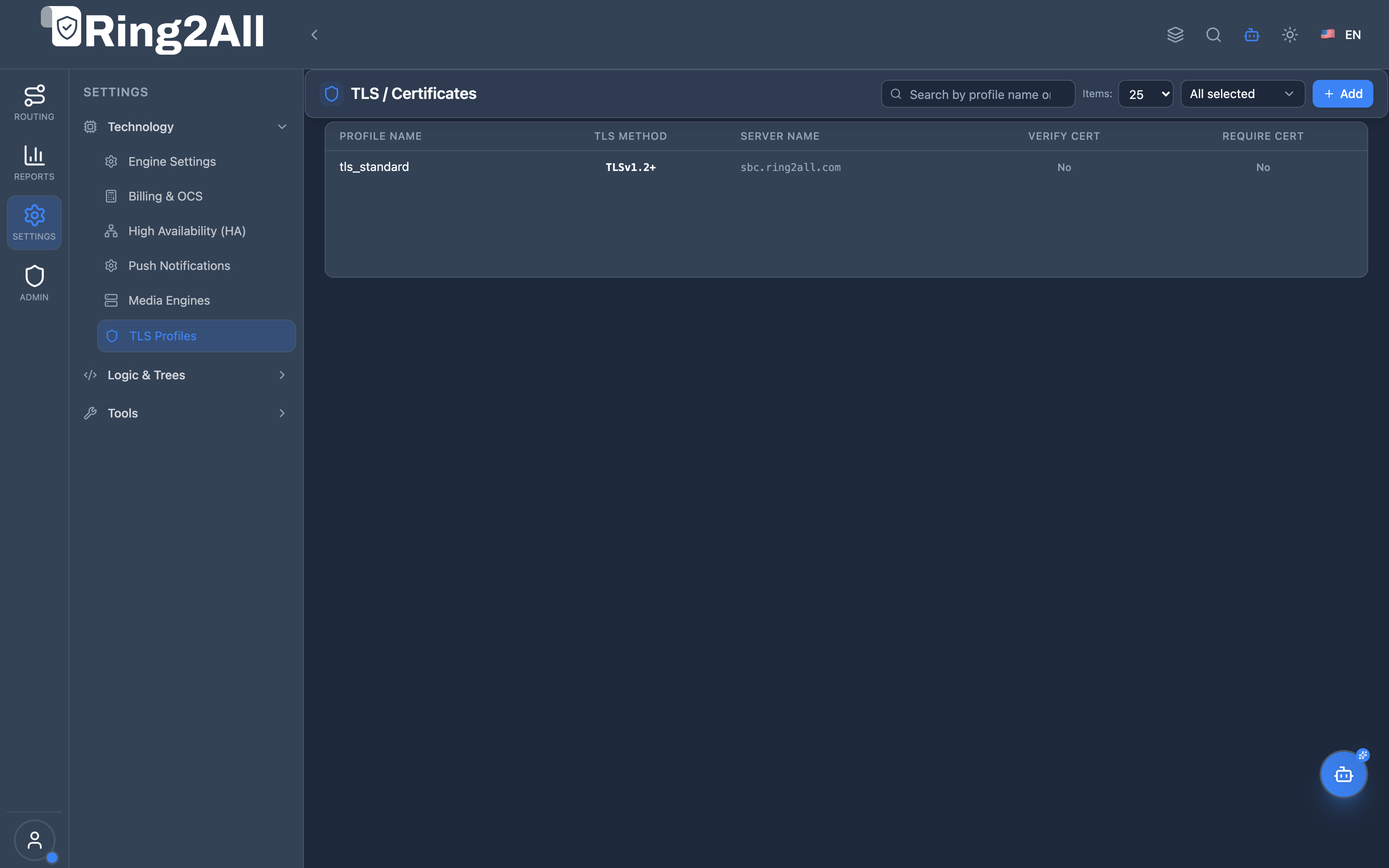
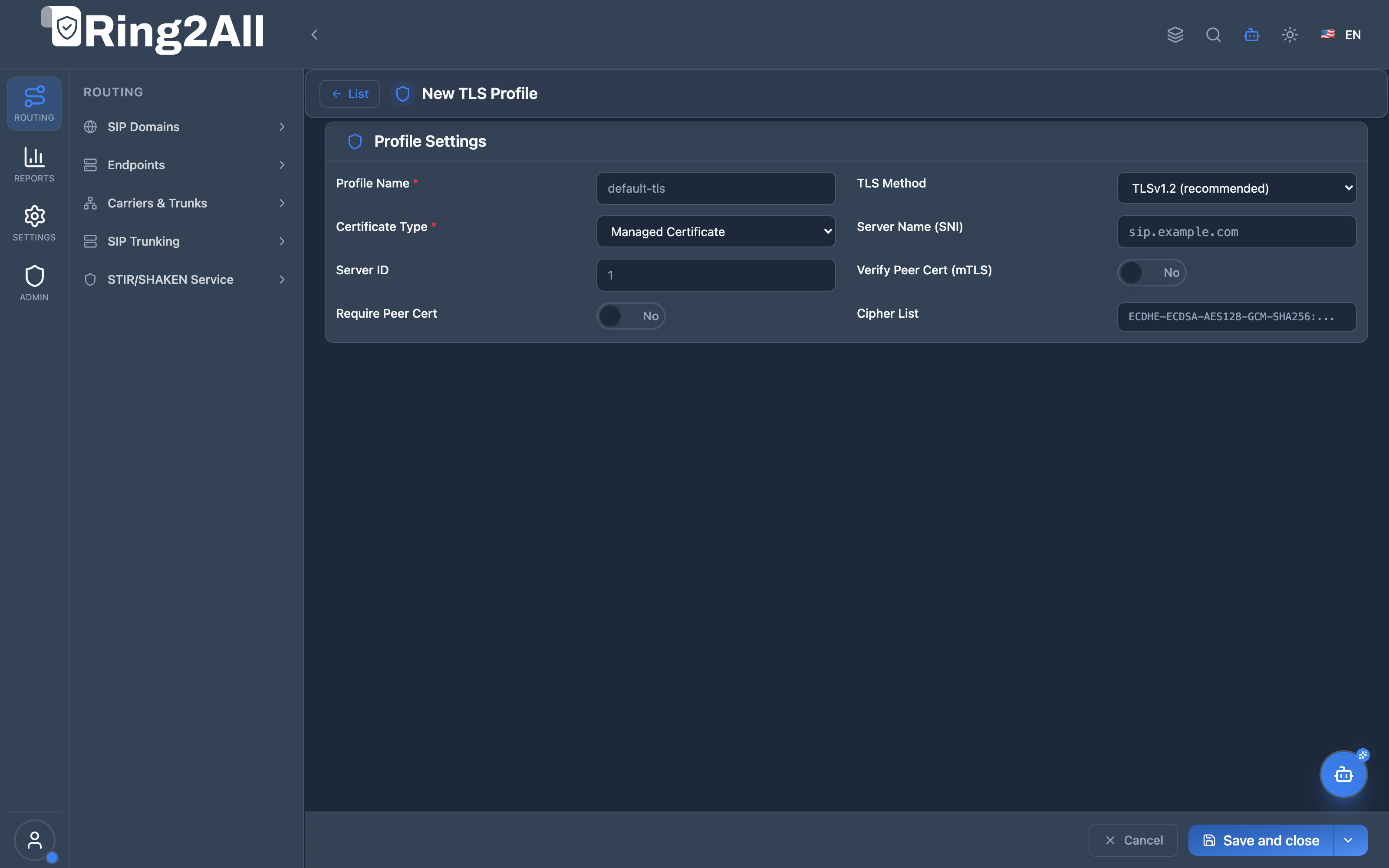
Section titled “4. Visual Interface & Layout”The TLS Profiles interface presents a catalog of all configured security profiles, along with a modal configuration form for defining cryptographic parameters, certificates, and ciphers.
4.1 TLS Profiles List View
Section titled “4.1 TLS Profiles List View”Displays all available TLS profiles, their associated domain/SNI names, TLS protocol versions, verification modes, and validity status.
4.2 TLS Profile Configuration Form
Section titled “4.2 TLS Profile Configuration Form”Form modal used to configure certificate paths, private keys, CA trust stores, and cipher strings.
5. Field Reference & Profile Parameters
Section titled “5. Field Reference & Profile Parameters”| Field Name | Data Type | Default | Description |
|---|---|---|---|
| Profile Name | String | tls_standard |
Unique internal identifier for the TLS profile (e.g., tls_standard, tls_msteams). |
| TLS Method | Select | TLSv1.2+ |
Permitted TLS protocol versions: TLSv1.2+ (recommended) or TLSv1.3 only. Older versions (SSLv3, TLS 1.0, 1.1) are strictly blocked. |
| Server Name (SNI) | String | sbc.ring2all.com |
Fully qualified domain name (FQDN) matched against the incoming client’s SNI extension. |
| Certificate Path | String / File | /etc/kamailio/certs/cert.pem |
Absolute path or file upload of the PEM-encoded X.509 server certificate (including full chain). |
| Private Key Path | String / File | /etc/kamailio/certs/key.pem |
Absolute path or file upload of the unencrypted RSA or ECDSA private key. |
| CA List Path | String / File | /etc/ssl/certs/ca-certificates.crt |
Path to trusted Certificate Authority bundle used to validate client certificates in mTLS mode. |
| Cipher Suites | String | ECDHE-ECDSA-AES256-GCM... |
Colon-delimited OpenSSL cipher string. Enforces forward secrecy and AEAD encryption. |
| Verify Client | Select | Optional |
Client certificate verification behavior: Disabled, Optional, or Mandatory / Enforced. |
| Require Client Cert | Switch | Off |
If enabled, the SBC abruptly terminates the TLS handshake if the remote client does not present a valid certificate. |
6. Kamailio tls_mgm Module Mechanics
Section titled “6. Kamailio tls_mgm Module Mechanics”Kamailio manages TLS contexts dynamically through the tls_mgm (TLS Management) module:
# Sample Kamailio tls_mgm profile definitionloadmodule "tls.so"loadmodule "tls_mgm.so"
modparam("tls_mgm", "tls_method", "TLSv1.2+")modparam("tls_mgm", "verify_cert", "1")modparam("tls_mgm", "require_cert", "0")modparam("tls_mgm", "certificate", "/etc/kamailio/certs/cert.pem")modparam("tls_mgm", "private_key", "/etc/kamailio/certs/key.pem")modparam("tls_mgm", "ca_list", "/etc/ssl/certs/ca-certificates.crt")modparam("tls_mgm", "ciphers_list", "ECDHE-ECDSA-AES256-GCM-SHA384:ECDHE-RSA-AES256-GCM-SHA384:ECDHE-ECDSA-CHACHA20-POLY1305")
Whenever certificates are renewed on disk, an operator triggers tls.reload via the RPC Console. Kamailio atomically instantiates a new OpenSSL SSL_CTX context in memory and swaps pointer references without terminating ongoing calls.
7. Microsoft Teams Direct Routing & Carrier mTLS Requirements
Section titled “7. Microsoft Teams Direct Routing & Carrier mTLS Requirements”When interfacing with Microsoft Teams Direct Routing or tier-1 carrier interconnects, strict cryptographic requirements must be enforced:
- Approved Public CA: The certificate must be issued by an approved root authority (e.g., DigiCert, Sectigo, GlobalSign). Self-signed certificates are rejected by Microsoft.
- FQDN Matching: The SAN (Subject Alternative Name) of the certificate must match the exact FQDN registered in the Microsoft 365 Admin Center (e.g.,
sbc.ring2all.com). - Mandatory Ciphers: Microsoft requires TLS 1.2 with ECDHE cipher suites:
ECDHE-RSA-AES256-GCM-SHA384ECDHE-RSA-AES128-GCM-SHA256
8. Troubleshooting & Verification
Section titled “8. Troubleshooting & Verification”Probing TLS Handshake from External Host
Section titled “Probing TLS Handshake from External Host”Verify certificate chains, ciphers, and protocol negotiation using OpenSSL:
openssl s_client -connect sbc.ring2all.com:5061 -servername sbc.ring2all.com -showcertsVerify the output confirms:
Protocol : TLSv1.3Cipher : TLS_AES_256_GCM_SHA384Verify return code: 0 (ok)Hot-Reloading TLS Contexts via RPC
Section titled “Hot-Reloading TLS Contexts via RPC”After updating certificate files on the SBC file system, trigger a hot reload without restarting Kamailio:
tls.reloadOutput:
{ "jsonrpc": "2.0", "result": "TLS configuration successfully reloaded", "id": 1}9. Model Context Protocol (MCP) AI Integration
Section titled “9. Model Context Protocol (MCP) AI Integration”The TLS Profiles subsystem exposes dedicated Model Context Protocol (MCP) tools enabling automated cryptographic inspection, certificate expiration auditing, and zero-downtime runtime reload triggers.
Available MCP Tools
Section titled “Available MCP Tools”| Tool Name | Operation Type | Risk Level | Description |
|---|---|---|---|
list_tls_profiles |
Status Query | read |
List all configured TLS cryptographic profiles (server name, methods, cipher suites, certificate paths). |
get_tls_profile_status |
Certificate Audit | read |
Get runtime status, validation state, and certificate expiration for a specific TLS profile. |
reload_tls_profiles |
Operational Reload | operational |
Issue a runtime reload command (tls.reload) to Kamailio via JSON-RPC without terminating calls. |
Tool Schemas & Payloads
Section titled “Tool Schemas & Payloads”1. list_tls_profiles
Section titled “1. list_tls_profiles”Input Schema
Section titled “Input Schema”{ "type": "object", "properties": {}}Output Payload Example
Section titled “Output Payload Example”{ "success": true, "data": { "totalProfiles": 2, "profiles": [ { "id": 1, "name": "tls_standard", "server_name": "sbc.ring2all.com", "method": "TLSv1.2+", "verify_client": "optional", "require_client_cert": false, "cipher_suite": "ECDHE-ECDSA-AES256-GCM-SHA384:ECDHE-RSA-AES256-GCM-SHA384" }, { "id": 2, "name": "tls_msteams", "server_name": "teams.ring2all.com", "method": "TLSv1.2+", "verify_client": "mandatory", "require_client_cert": true, "cipher_suite": "ECDHE-RSA-AES256-GCM-SHA384:ECDHE-RSA-AES128-GCM-SHA256" } ] }}2. get_tls_profile_status
Section titled “2. get_tls_profile_status”Input Schema
Section titled “Input Schema”{ "type": "object", "properties": { "profile_id": { "type": "number", "description": "Numeric identifier of the TLS profile to inspect." } }, "required": ["profile_id"]}Output Payload Example
Section titled “Output Payload Example”{ "success": true, "data": { "id": 1, "name": "tls_standard", "server_name": "sbc.ring2all.com", "certificate_path": "/etc/kamailio/certs/cert.pem", "certificate_exists": true, "private_key_exists": true, "status": "VALID", "expires_at": "2027-01-15T00:00:00.000Z" }}3. reload_tls_profiles
Section titled “3. reload_tls_profiles”Input Schema
Section titled “Input Schema”{ "type": "object", "properties": {}}Output Payload Example
Section titled “Output Payload Example”{ "success": true, "data": { "message": "TLS profiles reloaded successfully in Kamailio core.", "rpc_response": "TLS configuration successfully reloaded" }}Natural Language AI Prompts
Section titled “Natural Language AI Prompts”English Examples
Section titled “English Examples”- “List all configured TLS profiles on the SBC and check their client verification settings.”
- “Check the expiration date and certificate status for TLS profile ID 1.”
- “Hot-reload the TLS cryptographic profiles in Kamailio memory without restarting the service.”
Spanish Examples (Español)
Section titled “Spanish Examples (Español)”- “Lista todos los perfiles TLS configurados en el SBC y comprueba sus ajustes de verificación de cliente.”
- “Comprueba la fecha de expiración y el estado del certificado para el perfil TLS con ID 1.”
- “Recarga en caliente los perfiles criptográficos TLS en la memoria de Kamailio sin reiniciar el servicio.”
Enterprise Safeguards & Access Governance
Section titled “Enterprise Safeguards & Access Governance”- Private Key Masking: Cryptographic private key contents are never read, printed, or transmitted through MCP tools.
- Atomic Context Swap: The
reload_tls_profilestool invokes Kamailio’s memory pointer swap, ensuring zero disruption to existing encrypted calls. - Strict RBAC Enforcement: Modifying or reloading TLS cryptographic contexts is restricted to the
sbc_system_adminornoc_network_engineerrole.
10. Glossary
Section titled “10. Glossary”- mTLS (Mutual TLS): A security process where both client and server authenticate each other simultaneously using X.509 digital certificates.
- SNI (Server Name Indication): An extension to the TLS protocol that indicates which hostname the client is attempting to connect to at the start of the handshaking process.
- Forward Secrecy (PFS): A feature of secure communication protocols ensuring that compromised long-term private keys cannot decrypt past session traffic.
- X.509 Certificate: A standard format for public key certificates that cryptographically binds an identity to a public key.