

Telecom Engines & Infrastructure Nodes Module Documentation
Table of Contents
Section titled “Table of Contents”- Module Overview (Technical)
- Module Overview (Commercial & Business Value)
- 🎯 User Roles & Key Capabilities
- Visual Interface & Form Structure
- Architectural Flow & Distributed Node Synchronization
- Common Scenarios & Operational Playbooks
- Troubleshooting & Diagnostic Commands
- Model Context Protocol (MCP) AI Integration
- Glossary
1. Module Overview (Technical)
Section titled “1. Module Overview (Technical)”The Telecom Engines & Infrastructure Nodes module (public.telecom_nodes and telecomNodeService.ts) is the central orchestration bridge connecting Ring2All Billing to remote telephony switches. It manages the lifecycle, API authentication, health monitoring, and automated provisioning across both Ring2All PBX (Class 5 Core) and Ring2All SBC (Class 4 Core) instances.
Supported Engine Architectures
Section titled “Supported Engine Architectures”- Ring2All PBX (
ring2all_pbx): Class 5 enterprise voice engine based on Telephony Server. BSS pushes tenant creation, domain assignment, extension quotas, and inbound DID routing rules. - Ring2All SBC (
kalixor_sbc): Class 4 carrier session border controller based on Kamailio and RTPEngine. BSS pushes SIP trunk authentication credentials, dispatcher set load balancing, LCR prefix tables, and anti-fraud lockouts.
┌────────────────────────────────────────────────────────────────────────┐ │ Ring2All Billing Admin Orchestrator │ └───────────────────────────────────┬────────────────────────────────────┘ │ ┌─────────────────────────┴─────────────────────────┐ │ Secure REST API (X-API-Key) │ Secure REST API (X-API-Key) ▼ ▼ ┌───────────────────────────────────┐ ┌───────────────────────────────────┐ │ Node: Ring2All PBX (Class 5) │ │ Node: Ring2All SBC (Class 4) │ │ URL: https://192.168.10.31 │ │ URL: https://192.168.10.32 │ │ • Auto-creates Tenants & Domains│ │ • Auto-creates SIP Trunks │ │ • Provisions Mini-PBX Extensions│ │ • Ingests Perimeter CDRs │ │ • Binds Inbound DID Routing │ │ • Enforces Dialing Whitelists │ │ • Enforces Audio Storage Quotas │ │ • Executes Real-time Call Drops │ └───────────────────────────────────┘ └───────────────────────────────────┘2. Module Overview (Commercial & Business Value)
Section titled “2. Module Overview (Commercial & Business Value)”- Zero-Touch Automated Provisioning: Eliminates manual voice switch configuration. When a customer subscribes to a plan in the billing portal, Ring2All Billing immediately provisions the PBX tenant and SBC trunk via REST APIs.
- Geographic & Multi-Data Center Scalability: Enables horizontal expansion across multiple regional PBX and SBC clusters (e.g. US-East, Europe, Latin America) while maintaining unified billing and invoicing.
- Proactive Failover & High Availability: Continuously monitors node response latency and health. If a primary voice core becomes unreachable, the BSS alerts the NOC and reroutes new customer provisioning to secondary backup engines.
3. 🎯 User Roles & Key Capabilities
Section titled “3. 🎯 User Roles & Key Capabilities”| User Role | Key Permissions | Core Responsibilities & Workflows |
|---|---|---|
| Super Administrator | Full Infrastructure Control | Registers new telephony nodes, rotates API authentication keys, defines default cluster nodes, and oversees multi-datacenter topology. |
| NOC Engineer | Read & Connectivity Health | Monitors real-time ping latencies, investigates node disconnection alerts, and executes diagnostic interconnect tests. |
| Telecom Systems Architect | Configuration & Routing Policy | Configures API endpoints, assigns default SBC trunks for carrier termination, and verifies Kamailio/FreeSWITCH socket synchronization. |
| Billing Analyst | Read & Tenant Association | Verifies that customer subscriptions are linked to operational voice engine nodes. |
4. Visual Interface & Form Structure
Section titled “4. Visual Interface & Form Structure”4.1 Telecom Engines (List View)
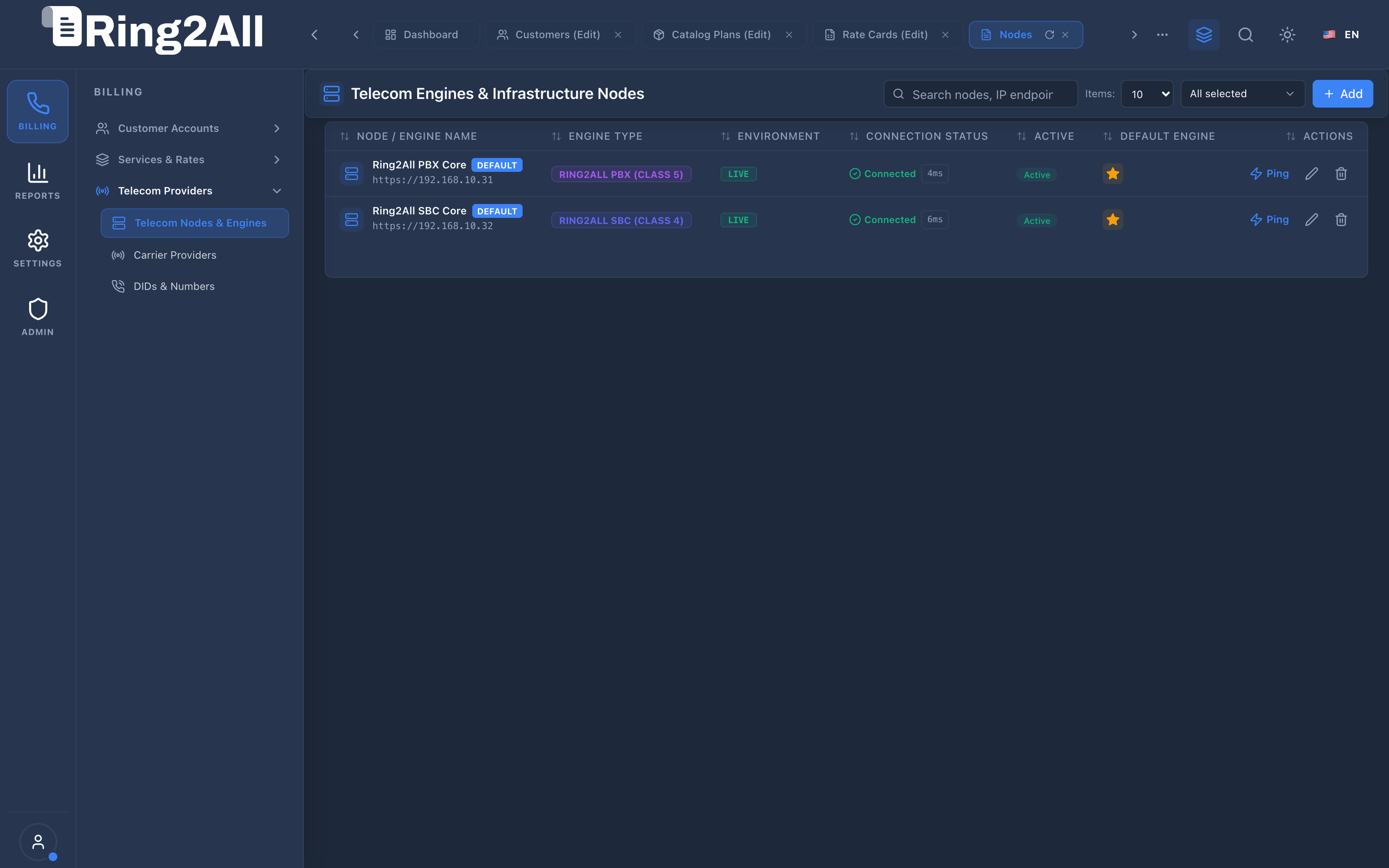
Section titled “4.1 Telecom Engines (List View)”The Telecom Engines & Infrastructure Nodes list displays all registered voice cores with real-time connectivity status, round-trip latency in milliseconds, environment badges, and instant diagnostic ping buttons.
4.2 Telecom Engine Configuration Form (Form View)
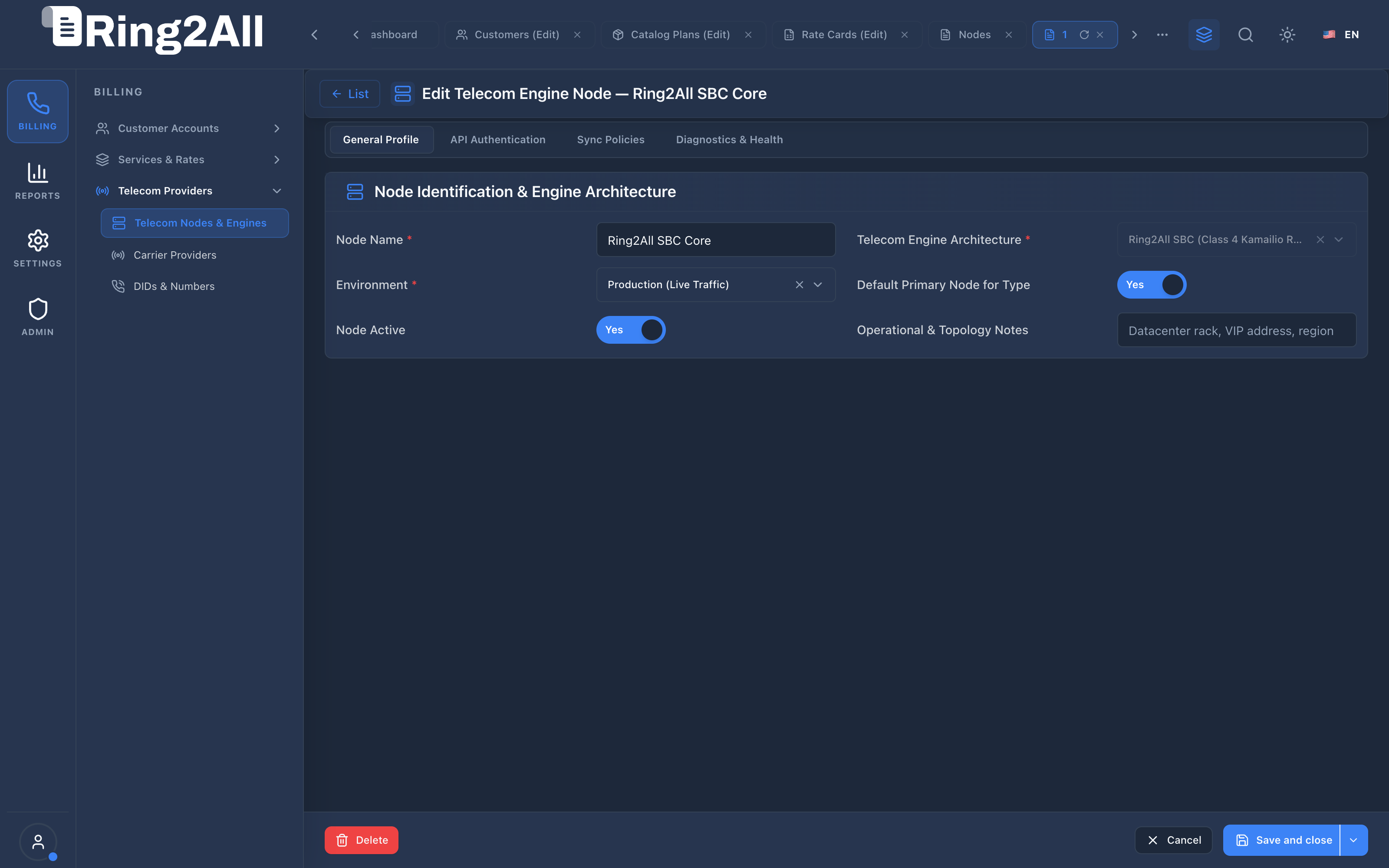
Section titled “4.2 Telecom Engine Configuration Form (Form View)”The Telecom Engine Configuration form manages API endpoint URLs, mutual TLS certificates, API secret keys, and default engine assignments.
4.3 Form Parameter Reference
Section titled “4.3 Form Parameter Reference”| Parameter Name | Data Type | Required | Default Value | Description & Business Rules |
|---|---|---|---|---|
| Node / Engine Name | String |
Yes | — | Clear identifier for the voice core (e.g. Ring2All PBX Core or Ring2All SBC Core). |
| Engine Architecture | Enum |
Yes | ring2all_pbx |
ring2all_pbx (Class 5 Ring2All Telephony Engine) or kalixor_sbc (Class 4 Kamailio SBC). |
| API Endpoint URL | URL |
Yes | — | Base HTTPS URL where the remote node daemon is listening (e.g. https://192.168.10.31). |
| API Secret Key | Password |
Yes | — | High-entropy authentication token sent via the X-API-Key HTTP header for administrative commands. |
| Deployment Environment | Enum |
Yes | live |
Target tier: live (production billing), staging, or sandbox. |
| Default Cluster Engine | Boolean |
Yes | false |
When true, new customer subscriptions are automatically provisioned on this node by default. |
| Active Status | Boolean |
Yes | true |
When active, the node receives automatic provisioning dispatches and health check pings. |
5. Architectural Flow & Distributed Node Synchronization
Section titled “5. Architectural Flow & Distributed Node Synchronization” Customer Subscription Event │ ▼ ┌───────────────────────────────────────────┐ │ Query Default Node for Service Type │ └─────────────────────┬─────────────────────┘ │ ┌─────────────┴─────────────┐ ▼ ▼ Engine: ring2all_pbx Engine: kalixor_sbc │ │ ▼ ▼ ┌─────────────────────────┐ ┌─────────────────────────┐ │ POST /api/tenants │ │ POST /api/sip-trunks │ │ Headers: │ │ Headers: │ │ X-API-Key: <TOKEN> │ │ X-API-Key: <TOKEN> │ │ Payload: │ │ Payload: │ │ tenant_id: 104 │ │ customer_id: 104 │ │ domain: voice.acme.com│ │ capacity: 20 channels │ └─────────────────────────┘ └─────────────────────────┘6. Common Scenarios & Operational Playbooks
Section titled “6. Common Scenarios & Operational Playbooks”Scenario A: Registering a New Ring2All SBC Core Node
Section titled “Scenario A: Registering a New Ring2All SBC Core Node”- Navigate to Telecom Providers → Telecom Nodes & Engines and click + Add.
- Enter Node Name:
Ring2All SBC Core Virginia. - Set Engine Architecture to
Ring2All SBC (Class 4). - Enter API Endpoint URL:
https://192.168.10.32. - Enter the pre-shared API Secret Key generated on the SBC server.
- Toggle Default Cluster Engine to
Yesif this SBC handles primary wholesale carrier transit. - Click Ping Test to verify TLS handshake and latency, then click Save Node.
Scenario B: Performing Zero-Downtime Node Maintenance
Section titled “Scenario B: Performing Zero-Downtime Node Maintenance”- Prior to performing OS or kernel updates on a voice core server, locate the node in the DataGrid.
- Toggle Active Status from
ActivetoInactive. - The platform automatically shifts all new incoming customer provisioning to secondary active nodes while leaving existing active calls on the server unaffected until scheduled drain completion.
7. Troubleshooting & Diagnostic Commands
Section titled “7. Troubleshooting & Diagnostic Commands”Verifying Registered Telecom Nodes & Status (PostgreSQL)
Section titled “Verifying Registered Telecom Nodes & Status (PostgreSQL)”su - postgres -c "psql -d ss_billing -c \"SELECT id, name, node_type, host, port, is_active, is_default, last_sync_at, last_ping_statusFROM telecom_nodesORDER BY id ASC;\""Testing Node Reachability & Latency via cURL
Section titled “Testing Node Reachability & Latency via cURL”curl -s -k -w "\nHTTP Code: %{http_code}\nTotal Time: %{time_total}s\n" \ https://192.168.10.31/health8. Model Context Protocol (MCP) AI Integration
Section titled “8. Model Context Protocol (MCP) AI Integration”The Telecom Engines & Infrastructure Nodes module connects directly to the Ring2All BSS MCP Server, providing NOC engineers and automated infrastructure copilots with real-time visibility into telephony node health and orchestration status.
Available MCP Tools
Section titled “Available MCP Tools”| Tool Name | Access Role | Description & Primary Function | Example Arguments |
|---|---|---|---|
list_telecom_nodes_status |
Telecom & Carrier Engineer / Admin |
Lists telephony core switching engines (Ring2All PBX, Ring2All SBC) with health status, ping metrics, and active flag. | {} |
sync_telecom_node |
Super Administrator |
Triggers configuration resynchronization or health ping against a specific telecom node engine. | {"nodeId": 1} |
diagnose_telecom_node_sync |
Telecom & Carrier Engineer / Admin |
Verifies end-to-end API connectivity, TLS handshakes, and node heartbeats between BSS and voice switches. | {} |
diagnose_ocs_realtime_pipeline |
Telecom & Carrier Engineer / Admin |
Deep diagnostic of the online charging pipeline: database latency, customer balances, active rate cards, and registered voice nodes. | {} |
Sample MCP Tool Execution: list_telecom_nodes_status
Section titled “Sample MCP Tool Execution: list_telecom_nodes_status”Request Payload
Section titled “Request Payload”{ "name": "list_telecom_nodes_status", "arguments": {}}Response Payload
Section titled “Response Payload”[ { "id": 1, "name": "Primary SBC Core", "nodeType": "kalixor_sbc", "host": "192.168.10.31", "port": 443, "isActive": true, "isDefault": true, "lastSyncAt": "2026-09-09T05:00:12Z", "lastPingStatus": "online", "lastPingLatencyMs": 4 }, { "id": 2, "name": "Primary PBX Cluster", "nodeType": "ring2all_pbx", "host": "192.168.10.30", "port": 443, "isActive": true, "isDefault": true, "lastSyncAt": "2026-09-09T05:00:14Z", "lastPingStatus": "online", "lastPingLatencyMs": 6 }]Conversational AI Prompts for Copilot
Section titled “Conversational AI Prompts for Copilot”- “Check the health status and round-trip ping latency for all telecom nodes.”
- “Run a complete diagnostic on the real-time OCS charging engine and connected voice switches.”
- “Is the Primary SBC Core node currently online and synchronized?”
- “Trigger an immediate sync against telecom node 1.”
9. Glossary
Section titled “9. Glossary”- Class 4 SBC: Carrier-grade network switch optimized for high-volume wholesale SIP transit, protocol normalization, and LCR routing.
- Class 5 PBX: Enterprise-facing switch providing end-user features like voicemail, IVR, queues, ring groups, and extension registration.
- X-API-Key: HTTP security header used to authenticate machine-to-machine REST communication between the billing engine and voice nodes.
- Node Orchestration: Automated synchronization ensuring accounts created in the billing system exist identically in the voice switching plane.
- Model Context Protocol (MCP): Open protocol standard that enables secure, controlled integration between Large Language Models and external tools, databases, and telecom rating engines.