

RPC Console
Table of Contents
Section titled “Table of Contents”- Overview & Management Architecture
- Business & Operational Significance
- 🎯 User Roles & Key Capabilities
- Visual Interface & Layout
- Essential Command Catalog & Reference
- Quick Command Shortcuts & Interactive Workflow
- Security Safeguards & Audit Logging
- Troubleshooting & Verification
- Model Context Protocol (MCP) AI Integration
- Glossary
1. Overview & Management Architecture
Section titled “1. Overview & Management Architecture”In Ring2All SBC, the RPC Console provides an interactive, terminal-like web interface for executing live management commands against the Kamailio core engine via its high-performance JSON-RPC interface (jsonrpcs module). Emulating the behavior of the native command-line utility kamcmd, the RPC Console allows engineers to query runtime memory statistics, inspect active dialog tables, trigger module reloads, and unblock blacklisted IPs directly from the browser.
┌─────────────────────────────────────────────────────────────┐ │ Ring2All SBC Web Interface │ │ Interactive RPC Console │ └──────────────────────────────┬──────────────────────────────┘ │ JSON-RPC 2.0 Request Payload {"method": "core.uptime", "id": 1} │ ▼ ┌─────────────────────────────────────────────────────────────┐ │ Ring2All SBC API / Backend Daemon │ └──────────────────────────────┬──────────────────────────────┘ │ UNIX Domain Socket (/run/kamailio/kamailio_rpc.sock) │ ▼ ┌─────────────────────────────────────────────────────────────┐ │ Kamailio JSON-RPC Server │ │ (jsonrpcs.so) │ └─────────────────────────────┴──────────────────────────────┘By communicating through a secured local UNIX domain socket rather than exposing network ports, the console achieves microsecond response times while preserving perimeter isolation.
2. Business & Operational Significance
Section titled “2. Business & Operational Significance”- Rapid Incident Triage Without SSH: Empowers Network Operations Center (NOC) engineers to diagnose trunk degradation, SIP timeouts, and worker process states without requiring Linux root credentials.
- Instant Hot Reloading: Triggers live reloads of dispatchers (
dispatcher.reload), memory trees (mtree.reload), TLS profiles (tls.reload), and dialplans in real time with zero packet loss. - Real-Time Capacity & Memory Telemetry: Provides deep diagnostic visibility into shared memory (
shm) pools, private process memory (pkg), and active dialog tables during peak load events. - Immediate Security Remediation: Enables security personnel to instantly unblock false-positive IP bans or flush suspicious sessions with single-click commands.
3. 🎯 User Roles & Key Capabilities
Section titled “3. 🎯 User Roles & Key Capabilities”| Role | Primary Use Case | Key Capabilities |
|---|---|---|
| NOC Tier 2/3 Incident Responder | Live Signaling Triage | Query dispatcher gateway states, inspect in-flight dialogs, and verify SIP transaction throughput. |
| Senior SBC Telecom Engineer | Live Module Management | Execute hot reloads of routing tables, inspect shared memory fragmentation, and tune worker threads. |
| Security Operations Analyst | IP Ban Management | Dump active anti-flood tables (htable.dump ipban), investigate threat keys, and release blocked client IPs. |
| Capacity Planning Analyst | Performance Benchmarking | Extract statistical counters (stats.get_statistics all) to evaluate call completion rates and CPS trends. |
| AI NOC Diagnostics Agent / Operations Copilot | Low-Level Core Telemetry & Triage | Execute authorized Kamailio JSON-RPC commands, inspect shared memory fragmentation, and unban client IPs via MCP. |
4. Visual Interface & Layout
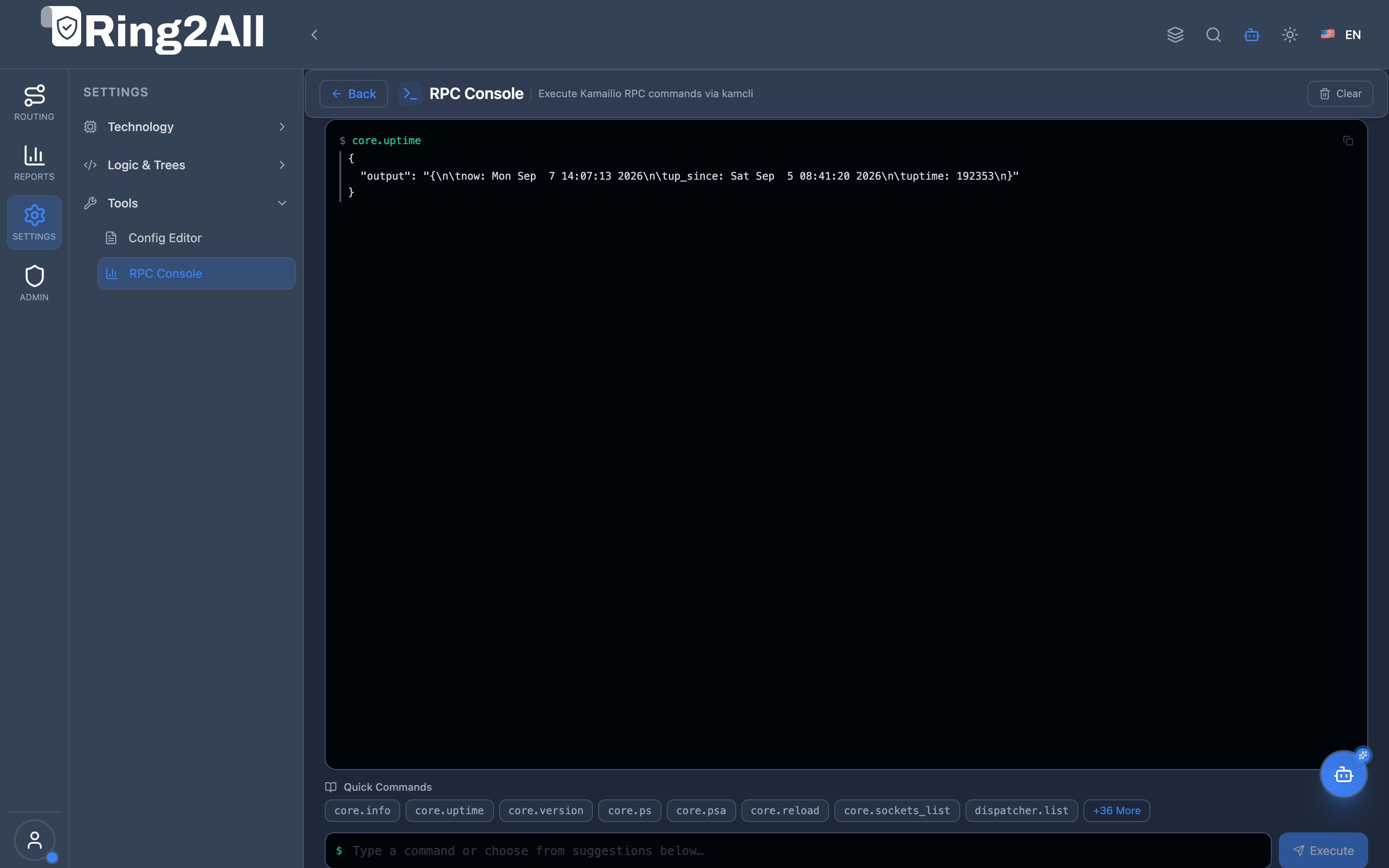
Section titled “4. Visual Interface & Layout”The RPC Console provides a command execution input bar with command history support, quick-action badge shortcuts for standard queries, and a syntax-highlighted terminal window displaying formatted JSON responses.
5. Essential Command Catalog & Reference
Section titled “5. Essential Command Catalog & Reference”5.1 Core Engine Commands
Section titled “5.1 Core Engine Commands”| Command | Arguments | Purpose & Output |
|---|---|---|
core.uptime |
None | Returns the daemon uptime in seconds, startup timestamp, and current system time. |
core.version |
None | Returns the exact Kamailio version, compiler flags, and compiled module features. |
core.shmmem |
None | Displays shared memory pool metrics: total available, used, real used, and fragmentation count. |
core.ps |
None | Lists all active POSIX worker child processes, their process IDs (PIDs), and assigned tasks. |
5.2 Dispatcher & Trunking Commands
Section titled “5.2 Dispatcher & Trunking Commands”| Command | Arguments | Purpose & Output |
|---|---|---|
dispatcher.list |
None | Dumps all registered carrier gateways, distribution sets, operational states (Active/Probing/Inactive), and latencies. |
dispatcher.reload |
None | Reloads the dispatcher routing table from PostgreSQL without dropping active calls. |
dispatcher.set_state |
<state> <group> <address> |
Manually sets a carrier gateway state (e.g., dispatcher.set_state 0 1 sip:192.168.10.50:5060 to force offline). |
5.3 Dialogs & Active Calls
Section titled “5.3 Dialogs & Active Calls”| Command | Arguments | Purpose & Output |
|---|---|---|
dlg.list |
None | Dumps all active in-flight SIP dialogs, Call-IDs, duration timers, and caller/callee contact URIs. |
dlg.profile_get_size |
<profile_name> |
Returns the total count of active calls currently tracked under a specific concurrency profile. |
dlg.terminate_dlg |
<call_id> <from_tag> |
Forcefully terminates an active call by injecting BYE packets to both call legs. |
5.4 Hash Tables & Security
Section titled “5.4 Hash Tables & Security”| Command | Arguments | Purpose & Output |
|---|---|---|
htable.dump |
<table_name> |
Dumps all keys, values, and remaining TTLs for a specific hash table (e.g., htable.dump ipban). |
htable.delete |
<table_name> <key> |
Immediately purges a specific key from memory (e.g., htable.delete ipban 192.168.11.199). |
htable.sets |
<table_name> <key> <val> |
Sets a string value for a key in a hash table. |
5.5 Statistics & Performance
Section titled “5.5 Statistics & Performance”| Command | Arguments | Purpose & Output |
|---|---|---|
stats.get_statistics |
all / <group> |
Returns real-time metrics for transactions (tm:), core counters (core:), and memory usage. |
6. Quick Command Shortcuts & Interactive Workflow
Section titled “6. Quick Command Shortcuts & Interactive Workflow”The console header features pre-configured quick badges that execute standard diagnostic routines with a single click:
- Uptime (
core.uptime): Instant verification that the Kamailio core daemon is running and responsive. - Shm Memory (
core.shmmem): Immediate health check of shared memory utilization to detect potential memory leaks. - Dispatchers (
dispatcher.list): Quick assessment of carrier trunk reachability and SIP options keepalive responses. - IP Bans (
htable.dump ipban): Fast inspection of currently blacklisted IP addresses.
7. Security Safeguards & Audit Logging
Section titled “7. Security Safeguards & Audit Logging”Because JSON-RPC commands operate directly upon runtime memory, Ring2All SBC enforces multi-layered governance:
- Role-Based Access Control (RBAC): The RPC Console is strictly restricted to users holding the
sbc.adminorsystem.superadminpermissions. - Dangerous Command Interception: Destructive commands (such as
core.killor manual memory freeing) are intercepted and restricted by backend authorization filters. - Audit Trail Logging: Every command executed via the console is logged in the Audit Logs module with the operator’s user identity, client IP address, timestamp, and command payload.
8. Troubleshooting & Verification
Section titled “8. Troubleshooting & Verification”Validating JSON-RPC Socket Accessibility from OS
Section titled “Validating JSON-RPC Socket Accessibility from OS”If the Web UI reports that the RPC server is unreachable, verify the UNIX socket on the SBC host:
ls -la /run/kamailio/kamailio_rpc.sockEnsure the socket is owned by the kamailio:kamailio user with read/write permissions (0660).
Testing Execution via Native CLI (kamcmd)
Section titled “Testing Execution via Native CLI (kamcmd)”kamcmd core.uptime9. Model Context Protocol (MCP) AI Integration
Section titled “9. Model Context Protocol (MCP) AI Integration”The RPC Console module integrates with the Model Context Protocol (MCP) to allow diagnostic agents to execute authorized management commands, inspect core memory statistics, query suggested commands, and troubleshoot engine state.
Available MCP Tools
Section titled “Available MCP Tools”| Tool Name | Operation Type | Risk Level | Description |
|---|---|---|---|
execute_rpc_command |
Core Command Execution | operational |
Execute an authorized JSON-RPC management command directly against the Kamailio core engine. |
get_rpc_suggestions |
Catalog Query | read |
Retrieve recommended RPC commands and catalog descriptions categorized by operational domain. |
Tool Schemas & Payloads
Section titled “Tool Schemas & Payloads”1. execute_rpc_command
Section titled “1. execute_rpc_command”Input Schema
Section titled “Input Schema”{ "type": "object", "properties": { "command": { "type": "string", "description": "The RPC method name (e.g. 'core.uptime', 'dispatcher.list', 'core.shmmem')." }, "params": { "type": "array", "items": { "type": "string" }, "description": "Optional array of string arguments for the RPC method." } }, "required": ["command"]}Output Payload Example
Section titled “Output Payload Example”{ "success": true, "data": { "command": "core.uptime", "result": { "uptime": 864200, "uptime_formatted": "10 days, 0 hours, 3 minutes", "started": "2026-08-29T11:24:00Z" } }}2. get_rpc_suggestions
Section titled “2. get_rpc_suggestions”Input Schema
Section titled “Input Schema”{ "type": "object", "properties": { "category": { "type": "string", "enum": ["core", "dispatcher", "dialog", "htable", "stats"], "description": "Optional category filter." } }}Output Payload Example
Section titled “Output Payload Example”{ "success": true, "data": { "suggestions": [ { "command": "core.uptime", "description": "Check Kamailio daemon uptime and startup time" }, { "command": "core.shmmem", "description": "Check shared memory usage and fragmentation" }, { "command": "dispatcher.list", "description": "List all carrier gateways and latency health" } ] }}Natural Language AI Prompts
Section titled “Natural Language AI Prompts”English Examples
Section titled “English Examples”- “Run ‘core.uptime’ in the RPC Console to check how long Kamailio has been running.”
- “Inspect shared memory pool usage and fragmentation using ‘core.shmmem’.”
- “List all carrier trunks and their keepalive status using ‘dispatcher.list’.”
Spanish Examples (Español)
Section titled “Spanish Examples (Español)”- “Ejecuta ‘core.uptime’ en la consola RPC para verificar cuánto tiempo lleva corriendo Kamailio.”
- “Inspecciona el uso de memoria compartida y fragmentación usando ‘core.shmmem’.”
- “Lista todas las troncales carrier y su estado de keepalive usando ‘dispatcher.list’.”
Enterprise Safeguards & Access Governance
Section titled “Enterprise Safeguards & Access Governance”- Destructive Command Interception: Commands that attempt to kill the engine or wipe runtime structures are strictly blocked by whitelist validation.
- UNIX Socket Boundary: Communications travel exclusively across a local
/run/kamailio/kamailio_rpc.sockdomain socket with strict OS filesystem permissions. - Role Enforcement: RPC execution requires the
sbc_system_adminornoc_network_engineerrole; unauthorized roles cannot trigger runtime commands.
10. Glossary
Section titled “10. Glossary”- JSON-RPC: A lightweight remote procedure call (RPC) protocol encoded in JSON format.
- UNIX Domain Socket: An inter-process communication endpoint for bidirectional data exchange between processes executing on the same host operating system.
- AVP (Attribute-Value Pair): A variable attached to a SIP transaction or user in Kamailio routing logic.
kamcmd: The official command-line administration utility for Kamailio, communicating with the core engine via RPC sockets.