

License & Feature Entitlements
Table of Contents
Section titled “Table of Contents”- Overview
- Commercial & Licensing Architecture
- 🎯 User Roles & Key Capabilities
- Visual Interface & Status Overview
- Telemetry & Feature Entitlement Matrix
- License Key Activation Workflow
- Operational Best Practices
- Troubleshooting & Verification
- Glossary
1. Overview
Section titled “1. Overview”The License & Feature Entitlements module in Ring2All SBC governs capacity allocations, software tier validation, cryptographic hardware fingerprint binding, and advanced telecom subsystem unlocks. From small enterprise SIP trunking deployments to multi-thousand channel Tier-1 carrier networks, this module provides administrators with transparent visibility into their active concurrent channel ceiling and carrier feature entitlements.
The licensing subsystem executes local cryptographic verification using asymmetric public-key cryptography (Ed25519 / RSA-4096), ensuring that carrier installations operate autonomously without requiring continuous outbound internet connectivity or cloud “phone-home” dependencies.
2. Commercial & Licensing Architecture
Section titled “2. Commercial & Licensing Architecture”- Autonomous Air-Gapped Enforcement: Carrier-grade telecommunications backbones frequently operate within secure, isolated DMZs. Ring2All SBC verifies license key signatures locally against embedded root authority certificates.
- Granular Subsystem Scaling: Capacities scale dynamically based on licensed concurrent sessions (CPS and active channels), unlocking high-throughput features like Class 4 LCR routing, WebRTC media bridging, and STIR/SHAKEN attestation.
- Community Edition Transparency: Every default SBC installation includes an unexpiring Community Edition license with full access to standard Kamailio SIP proxying, basic firewall controls, and up to 10 concurrent calls.
3. 🎯 User Roles & Key Capabilities
Section titled “3. 🎯 User Roles & Key Capabilities”| Role | Key Capabilities |
|---|---|
| SBC Administrator | Review active concurrent call usage against license caps, copy the unique hardware fingerprint, and apply new license keys. |
| Telecom Procurement Officer | Inspect feature entitlement tiers (Class 4 LCR, HA Clustering, WebRTC) to plan network expansion and capacity upgrades. |
| System Auditor | Verify license authenticity, expiration milestones, and ensure regulatory compliance across telecommunications infrastructure. |
4. Visual Interface & Status Overview
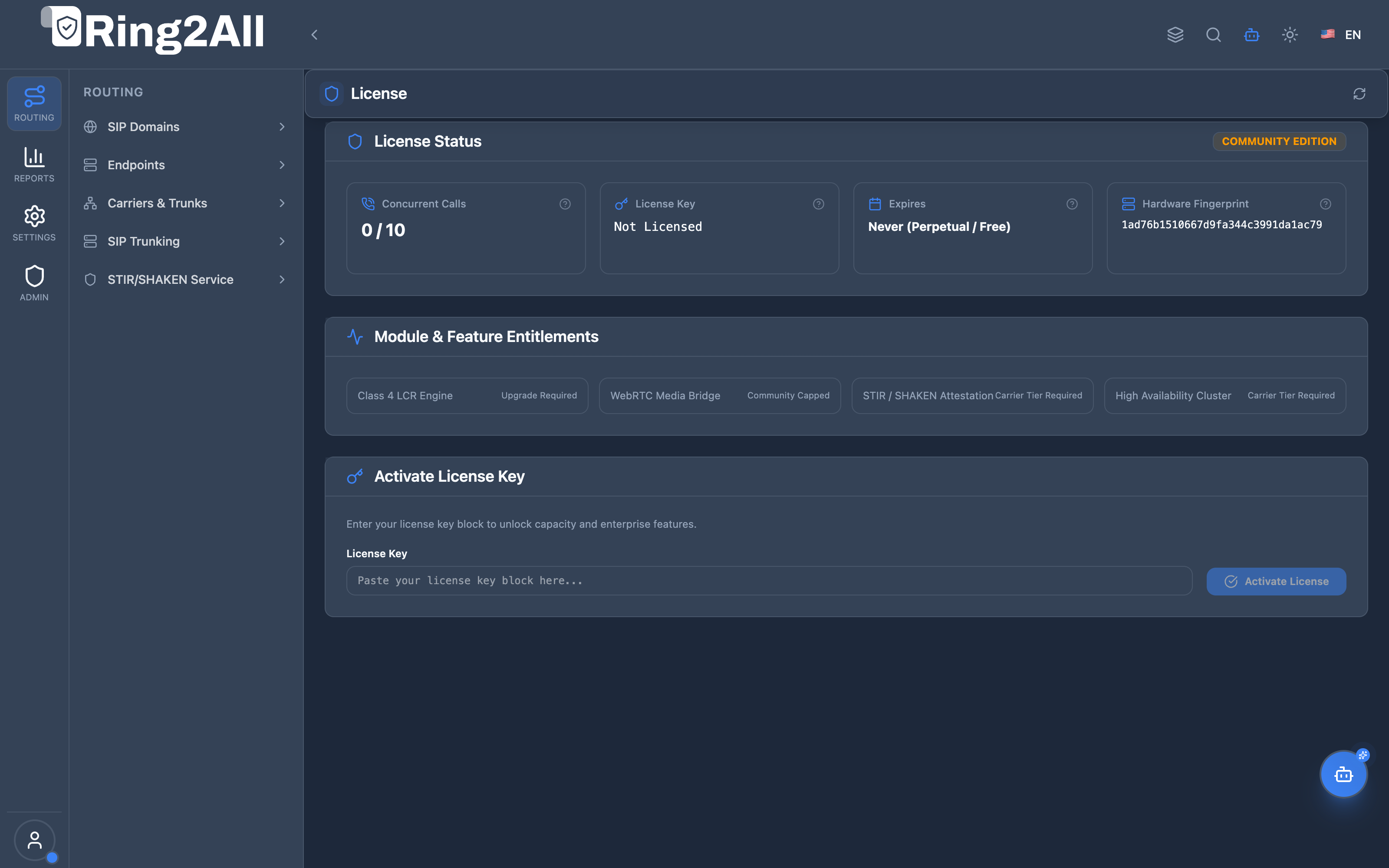
Section titled “4. Visual Interface & Status Overview”The License console is organized into three distinct cards: License Status, Module & Feature Entitlements, and Activate License Key.
5. Telemetry & Feature Entitlement Matrix
Section titled “5. Telemetry & Feature Entitlement Matrix”License Status Card
Section titled “License Status Card”| Metric / Attribute | Sample Value | Description |
|---|---|---|
| License Tier Badge | COMMUNITY EDITION |
Visual indicator denoting whether the platform is running Free Community, Professional, or Carrier Tier. |
| Concurrent Calls | 0 / 10 |
Real-time session meter displaying active SIP dialogs versus the maximum allowed concurrent call ceiling. |
| License Key | Not Licensed / Cryptographic ID |
Unique license token identifier registered on the host. |
| Expires | Never (Perpetual / Free) / Date |
Expiration threshold of the active license token. |
| Hardware Fingerprint | 1ad76b151066...da1ac79 |
SHA-256 machine hash derived from CPU, motherboard UUID, and primary network MAC address. |
Module & Feature Entitlements
Section titled “Module & Feature Entitlements”| Enterprise Subsystem | Community Tier Status | Carrier / Enterprise Tier Status | Technical Capability Unlocked |
|---|---|---|---|
| Class 4 LCR Engine | Upgrade Required |
Fully Enabled | High-performance dynamic least-cost routing with multi-carrier rate deck evaluation in microseconds. |
| WebRTC Media Bridge | Community Capped |
Unlimited Media Channels | RTPEngine transcoding bridge connecting browser SIP endpoints (DTLS-SRTP) to legacy carrier RTP. |
| STIR / SHAKEN Attestation | Carrier Tier Required |
Fully Enabled | Cryptographic call signing, PASSporT token generation, and Tier-A/B/C attestation verification. |
| High Availability Cluster | Carrier Tier Required |
Active-Active / Active-Standby | Multi-node state replication via VRRP and distributed DMQ clustering for zero-downtime failover. |
6. License Key Activation Workflow
Section titled “6. License Key Activation Workflow”- Obtain Hardware Fingerprint:
- Navigate to License from the account menu.
- Copy the 64-character Hardware Fingerprint string displayed in the status overview.
- Generate / Request License:
- Provide the hardware fingerprint to your Ring2All account representative or enterprise provisioning portal.
- Apply the License Block:
- Paste the armored cryptographic license key string into the Activate License Key input area.
- Click Activate License.
- The SBC daemon verifies the signature, reloads internal htables, and updates concurrent call thresholds instantly without dropping active phone calls.
7. Operational Best Practices
Section titled “7. Operational Best Practices”- Monitor Concurrent Call Peak Ratios: Establish automated alerts when active calls reach 80% of your licensed ceiling to ensure capacity expansions are ordered prior to trunk throttling.
- Record Fingerprint Prior to Hardware Migrations: If planning a hypervisor host migration or server replacement, verify if network MAC changes will alter the hardware fingerprint.
- Keep Backup of License Block: Safely archive your active license block in your organizational secret management vault for rapid disaster recovery rebuilding.
8. Troubleshooting & Verification
Section titled “8. Troubleshooting & Verification”| Issue / Symptom | Root Cause | Resolution |
|---|---|---|
| Error: “Hardware fingerprint mismatch” | The license was generated for a different server or network MAC changed | Verify that the hardware fingerprint on the target host matches the fingerprint submitted during key issuance. |
| Calls rejected with SIP 503 Service Unavailable | Concurrent call volume has reached the licensed limit (e.g. 10/10) | Upgrade the license tier or review active calls to terminate orphaned sessions. |
| License key fails cryptographic verification | Key block truncated or corrupted during copy-paste | Ensure the entire block (including header and footer delimiters) is copied without extra whitespaces. |
9. Glossary
Section titled “9. Glossary”- Concurrent Calls (CC): Active bidirectional SIP call dialogs traversing the SBC at any given moment.
- Hardware Fingerprint: Deterministic hardware signature computed from immutable host machine parameters.
- STIR/SHAKEN: Telecom security framework designed to prevent fraudulent caller ID spoofing via digital certificates.
- LCR (Least-Cost Routing): Algorithmic selection of wholesale voice paths based on real-time rate card comparison.